Bloodgood Japanese Maple
'Bloodgood' is the benchmark red-leaf Japanese maple, prized because its deep purple-red foliage holds its colour through summer heat far better than most red cultivars, which tend to fade to bronze or green.
Last reviewed: September 2026
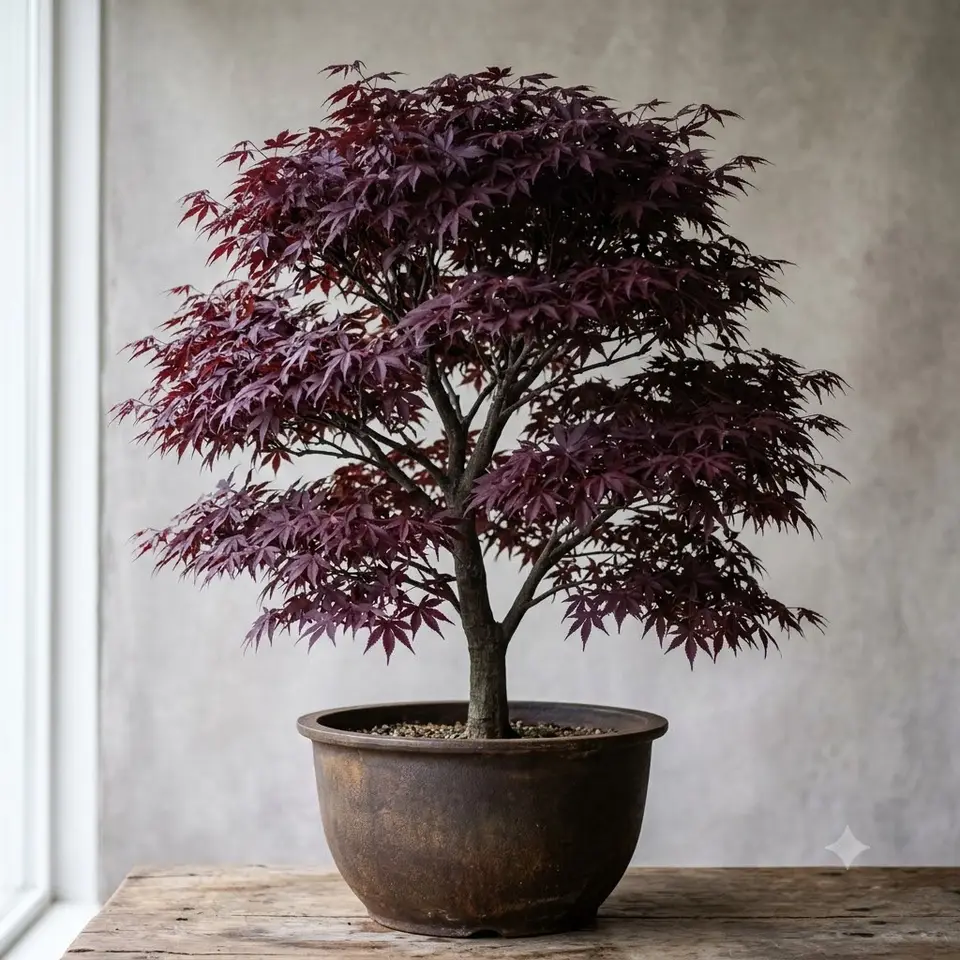 AI illustration
 Overview
'Bloodgood' is the benchmark red-leaf Japanese maple, prized because its deep purple-red foliage holds its colour through summer heat far better than most red cultivars, which tend to fade to bronze or green. It is an upright, vase-shaped small tree rather than a weeping mound, making it one of the few Japanese maples large enough to stand alone as a specimen (Acer palmatum 'Bloodgood'). Its combination of reliable colour, cold hardiness, and graceful branching has kept it the industry standard red maple for decades.
Origin & Background
The species Acer palmatum is native to Japan, Korea, eastern China, and parts of southeast Russia, where it grows as a woodland understory tree. The cultivar 'Bloodgood' was selected and popularised in the United States in the mid-20th century and takes its name from the Long Island, New York nursery trade that distributed it. Because it is a named clone, every 'Bloodgood' is propagated vegetatively so that each tree carries the identical foliage colour and form.
Appearance
The palmate, five to seven lobed leaves emerge and hold a rich blackish burgundy to purple-red through spring and summer, then turn a brilliant crimson to scarlet in autumn before dropping. In spring it produces small reddish-purple flowers, followed by decorative red samaras (winged seeds) that hang against the dark foliage. The habit is upright and rounded, typically maturing at around 4.5 to 6 m tall with a similar spread, and the layered branch structure gives good winter silhouette once the leaves fall.
Why People Grow It - Qualities & Benefits
- Reliable deep red foliage that resists the mid-summer fade common to lesser red cultivars
- Strong autumn display, shifting from burgundy to fiery crimson
- Upright tree form that works as a stand-alone specimen or focal point
- One of the hardier and more sun-tolerant Japanese maples, widening the range of sites where it can be grown
Care
Light: Full sun to part shade; in hot summer regions, dappled or afternoon shade prevents leaf scorch and keeps colour clean. Water: Consistent, moderate moisture; keep the root zone evenly moist and never waterlogged, with extra attention during the first few years and in drought. Soil: Fertile, humus-rich, well-drained soil that is slightly acidic; mulch to keep roots cool and steady. Hardiness: USDA zones 5 to 8. Bloom or Season: Grown for foliage from spring leaf-out through the autumn crimson show; bare, sculptural branches carry winter interest. Extra: Its signature quirk is colour stability - the leaves stay purple-red in summer instead of greening out, but that colour is deepest in good light. Non-toxic to cats and dogs.
Planting & Propagation
Plant in spring or autumn in a sheltered spot out of harsh afternoon sun and drying wind, setting the graft union at or just above soil level and mulching without piling material against the trunk. 'Bloodgood' does not come true from seed, so it is propagated by grafting a scion onto Acer palmatum seedling rootstock; hobbyists sometimes attempt air layering, but grafting is the standard commercial method. Avoid heavy pruning, and do any shaping in late autumn or winter when the tree is dormant to limit sap bleeding.
Common Problems & Pests
- Leaf scorch (browning leaf edges) from excess sun, wind, or dry soil in hot climates
- Aphids and scale, which can be followed by sooty mould on honeydew
- Fungal issues such as verticillium wilt and anthracnose, favoured by poor drainage or wet foliage
Toxicity & Safety
Non-toxic to cats and dogs. Japanese maple (Acer palmatum) is not listed among plants toxic to pets, so it is a safe choice for gardens shared with animals. Curious pets may still get a mild stomach upset from chewing large amounts of any foliage, so gentle discouragement is sensible.
Pros & Cons
Pros
- Dependable, non-fading red colour spring through autumn
- Cold-hardy and more sun-tolerant than many Japanese maples
Cons
- Slow growing, so a specimen-sized tree takes patience or a bigger budget
- Prone to leaf scorch in hot, exposed, or under-watered sites
Best Suited For
- Gardeners wanting a single striking red specimen tree for a lawn, courtyard, or entryway
- Cooler and temperate climates in zones 5 to 8 with some shelter from afternoon sun
FAQ
How big does a Bloodgood Japanese Maple get?
Expect roughly 4.5 to 6 m tall and wide at maturity, reached slowly over many years, which makes it one of the larger and more tree-like Japanese maples.
Why are the leaf edges turning brown in summer?
That is usually leaf scorch from too much sun, drying wind, or dry roots. Deep, consistent watering, a cooling layer of mulch, and a spot with afternoon shade in hot climates all help prevent it.
Gear for growing bloodgood japanese maple
Links go to Amazon or a partner store (such as Adagio Teas) and may earn us a commission at no extra cost to you. As an Amazon Associate we earn from qualifying purchases. We link gear types, not sponsors' picks: you choose the exact product.