Bobo Hydrangea
Bobo is a compact panicle hydrangea prized for its outsized flower display on a genuinely dwarf frame, packing full-size cone-shaped blooms onto a plant that rarely tops waist height (Hydrangea paniculata 'Bobo').
Last reviewed: September 2026
 AI illustration
 Overview
Bobo is a compact panicle hydrangea prized for its outsized flower display on a genuinely dwarf frame, packing full-size cone-shaped blooms onto a plant that rarely tops waist height (Hydrangea paniculata 'Bobo'). Unlike the mophead types, it blooms reliably on new wood every year, so a hard winter or a mistimed prune will not cost you the flowers.
Origin & Background
The panicle hydrangea, Hydrangea paniculata, is native to eastern Asia, growing wild across China, Korea, Japan and far-eastern Russia, where it forms a large shrub or small tree in open woodland and along forest edges. 'Bobo' is a dwarf selection bred by Johan Van Huylenbroeck at an agricultural research institute in Belgium and introduced to gardens around 2011, developed specifically for its small stature and heavy flowering.
Appearance
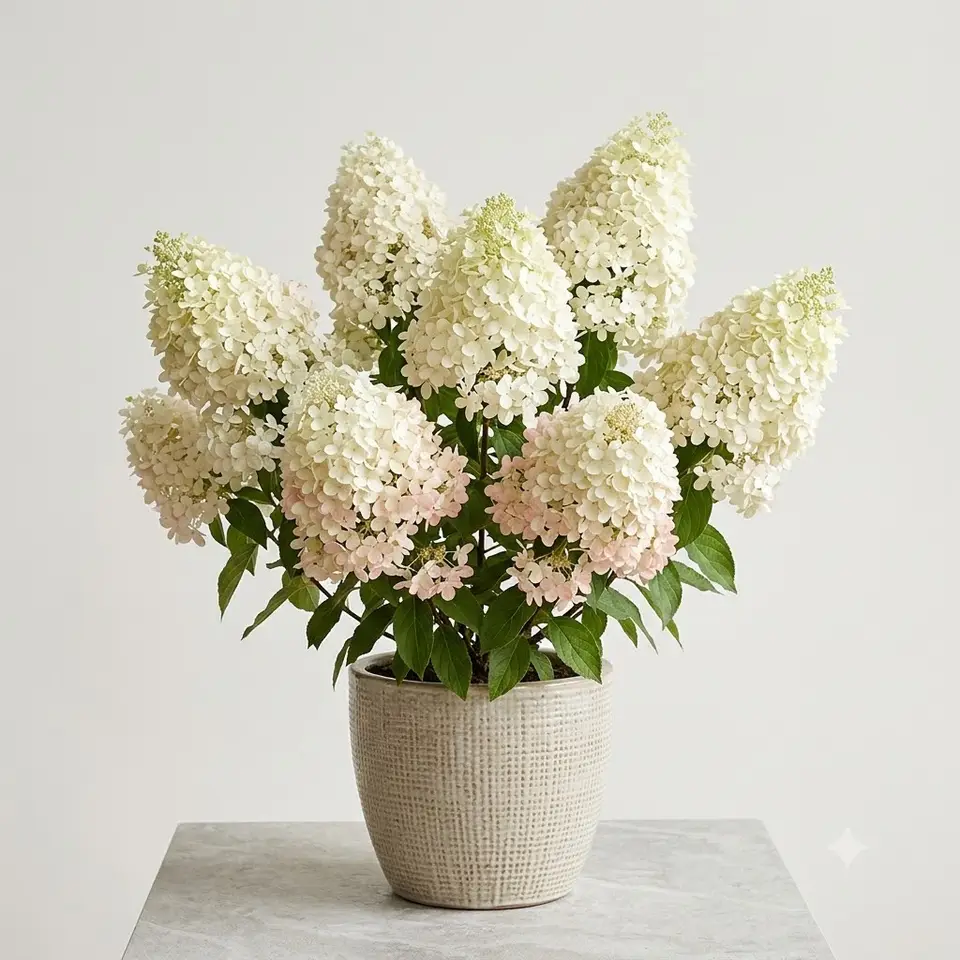
The flowers open creamy white to soft lime-green in mid to late summer, held in dense upright panicles that crowd the plant so thickly the foliage almost disappears. As the season cools the blooms blush pink from the base upward, deepening to rosy tones by autumn before drying to tan. Mature height is roughly 75 to 90 cm with a spread of 90 cm to 1.2 m, giving a rounded, well-branched habit clothed in dark green oval leaves. The stems are notably sturdy for the size of the blooms, so the flower heads tend to stay upright rather than flopping.
Why People Grow It - Qualities & Benefits
- Fits small gardens, borders and large containers where standard panicle hydrangeas would be too big
- Blooms dependably on the current season's growth, so flowering is unaffected by cold winters
- Long display that shifts from white through pink over months, plus dried heads for winter interest
- Very cold hardy and low fuss, forgiving of pruning timing and beginner mistakes
Care
Light: Full sun to part shade; at least six hours of sun gives the best flowering and the strongest pink autumn colour, though a little afternoon shade helps in hot climates. Water: Moderate and steady; keep the root zone evenly moist, especially in the first two seasons and during summer heat, as panicle hydrangeas dislike drying out fully. Soil: Adaptable to most well-drained soils and tolerant of a range of pH. Note that soil pH does not shift the flower colour here; that blue-to-pink chemistry applies only to bigleaf hydrangeas (Hydrangea macrophylla), not to panicle types like 'Bobo'. Hardiness: USDA zones 3 to 8. Bloom or Season: Mid to late summer into autumn, with the display often lasting two to three months as the flowers age and change colour. Extra: Prune in late winter or early spring since it flowers on new wood; a hard cut back keeps the plant tidy and encourages large blooms. Toxic to cats, dogs and horses; the leaves and flowers contain a cyanogenic glycoside, and ingestion can cause vomiting, diarrhoea and lethargy.
Planting & Propagation
Plant in spring or early autumn, setting the shrub at the same depth it sat in its pot, spacing multiples about 90 cm to 1.2 m apart, and watering in well while it establishes. Named cultivars like 'Bobo' are propagated vegetatively so the plant comes true, not from seed. Take softwood cuttings in early summer or hardwood cuttings in late autumn, or use simple layering by pinning a low, flexible stem to the ground until it roots and then severing it from the parent.
Common Problems & Pests
- Wilting or scorched leaf edges from drought stress or intense afternoon sun in hot regions
- Powdery mildew or leaf spot in humid, crowded conditions with poor air flow
- Occasional aphids on soft new growth, usually minor and easily rinsed off
Toxicity & Safety
All hydrangeas, including 'Bobo', contain a cyanogenic glycoside in the leaves and flowers, and this makes the plant toxic to cats, dogs and horses if eaten. Typical signs are vomiting, diarrhoea and lethargy. Serious poisoning is uncommon because a large amount of plant material would need to be consumed, but it is sensible to site the shrub away from pets that graze and to discourage chewing.
Pros & Cons
Pros
- Big, colour-changing blooms on a compact plant that suits small spaces and pots
- Extremely cold hardy and reliable, flowering every year on new wood
Cons
- Toxic to pets, so a poor choice where cats, dogs or horses browse freely
- Needs steady moisture and can scorch if left dry or in relentless afternoon heat
Best Suited For
- Small gardens, mixed borders and container planting where space is tight
- Beginner gardeners and cold-climate growers wanting dependable summer-to-autumn colour
FAQ
Do I need to prune Bobo Hydrangea?
Pruning is not essential, but a cut back in late winter or early spring keeps the shrub compact and promotes larger flowers, since it blooms on the current season's growth.
Can I change the flowers to blue?
No. Panicle hydrangeas like 'Bobo' do not respond to soil pH; only bigleaf hydrangeas shift between blue and pink. Bobo's colour moves from white to pink naturally as the blooms age.
Gear for growing bobo hydrangea
Links go to Amazon or a partner store (such as Adagio Teas) and may earn us a commission at no extra cost to you. As an Amazon Associate we earn from qualifying purchases. We link gear types, not sponsors' picks: you choose the exact product.