Butterfly Japanese Maple
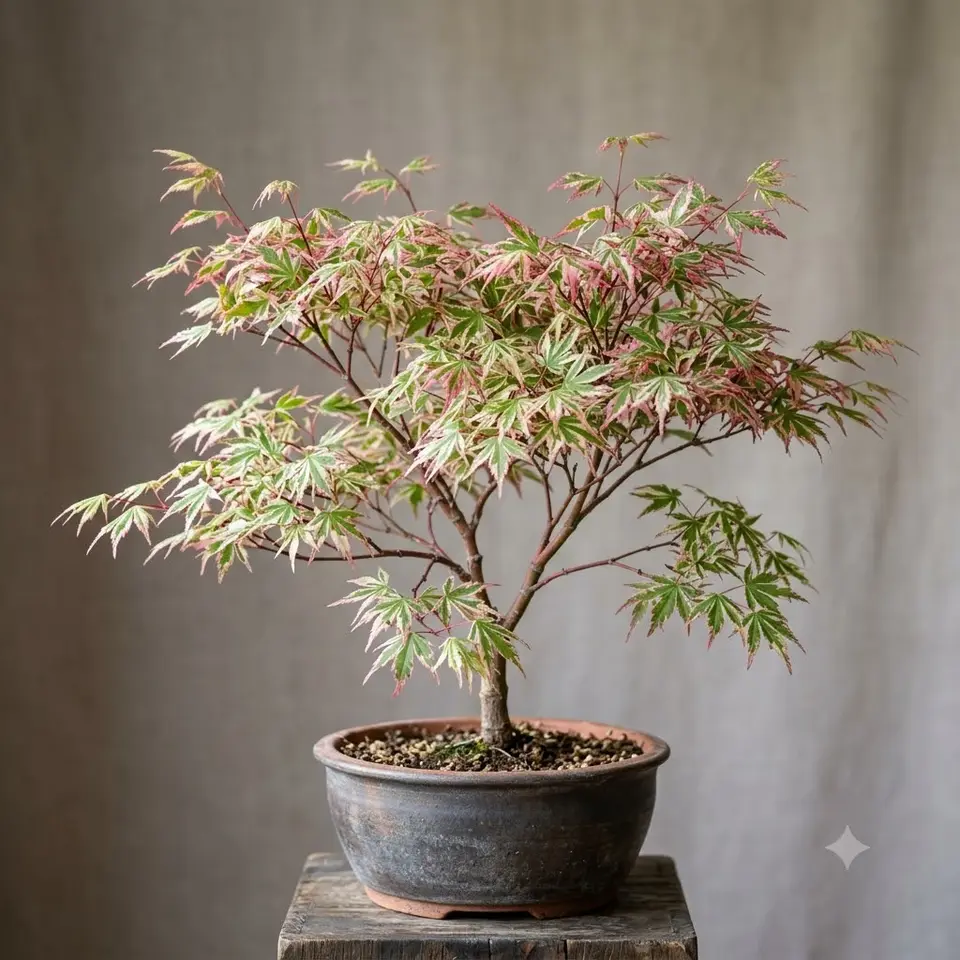
'Butterfly' is a compact, variegated Japanese maple prized for its small, deeply cut grey-green leaves edged in creamy white, with rosy-pink tones on fresh spring growth (Acer palmatum 'Butterfly').
Last reviewed: September 2026
 AI illustration
 Overview
'Butterfly' is a compact, variegated Japanese maple prized for its small, deeply cut grey-green leaves edged in creamy white, with rosy-pink tones on fresh spring growth (Acer palmatum 'Butterfly'). Its upright, shrubby habit and refined foliage make it one of the most popular variegated cultivars for small gardens and containers. Unlike many maples grown for a single flush of autumn colour, it earns its place through three seasons of delicate, painterly foliage.
Origin & Background
The parent species, Acer palmatum, is native to Japan, Korea, and parts of China, where it grows as an understory tree in cool, humid woodlands. 'Butterfly' is a Japanese selection that has been in cultivation for many decades and reached Western gardens through the nursery trade, where it remains a long-standing favourite among variegated forms. Like nearly all named Japanese maple cultivars, it is propagated by grafting to keep its distinctive variegation true.
Appearance
The leaves are small, palmate, and deeply five-lobed, coloured blue-green to grey-green with irregular cream to white margins. New spring growth is flushed with pink and rose tints along the variegated edges, and in autumn those margins deepen to magenta and crimson while the centres take on warm tones. The habit is distinctly upright and vase-shaped, denser and more columnar than many spreading maples. It is slow-growing, typically reaching about 2 to 3.5 m tall and 1.2 to 1.8 m wide over many years, staying well-suited to tight spaces. The spring flowers are small and reddish-purple, inconspicuous, and followed by winged samaras.
Why People Grow It - Qualities & Benefits
- Three-season foliage interest, from pink-tinged spring growth to magenta autumn margins
- Compact, upright form that fits small gardens, courtyards, and large containers
- Bright variegation that lifts shaded and woodland-style plantings
- Slow, restrained growth that needs little pruning to stay in scale
Care
Light: Part shade is ideal; morning sun with afternoon shade protects the pale variegation. The white areas scorch in hot, direct afternoon sun, though cooler climates tolerate more light. Water: Keep the soil consistently moist but never waterlogged, especially in the first few years and during dry spells. Mulch helps retain moisture and keep roots cool. Soil: Rich, moist, well-drained soil high in organic matter, slightly acidic (pH about 5.5 to 6.5). It dislikes soggy or strongly alkaline ground. Hardiness: USDA zones 5 to 8. Bloom or Season: Grown for foliage from spring leaf-out through a magenta and crimson autumn display; the tree is deciduous and bare in winter, showing its upright branch structure. Extra: The variegated leaves are more prone to sun scorch than green maples, so siting matters more than with most cultivars. Butterfly Japanese Maple is non-toxic to cats and dogs.
Planting & Propagation
Plant in spring or autumn in a sheltered spot out of harsh afternoon sun and drying wind, setting the graft union above soil level and watering in well. This cultivar is almost always grafted onto Acer palmatum seedling rootstock because it does not come true from seed and roots poorly from cuttings. Home gardeners can attempt air layering, but grafting remains the reliable commercial method.
Common Problems & Pests
- Leaf scorch on the pale margins in too much sun, wind, or dry soil
- Aphids and scale insects, and occasional mites on stressed plants
- Verticillium wilt and root rot in heavy, poorly drained soils; watch too for all-green reverted shoots, which should be pruned out
Toxicity & Safety
Butterfly Japanese Maple is non-toxic to cats and dogs. Japanese maple (Acer palmatum) is not listed as toxic to pets, so it is a safe choice for gardens shared with animals.
Pros & Cons
Pros
- Elegant variegated foliage with strong spring and autumn colour
- Compact, slow-growing, and well-behaved in small spaces
Cons
- Variegation scorches easily in hot, exposed sites
- Slow growth and grafted stock mean higher cost and patience
Best Suited For
- Small gardens, courtyards, and large patio containers
- Shaded and woodland-style beds where bright foliage adds contrast
FAQ
How big does Butterfly Japanese Maple get?
It is slow-growing and usually reaches about 2 to 3.5 m tall and 1.2 to 1.8 m wide over many years, with a narrow, upright, vase-shaped habit.
Why are the leaf edges turning brown?
Brown, crisped margins are usually leaf scorch from too much afternoon sun, drying wind, or dry soil. Move or shade the plant, keep the soil evenly moist, and mulch to cool the roots.
Gear for growing butterfly japanese maple
Links go to Amazon or a partner store (such as Adagio Teas) and may earn us a commission at no extra cost to you. As an Amazon Associate we earn from qualifying purchases. We link gear types, not sponsors' picks: you choose the exact product.