Camassia
Camassia is a North American meadow bulb with meter-tall wands of starry blue flowers opening upward in late spring, filling the gap after tulips quit, and thriving in the damp clay that kills Dutch bulbs.
Last reviewed: October 2026
 AI illustration
 Overview
Camassia is a North American meadow bulb with meter-tall wands of starry blue flowers opening upward in late spring, filling the gap after tulips quit, and thriving in the damp clay that kills Dutch bulbs. Native, vole-proof, and the backbone of modern meadow plantings. (Camassia leichtlinii / quamash.)
Origin & Natural Habitat
Damp meadows of the American Northwest - camas prairies were (and are) indigenous food landscapes of profound importance.
Appearance
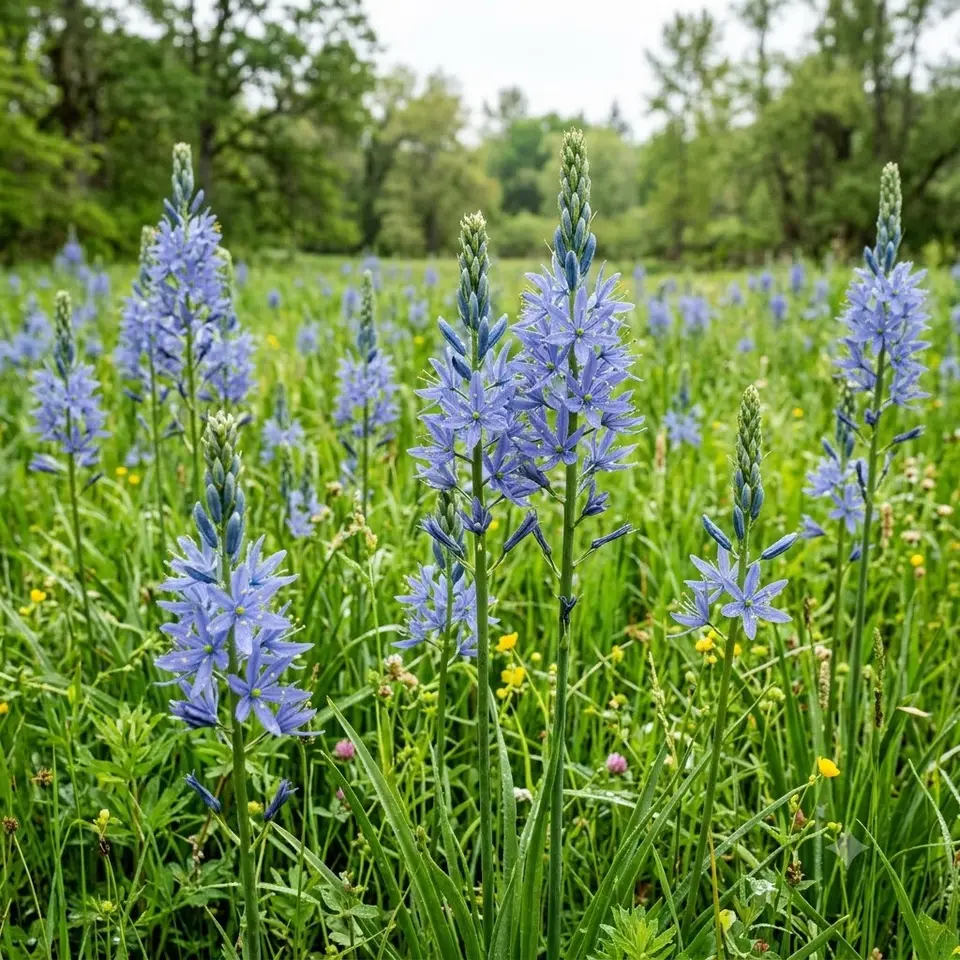
60-100 cm spires of 30-80 starry blooms (steel-blue, violet, cream) opening bottom-up over two-three weeks in May-June; grassy basal leaves.
Why People Grow It - Qualities & Benefits
- Fills the May gap between bulbs and summer
- LOVES damp heavy soil: the clay-gardener's bulb
- North American native for native schemes
- Naturalizes in grass beautifully
Care
Light: Sun to light shade.
Water: Moist springs essential, damp-tolerant always - plant where tulips drowned.
Soil: Heavy, moisture-retentive welcomed; the anti-drainage bulb.
Planting: Fall, 10-12 cm deep; groups of 10+ for spire choruses.
Hardiness: Zones 4-8.
After flowering: Meadow-mow after foliage fades (July); left alone it clumps and seeds into permanence.
Propagation
Division of clumps in fall; patient self-seeding.
Common Problems & Pests
- Almost none: occasional slug on emergence; its rarity in gardens is pure unfamiliarity, not difficulty
Toxicity & Safety
The historic species were staple FOOD (properly slow-cooked camas) - but lookalike 'death camas' (Toxicoscordion) is deadly; garden rule stays simple: admire, don't forage from borders. Camassia has no entry on the ASPCA plant lists, so we make no pet claim either way: keep dogs from digging up and chewing the bulbs.
Pros & Cons
Pros
- Late-spring blue spires
- Clay + damp = finally, a bulb
- Native, permanent, vole-proof
Cons
- Short individual spire life
- Big leaves linger after
- Blue shades vary by strain: buy named
Best Suited For
- Damp meadows and swales
- Clay-soil borders
- Native and matrix plantings
- The tulip-to-allium gap
FAQ
What blooms between tulips and summer perennials?
This is the textbook answer - camassia's May spires bridge exactly that lull, in soils that suit real gardens rather than Dutch sand.
Is it really native food?
Quamash bulbs sustained Northwest nations for millennia (slow-pit-cooked to sweetness) and remain culturally vital - grow it as a garden plant and let that history deepen the border.
Gear for growing camassia
Links go to Amazon or a partner store (such as Adagio Teas) and may earn us a commission at no extra cost to you. As an Amazon Associate we earn from qualifying purchases. We link gear types, not sponsors' picks: you choose the exact product.