Bowl of Beauty Peony
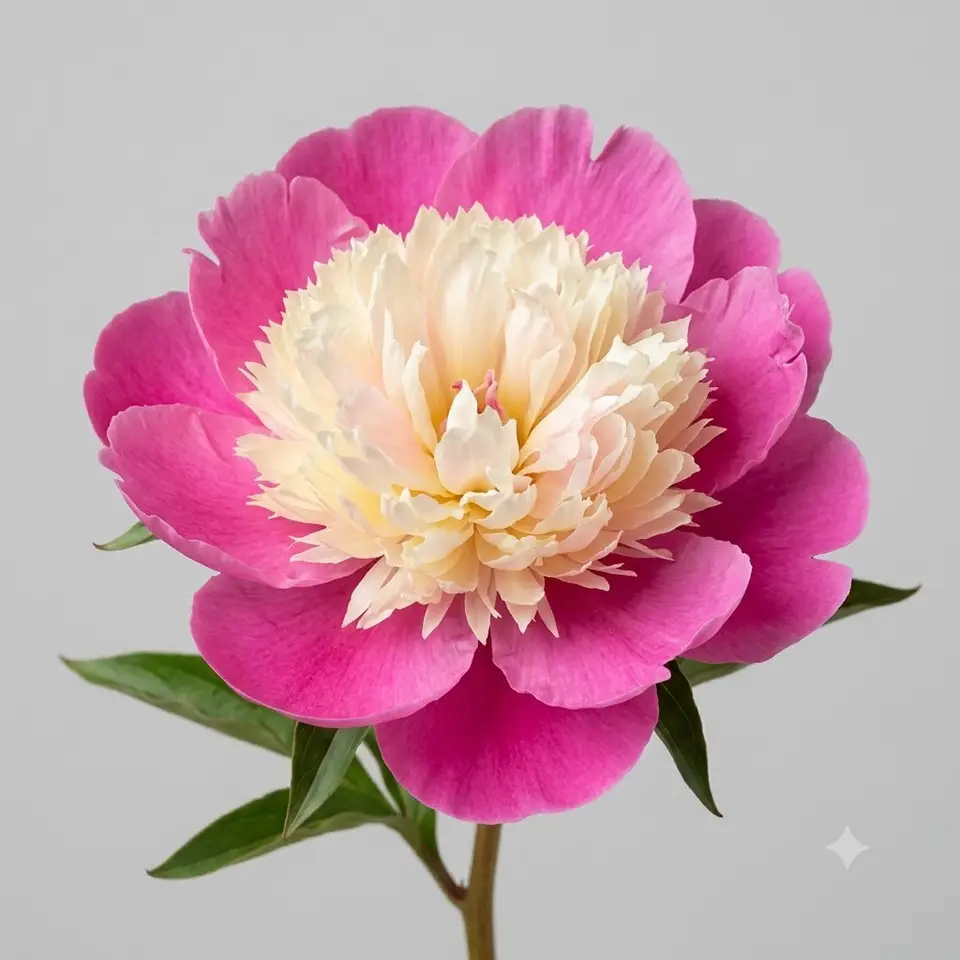
'Bowl of Beauty' is one of the most recognisable herbaceous peonies, prized for its striking Japanese-form flowers: a broad ring of rose-pink outer petals cradling a dense central mound of narrow, creamy ivory staminodes (Paeonia lactiflora 'Bowl of Beauty').
Last reviewed: July 2026
 AI illustration
 Overview
'Bowl of Beauty' is one of the most recognisable herbaceous peonies, prized for its striking Japanese-form flowers: a broad ring of rose-pink outer petals cradling a dense central mound of narrow, creamy ivory staminodes (Paeonia lactiflora 'Bowl of Beauty'). The two-tone contrast reads clearly from across the garden, which is what sets this cultivar apart from the fuller, all-pink doubles. It is a long-lived, cold-hardy perennial that rewards patience with decades of early-summer bloom.
Origin & Background
The genus Paeonia is native across temperate Eurasia and parts of western North America, with the Chinese peony (Paeonia lactiflora) originating in eastern Asia, including China, Mongolia and Siberia, where it has been cultivated for well over a thousand years. 'Bowl of Beauty' is a garden hybrid of P. lactiflora raised in the Netherlands by the Hoogendoorn nursery and introduced around 1949. It has since become a classic of the Japanese-form group and holds the Royal Horticultural Society's Award of Garden Merit.
Appearance
The flowers are large, often 15 to 20 cm across, in an anemone or Japanese form: a single collar of satiny carmine-pink guard petals surrounding a raised puff of thread-like petaloids that open cream to pale yellow and soften as the bloom matures. Flowering comes in late spring to early summer, usually late May into June, with a lightly fragrant, generous show. Plants form an upright clump roughly 80 to 90 cm tall and 70 to 90 cm wide, clothed in glossy, deeply divided dark green foliage that stays handsome after flowering and often takes on bronze and russet tints in autumn before dying back for winter.
Why People Grow It - Qualities & Benefits
- Bold two-tone flowers with unusually clear pink-and-cream contrast
- Extremely long-lived and low-maintenance once established, often thriving for decades
- Excellent cut flower with a light, pleasant fragrance
- Fully cold-hardy and reliably perennial, returning stronger each year
Care
Light: Full sun is best; tolerates light afternoon shade, though bloom is reduced in deeper shade. Water: Moderate and even during growth and budding; established clumps are fairly drought-tolerant but dislike waterlogging. Soil: Deep, fertile, well-drained loam, ideally neutral to slightly alkaline (pH about 6.5 to 7.5); enrich with compost but avoid heavy fresh manure on the crown. Hardiness: USDA zones 3 to 8. Bloom or Season: Late spring to early summer (roughly late May to June), with a flush lasting about 7 to 10 days per plant. Extra: Plant the crown shallow - buds no more than 3 to 5 cm below the surface - or the plant will grow but refuse to flower; the tall Japanese-form blooms may need discreet support in wind or rain. All parts are toxic to cats and dogs if eaten.
Planting & Propagation
Plant bare-root divisions or potted plants in autumn or early spring in a permanent, sunny spot, setting the eyes just below soil level and spacing about 90 cm apart. Propagate by dividing the fleshy, tuberous roots in early autumn once the foliage fades: lift the clump, wash off soil, and cut sections that each carry 3 to 5 healthy eyes (buds) with a portion of root. Replant divisions promptly at the correct shallow depth. Peonies resent disturbance and may sulk for a season or two after division. Growing from seed is possible but very slow, needing a double cold period to germinate and several years to first bloom, so division is far more reliable for keeping the cultivar true.
Common Problems & Pests
- Botrytis (grey mould) causing blackened buds and wilting stems in wet springs; improve airflow and remove affected growth
- Failure to flower, usually from crowns planted too deep, too much shade, or recent division
- Occasional powdery mildew and, rarely, root rot in poorly drained soil
Toxicity & Safety
Peonies, including 'Bowl of Beauty', are toxic to cats and dogs. The plant contains paeonol, a compound most concentrated in the bark and roots. If a pet chews or swallows plant material, the typical signs are vomiting and diarrhoea. Reactions are usually mild to moderate rather than life-threatening, but it is sensible to site the plant away from pets that like to dig or nibble and to contact a vet if a large amount is eaten. The ants often seen on peony buds are harmless and are not a sign of a pest problem.
Pros & Cons
Pros
- Distinctive, eye-catching flowers unlike standard double peonies
- Tough, hardy and long-lived with very little ongoing care
Cons
- Short main flowering window of only a week or two
- Slow to establish and slow to recover after moving or dividing
Best Suited For
- Cottage gardens, mixed herbaceous borders and cutting gardens
- Gardeners in cold-winter climates wanting a permanent, fuss-free perennial
FAQ
Why won't my Bowl of Beauty peony bloom?
The most common reason is planting the crown too deep. The eyes should sit only 3 to 5 cm below the surface. Too much shade, or division within the last year or two, can also delay flowering.
Do I need to remove the ants on the flower buds?
No. Ants are simply attracted to the sweet nectar on the buds and do no harm. They do not help the buds open either, contrary to old garden lore, so you can leave them be or gently rinse them off cut stems.
Gear for growing bowl of beauty peony
Links go to Amazon or a partner store (such as Adagio Teas) and may earn us a commission at no extra cost to you. As an Amazon Associate we earn from qualifying purchases. We link gear types, not sponsors' picks: you choose the exact product.