Alocasia Stingray
Alocasia Stingray is a striking cultivar of the giant upright elephant ear, prized for leaves that look uncannily like a stingray gliding through water - a broad body plus a long, whip-like tail tip.
Last reviewed: September 2026
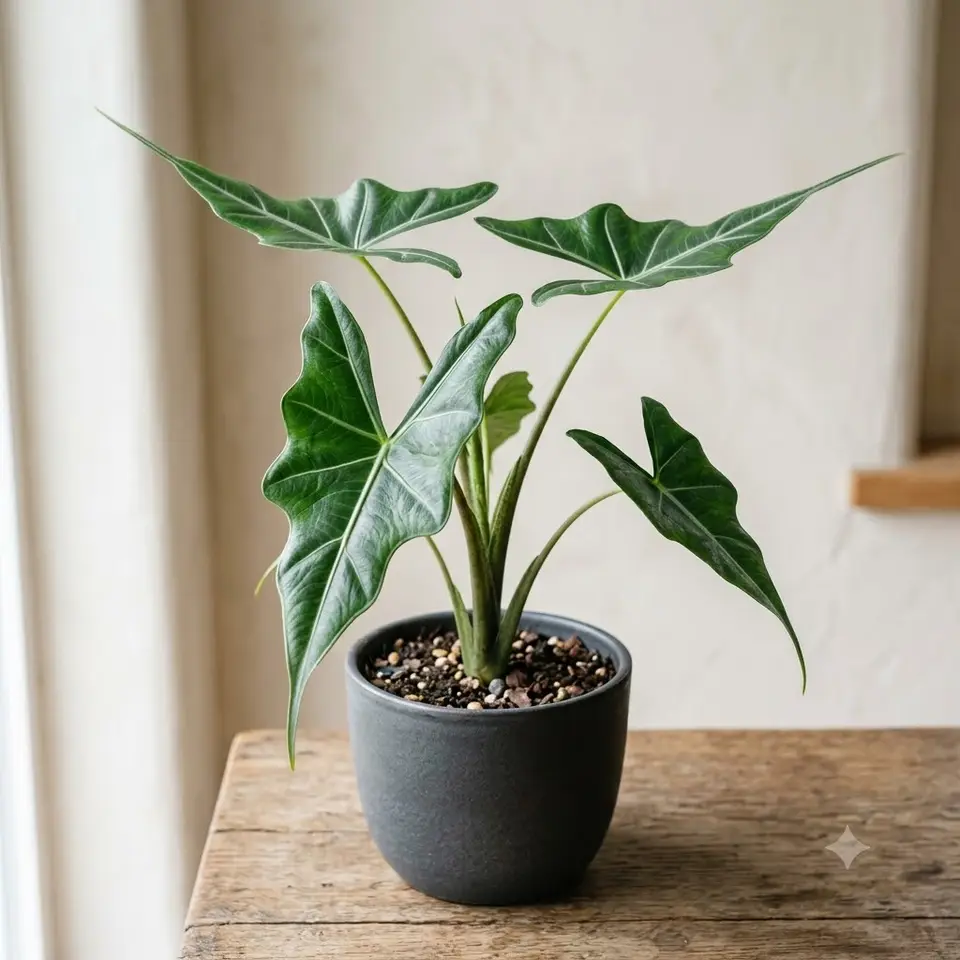 AI illustration
 Overview
Alocasia Stingray is a striking cultivar of the giant upright elephant ear, prized for leaves that look uncannily like a stingray gliding through water - a broad body plus a long, whip-like tail tip. Collectors love its sculptural, almost animal-like silhouette and glossy green blades held on tall, patterned stems. It is a cultivated selection of the species (Alocasia macrorrhiza).
Origin & Natural Habitat
The parent species, Alocasia macrorrhiza, is native to the warm, humid tropical rainforests of Southeast Asia and the Pacific Islands, where it grows in moist, filtered-light understory and forest-edge conditions. The Stingray form is a horticultural cultivar rather than a wild-collected plant.
Appearance
Each leaf has a wide, arrow-to-shield-shaped blade that tapers into a slender, curling tail, giving the whole leaf the outline of a stingray. Blades are glossy mid-to-deep green with prominent raised veins, carried on upright green stems often marked with darker mottling near the base. Indoors it commonly reaches 60 to 90 cm tall, though in ideal warm conditions and larger pots it can climb well beyond that over time.
Why People Grow It - Qualities & Benefits
- Unmistakable "stingray" leaf shape that reads as living sculpture
- Upright, space-efficient growth habit that suits shelves and corners
- Fast, rewarding new-leaf production when it is happy
- A conversation-piece aroid that stays more compact than some giant Alocasia
Care
Light: Bright, indirect light. It tolerates a little gentle morning sun but harsh midday sun scorches the blades; too little light gives weak, stretched growth.
Water: Keep the mix lightly and evenly moist during active growth, letting the top 2-3 cm dry between waterings. It hates both soggy roots and full dry-out - inconsistent watering triggers leaf drop.
Soil: A chunky, fast-draining aroid mix - for example potting soil blended with orchid bark, perlite, and a little coco coir - so water moves through quickly and roots get air.
Temperature & Humidity: Warmth-loving: 18 to 29°C is ideal, and it dislikes anything below about 13°C. It genuinely wants higher humidity (ideally 60% or more); in dry indoor air the leaf edges crisp and pests move in.
Feeding: Feed with a balanced, diluted liquid fertilizer every 2 to 4 weeks during spring and summer. Stop feeding in fall and winter when growth slows.
Extra: Be ready for dormancy - in cooler, darker months an Alocasia may drop leaves and rest; keep the tuber barely moist and warm rather than tossing it, and growth usually returns in spring. Toxic to cats and dogs (insoluble calcium oxalate crystals in the sap) - keep out of reach of pets and children.
Propagation
Propagate by division of the underground rhizome or by separating offset pups or cormlets from the base during repotting in spring or summer. Pot each division into a small container of moist, airy mix and keep it warm and humid until new roots and leaves establish. It does not root from a single leaf cutting.
Common Problems & Pests
- Spider mites are the number-one pest, especially in dry air - watch for fine webbing and stippled, fading leaves
- Root rot from overwatering or heavy, water-logged soil; yellowing lower leaves are an early warning
- Crispy brown leaf edges and tips from low humidity, underwatering, or fertilizer buildup
Toxicity & Safety
Like all Alocasia, the Stingray is toxic to cats and dogs. The plant contains insoluble calcium oxalate crystals throughout its tissues; when chewed, these needle-like crystals irritate the mouth and throat, causing intense oral pain, drooling, pawing at the mouth, and vomiting. The sap can also irritate skin, so wear gloves when dividing or pruning and wash your hands afterward. Keep it well out of reach of curious pets and small children.
Pros & Cons
Pros
- Show-stopping, one-of-a-kind leaf shape
- Grows upright and stays reasonably compact for the drama it delivers
Cons
- Fussy about humidity and warmth, and prone to spider mites
- Seasonal dormancy and leaf drop can alarm newer growers
Best Suited For
- Aroid collectors who can offer warmth, humidity, and consistent care
- Growers with a bright spot (or grow light) and patience for a plant with moods
FAQ
Why is my Alocasia Stingray dropping all its leaves?
Sudden leaf loss is often seasonal dormancy triggered by cooler temperatures and shorter days, but it can also come from overwatering, cold drafts, or root rot. If the tuber is firm, keep it warm and barely moist and wait for spring regrowth.
How do I keep spider mites off it?
Raise the humidity, keep air gently moving, and inspect the undersides of leaves weekly. At the first sign of webbing or stippling, rinse the foliage and treat with insecticidal soap or a horticultural oil, repeating every few days until they are gone.
Sources
Pet toxicity: checked against the ASPCA Animal Poison Control Center lists of toxic and non-toxic plants for cats and dogs, genus-wide entry "Alocasia" (Alocasia spp.): toxic to cats and dogs. Lists read on 10 October 2026.
Gear for growing alocasia stingray
Links go to Amazon or a partner store (such as Adagio Teas) and may earn us a commission at no extra cost to you. As an Amazon Associate we earn from qualifying purchases. We link gear types, not sponsors' picks: you choose the exact product.