Tamukeyama Japanese Maple
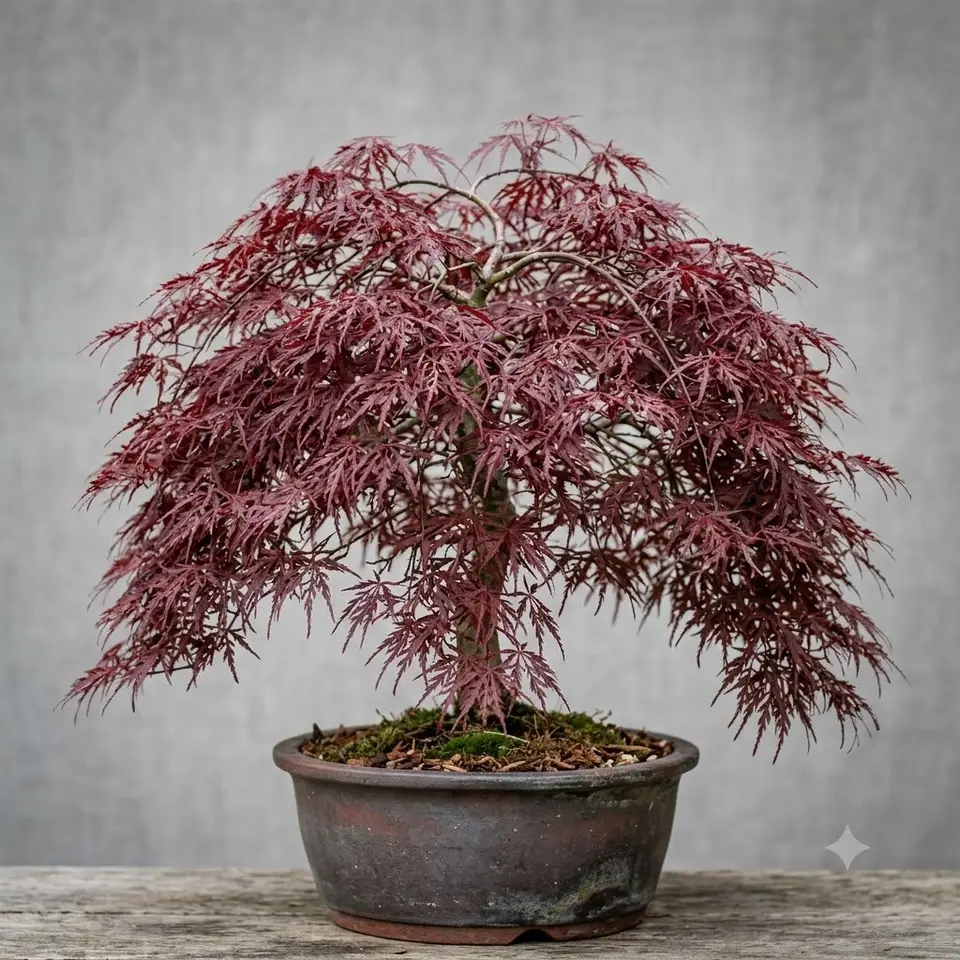
Tamukeyama is a weeping, cutleaf (dissectum) Japanese maple prized for deep crimson-red foliage that holds its color through summer better than most other laceleaf types (Acer palmatum var. dissectum 'Tamukeyama').
Last reviewed: September 2026
 AI illustration
 Overview
Tamukeyama is a weeping, cutleaf (dissectum) Japanese maple prized for deep crimson-red foliage that holds its color through summer better than most other laceleaf types (Acer palmatum var. dissectum 'Tamukeyama'). It forms a low, cascading mound of finely dissected leaves, making it a living sculpture rather than a shade tree. It is also one of the oldest documented Japanese maple selections, valued for both vigor and heat tolerance.
Origin & Background
The parent species, Acer palmatum, is native to Japan, Korea, and parts of eastern China, where it grows as an understory tree in cool, humid woodlands. Tamukeyama is a classic dissectum cultivar that has been cultivated in Japan for centuries, with references dating back to the early 1700s, and it remains a benchmark for red laceleaf maples because of its stronger vigor and better sun and heat resistance than many older red weeping forms.
Appearance
The leaves are deeply dissected, almost fern-like, emerging bright crimson to purple-red in spring and holding a rich burgundy-red through summer heat, when many red laceleafs fade toward green or bronze. In autumn the foliage shifts to a brilliant scarlet before dropping. The habit is a strongly weeping, cascading mound: expect roughly 1.8 to 2.5 m tall and 2.5 to 3.5 m wide at maturity, wider than it is tall, with pendulous branches that drape and layer over time. The small spring flowers are reddish and inconspicuous, followed by winged samaras; the plant is grown for foliage, not bloom.
Why People Grow It - Qualities & Benefits
- Holds deep red color through summer heat better than most red laceleaf maples
- Elegant weeping, cascading form that works as a stand-alone focal point
- Strong three-season interest: crimson spring flush, burgundy summer, scarlet fall
- Naturally compact and slow-growing, ideal for small gardens, containers, and near water features
Care
Light: Full sun to part shade; in hot climates give afternoon shade to prevent leaf scorch, while cooler regions allow more direct sun and richer color. Water: Consistent, even moisture; water deeply during dry spells and never let the root zone fully dry out, but avoid waterlogging. Soil: Rich, well-drained soil high in organic matter; slightly acidic pH (about 5.5 to 6.5) is ideal. Hardiness: USDA zones 5 to 9. Bloom or Season: Grown for foliage; crimson spring emergence, burgundy summer, and scarlet autumn color are the main seasonal draws. Extra: Its signature quirk is better summer heat and sun tolerance than older red laceleafs, though a sheltered spot away from harsh wind still gives the cleanest foliage. Non-toxic to cats and dogs; Japanese maple is not listed as toxic to pets.
Planting & Propagation
Plant in spring or fall in a sheltered spot with good drainage, setting the graft union at or slightly above soil level and mulching to keep roots cool and evenly moist. Tamukeyama is a named cultivar, so it is almost always propagated by grafting onto seedling Acer palmatum rootstock to keep the foliage color and weeping habit true; seed will not come true. Home gardeners occasionally try layering, but grafting done by nurseries is the reliable method.
Common Problems & Pests
- Leaf scorch and crisped margins from too much hot sun, drying wind, or inconsistent watering
- Aphids, scale, and mites, which can be worse on stressed plants
- Verticillium wilt and various fungal leaf spots and cankers, favored by poor drainage or overhead moisture
Toxicity & Safety
Non-toxic to cats and dogs. Japanese maple (Acer palmatum), including the Tamukeyama cultivar, is not listed as toxic to pets, so it is a safe choice for gardens shared with animals. As a general precaution, discourage pets from chewing woody stems.
Pros & Cons
Pros
- Superior summer color retention and heat tolerance for a red laceleaf
- Sculptural weeping form that anchors a bed, container, or entryway
Cons
- Slow-growing and comparatively expensive because it is grafted
- Foliage can scorch in exposed, hot, or windy sites without some shade
Best Suited For
- Small gardens, courtyards, and container plantings needing a year-round focal point
- Gardeners in zones 5 to 9 who want reliable red laceleaf color with some heat tolerance
FAQ
How big does Tamukeyama get?
It is slow-growing and stays compact, typically reaching about 1.8 to 2.5 m tall and 2.5 to 3.5 m wide at maturity, spreading wider than it is tall.
Does Tamukeyama keep its red color all summer?
Yes, more reliably than most red laceleaf maples. It holds a deep burgundy-red through summer heat, then turns bright scarlet in fall, though a little afternoon shade in hot climates keeps the foliage cleanest.
Gear for growing tamukeyama japanese maple
Links go to Amazon or a partner store (such as Adagio Teas) and may earn us a commission at no extra cost to you. As an Amazon Associate we earn from qualifying purchases. We link gear types, not sponsors' picks: you choose the exact product.