Georgia Peach Heuchera
Georgia Peach is a coral bells cultivar grown almost entirely for its large, ruffled leaves, which open a warm peach shade veiled in silver and shift toward rose-red as the weather cools (Heuchera 'Georgia Peach').
Last reviewed: September 2026
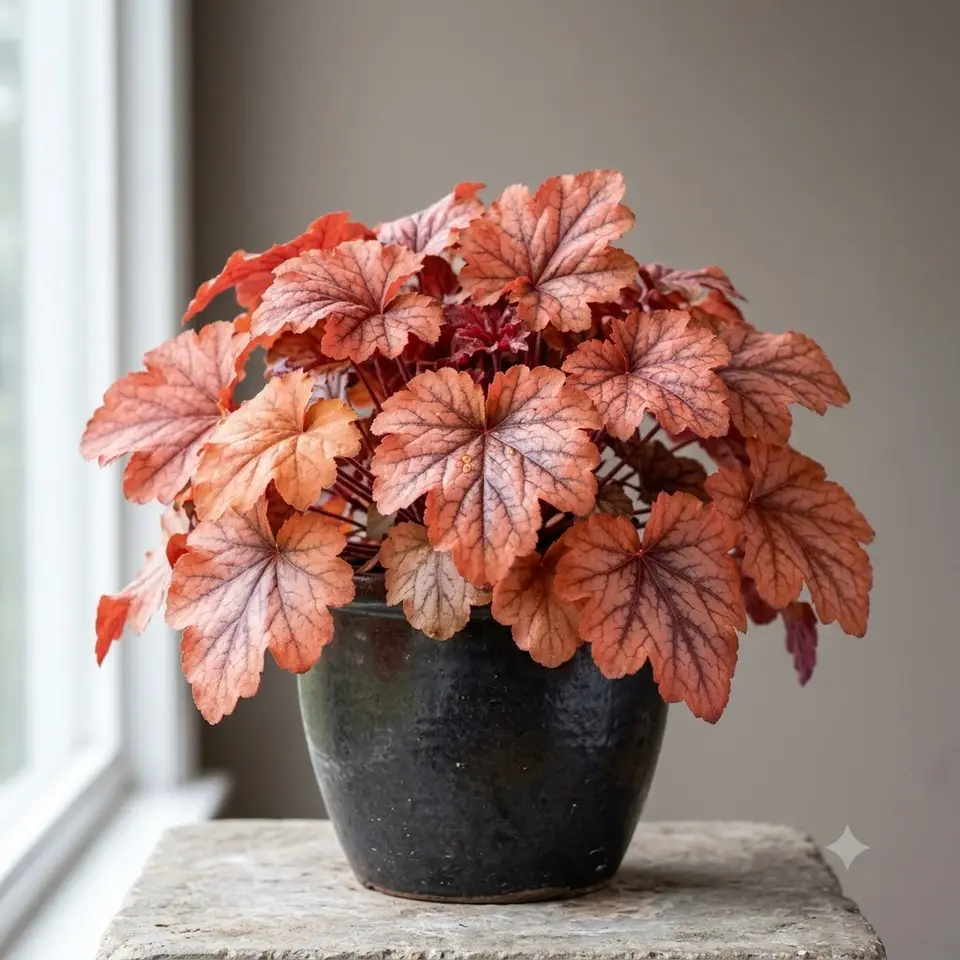 AI illustration
 Overview
Georgia Peach is a coral bells cultivar grown almost entirely for its large, ruffled leaves, which open a warm peach shade veiled in silver and shift toward rose-red as the weather cools (Heuchera 'Georgia Peach'). What sets it apart from older coral bells is its Heuchera villosa parentage, which gives it noticeably better tolerance of heat and humidity along with the bright fruit-toned colour. It forms a tidy, rounded mound that holds interest for most of the year.
Origin & Background
The genus Heuchera is native to North America, where its species grow across woodlands, rocky slopes, and stream banks from Canada down into Mexico. Georgia Peach itself is not a wild plant but a modern hybrid, developed in a specialist perennial breeding program and introduced in the late 2000s. Its lineage draws on Heuchera villosa, a heat- and humidity-tolerant species from the southeastern United States, which explains why this cultivar performs better in warm, muggy summers than many earlier coral bells.
Appearance
The leaves are the whole show: large, broadly lobed, and gently ruffled at the edges. New growth emerges peach to apricot with a fine silver overlay and darker veining, then deepens toward rose-red and amber tones as nights turn cool in autumn, with silver frosting becoming more pronounced. The plant grows as a dense, rounded mound of foliage roughly 20 to 25 cm tall and about 35 to 45 cm wide. In early to midsummer, slender wiry stems rise well above the leaves, to around 50 to 65 cm, carrying airy sprays of small creamy-white flowers.
Why People Grow It - Qualities & Benefits
- Long season of bright peach-to-rose foliage colour, not dependent on flowers
- Better heat and humidity tolerance than many older coral bells thanks to villosa parentage
- Compact, well-behaved mound that suits borders, edging, and containers
- Semi-evergreen in milder zones, giving structure and colour through much of the year
Care
Light: Part shade is ideal; morning sun with afternoon shade brings out the best colour. It takes more sun in cooler climates, but harsh afternoon sun in hot regions can scorch the leaves. Water: Moderate and even moisture. Keep the soil from drying out fully, but avoid waterlogging, which invites crown rot. Soil: Humus-rich, moisture-retentive but well-drained soil; slightly acidic to neutral pH around 6.0 to 7.0. Hardiness: USDA zones 4 to 9. Bloom or Season: Foliage is the main feature and is semi-evergreen in mild zones; slender spikes of creamy-white flowers appear in early to midsummer. Extra: Coral bells tend to heave, meaning the woody crown slowly lifts out of the soil over winter and needs to be mulched or replanted deeper each spring. Non-toxic to cats and dogs, so it is a safe pick for pet-friendly gardens.
Planting & Propagation
Plant in spring or early autumn, setting the crown at soil level in well-drained ground enriched with compost, and space plants about 35 to 45 cm apart. The most reliable way to increase this cultivar is by division: lift the clump every 3 to 4 years, ideally in spring or early autumn, and split it into sections that each keep a piece of crown and healthy roots. This also refreshes an aging, woody centre. While some Heuchera species can be raised from seed, named cultivars like Georgia Peach do not come true from seed and should be propagated by division to keep their colour.
Common Problems & Pests
- Crown and root rot in heavy, wet soils or where drainage is poor
- Winter heaving that exposes the crown, calling for spring mulching or replanting
- Vine weevil larvae, which chew roots, plus occasional slugs, snails, and foliar nematodes
Toxicity & Safety
Georgia Peach Heuchera is non-toxic to cats and dogs. Coral bells are not listed among plants that are toxic to pets, making this a reassuring, low-worry choice for households with animals. As with any plant, discourage pets from nibbling foliage, but there is no known poisoning risk from this genus.
Pros & Cons
Pros
- Vivid, shifting foliage colour that carries the garden without relying on bloom
- Handles heat and humidity better than many older coral bells
Cons
- Prone to crown rot in soggy soil and to winter heaving in cold zones
- Named cultivar must be divided rather than grown from seed, and clumps need periodic refreshing
Best Suited For
- Shade and part-shade borders, woodland edges, and container plantings that need long-season colour
- Pet-friendly gardens where a non-toxic ornamental is a priority
FAQ
Does Georgia Peach Heuchera need full sun for good colour?
No. It colours best in part shade with morning sun and afternoon protection. Full afternoon sun in hot climates can scorch the leaves, while too much deep shade can mute the peach tones.
How often should I divide it?
Every 3 to 4 years is a good rhythm. Dividing in spring or early autumn refreshes the woody crown, keeps the mound vigorous, and gives you extra plants that stay true to the parent.
Gear for growing georgia peach heuchera
Links go to Amazon or a partner store (such as Adagio Teas) and may earn us a commission at no extra cost to you. As an Amazon Associate we earn from qualifying purchases. We link gear types, not sponsors' picks: you choose the exact product.