'Gertrude Jekyll' Rose
'Gertrude Jekyll' is a bright pink English shrub rose that David Austin introduced in 1986, grown above all for its strong Old Rose scent.
Last reviewed: October 2026
 AI illustration
 Overview
'Gertrude Jekyll' is a bright pink English shrub rose that David Austin introduced in 1986, grown above all for its strong Old Rose scent. David Austin Roses says the scent is often described as the quintessential Old Rose fragrance, and the RHS, which gives it the Award of Garden Merit, calls it one of the best roses for fragrance. (Rosa 'Gertrude Jekyll', English shrub.)
Origin & Natural Habitat
Its parents are the Austin shrub rose 'Wife of Bath' and the Portland rose 'Comte de Chambord', a pairing given by both Wikipedia and NC State Extension. It is named for the garden designer and author Gertrude Jekyll, and NC State Extension lists the James Mason Award among its honors as well as the RHS Award of Garden Merit. Its registration name is Ausbord.
Appearance
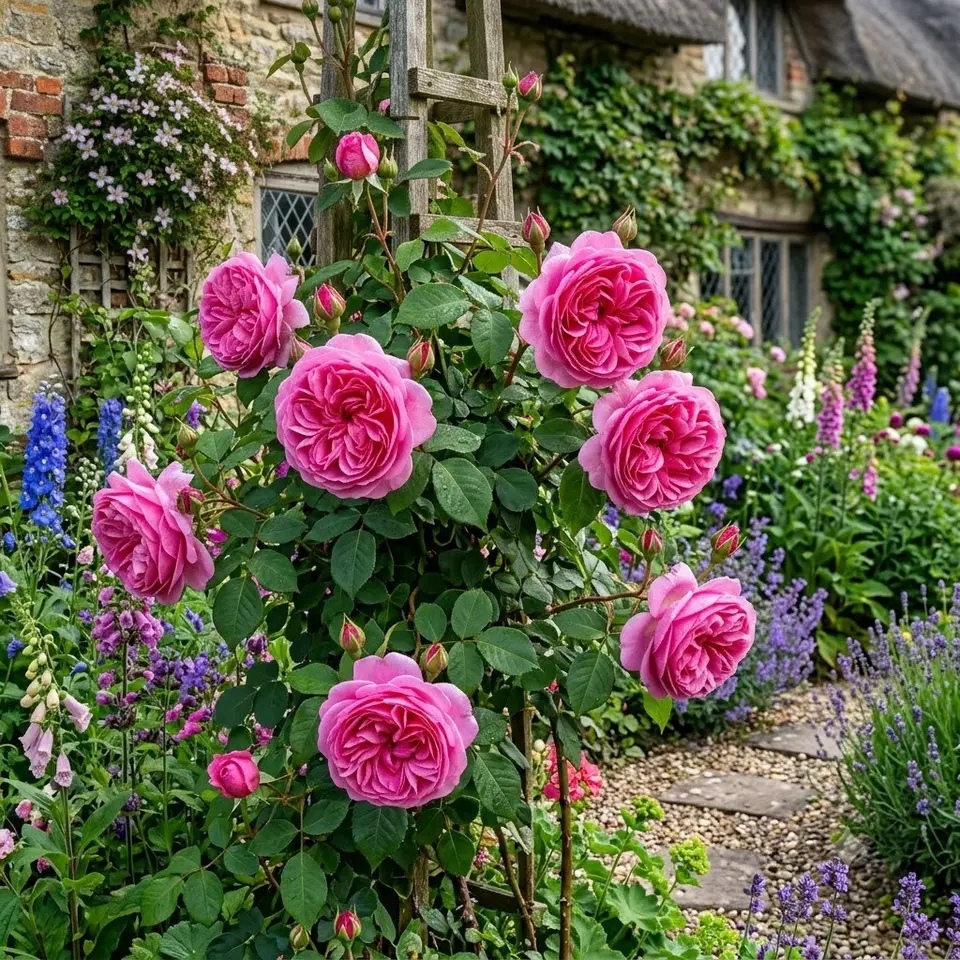
Scrolled buds open to large, rosette-shaped flowers of bright glowing pink, in David Austin's description. The breeder's British site lists 3 1/2 ft (110 cm) by 3 ft (90 cm) for a three-year-old plant, and its American site 5 ft by 3 1/2 ft, with 80 petals. NC State Extension gives flat rosettes 4-5 inches wide with a reddish center and 50-80 petals, the RHS describes grey-green foliage, and Wikipedia notes prickles on the stems.
Why People Grow It - Qualities & Benefits
- Old Rose fragrance that its breeder rates strong
- Always one of the first English Roses to start flowering, David Austin Roses says
- Flowers almost continuously from early summer to the first autumn frosts, according to the RHS
- Grows as a shrub or, in its climbing form, to 8 ft (2.5 m)
Care
Light: Full sun or partial shade, the two positions the RHS gives for it. David Austin Roses lists north-, east-, south- and west-facing positions.
Water: A thorough soak once a week in summer for an established plant, depending on rainfall. David Austin Roses suggests about 5 litres each time for a shrub rose and about 10 litres for a climber.
Soil & Feeding: David Austin Roses rates it for all soil types, and the RHS for chalk, clay, loam or sand. A feeding schedule is on the rose care page.
Temperature & Hardiness: David Austin's American site rates it for zones 4-11, NC State Extension lists 4a to 8b, and the RHS gives H6.
Pruning & Maintenance: The RHS puts the shrub in pruning group 21, or group 17 when it is trained as a climber; the RHS says it can be grown as a short climber to 2.4 m and is suitable for hedging. NC State Extension's timing for pruning is late winter.
Planting & Propagation
Besides the shrub, David Austin Roses sells a separate English Climbing Rose form, a short climber for a 6 ft wall or fence, a doorway, or an obelisk or pillar. NC State Extension notes that it can be grown in a pot placed near a patio to enjoy its fragrance.
Common Problems & Pests
- Watch for black spot, rust and powdery mildew, especially in humid conditions, NC State Extension advises
- Scale insects, aphids and glasshouse red spider mite, among the pests in the RHS profile
- Prickly stems, noted by Wikipedia and NC State Extension
Toxicity & Safety
Roses are non-toxic to dogs and cats - the thorns are the only hazard.
Pros & Cons
Pros
- One of the best roses for fragrance, in the RHS's view
- An early start to flowering
- RHS Award of Garden Merit
Cons
- Prickles
- Disease watch needed in humid summers
- Tall in warm climates: NC State Extension gives 6-10 feet
Best Suited For
- Cutting
- Rose hedges
- Pots near a patio
- Walls, doorways and pillars, in the climbing form
FAQ
Who was Gertrude Jekyll?
A garden designer and author who, David Austin Roses writes, had a profound effect on the style of English gardens. She advocated roses in mixed borders, created over 400 gardens in the UK, Europe and America, and received the Veitch Memorial Medal and the RHS Victoria Medal of Honour.
Is there a climbing 'Gertrude Jekyll'?
Yes. David Austin Roses sells an English Climbing Rose form with the same bright pink flowers and strong Old Rose scent, a short climber of 8 ft (2.5 m). The RHS adds that the shrub itself can be trained as a short climber.
Gear for growing 'gertrude jekyll' rose
Links go to Amazon or a partner store (such as Adagio Teas) and may earn us a commission at no extra cost to you. As an Amazon Associate we earn from qualifying purchases. We link gear types, not sponsors' picks: you choose the exact product.