How to Divide Perennials
The short answer: late summer and early autumn is the best window for most spring bloomers, and the job is mostly digging, splitting and replanting within the same hour. Here is the timing, the technique and the plants that hate being touched.
The short answer: dividing a perennial means lifting the clump, splitting it into pieces that each carry roots and growing points, and getting those pieces back in the ground fast. Most spring and early summer bloomers are divided in late summer or early autumn; most late summer bloomers are divided in spring. The practical deadline for autumn work is roughly four to six weeks before your first hard frost, so the new roots have time to grip before the ground cools.
That timing rule is the part people get wrong most often, and it costs plants. Everything else is forgiving.
Why bother dividing at all
A clump-forming perennial expands outward from the centre. After three to five years, many species have hollowed out in the middle, are flowering less, are drying out faster than they used to, or are simply crowding a neighbour. Dividing resets all four problems at once, and you end up with free plants.
Signs a clump is ready:
- A bare or woody centre with growth pushed to the outside ring
- Noticeably fewer or smaller flowers than two seasons ago
- Foliage that wilts sooner between waterings than it used to
- A clump that has outgrown its space or is smothering something
If none of those apply, leave it alone. Dividing a healthy, well-flowering plant “on schedule” is one of the more common bits of unnecessary garden work.
Timing, by bloom season
The general rule most growers use is simple: divide a perennial in the season opposite the one it flowers in.
- Spring and early summer bloomers - divide in late summer or early autumn. This includes hosta, daylily, bearded iris and most spring-flowering clumps.
- Late summer and autumn bloomers - divide in spring as new growth appears. Asters, chrysanthemums and Japanese anemone belong here.
- Bearded iris is the exception worth remembering: it is usually divided about six to eight weeks after it finishes flowering, which lands in mid to late summer in most temperate gardens.
Two more timing notes. Autumn division wants cooling air and still-warm soil, which is exactly what late August and September give you in most zones. And avoid dividing anything during a heatwave or a drought - the plant is already spending everything it has on staying alive.
The plants that resent it
Not everything divides well:
- Peony can be divided, but rarely needs it, and it sulks for a year or two afterwards. If you do lift one, each piece wants three to five eyes, and the eyes go only about 2 to 5 cm below the surface - a peony planted too deep is the classic “healthy leaves, no flowers” case. See the peony profile for the details.
- Taprooted plants - baptisia, oriental poppy, butterfly weed, lupin, gas plant - do not have a clump to split. They are usually left in place for their whole life.
- Woody-based subshrubs like lavender and Russian sage are propagated from cuttings, not division.
The actual technique
- Water the day before. A hydrated clump lifts and recovers far better than a dry one.
- Cut the foliage back to roughly a third of its height on large leafy clumps. It makes the work possible and reduces water loss while the roots are damaged.
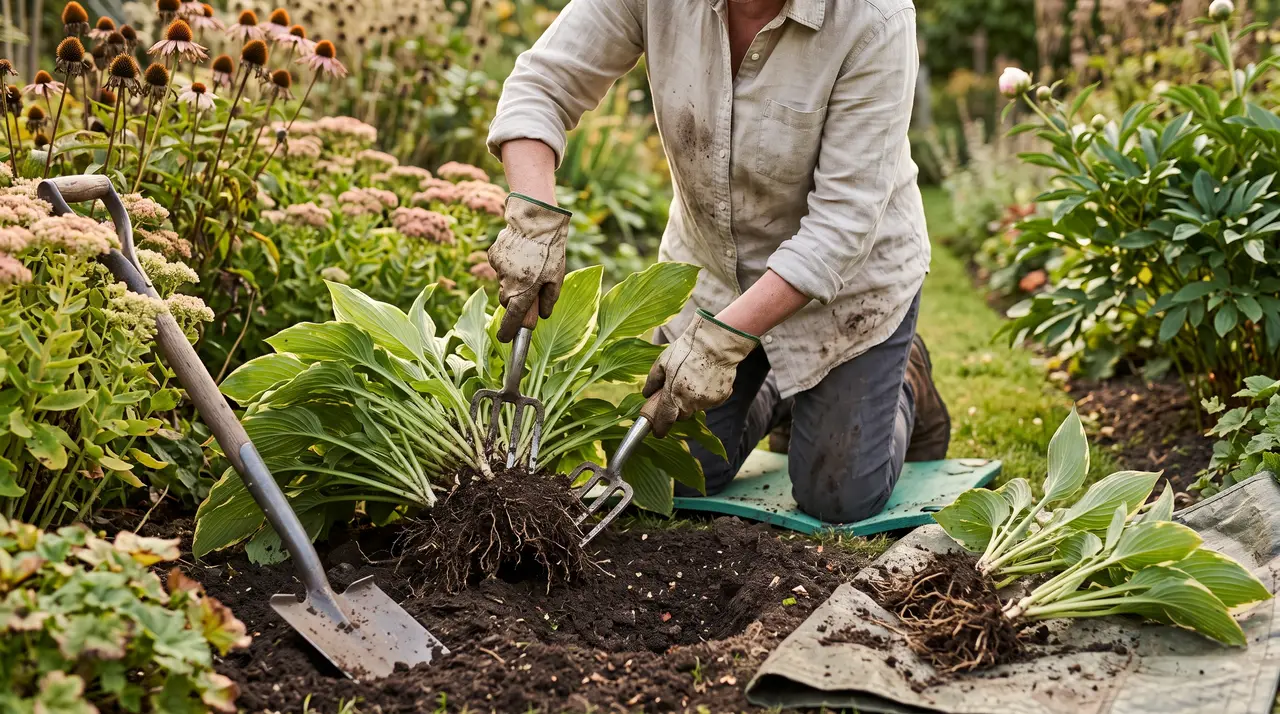
- Dig a full circle around the drip line of the clump, then lever underneath and lift the whole root ball out.
- Split it. Fibrous, loose clumps such as daylily often pull apart by hand or with two garden forks back to back. Dense, woody crowns need a sharp spade, an old bread knife or a garden saw. Do not be gentle here - a clean decisive cut heals better than a lot of tearing.
- Keep useful pieces only. Each division wants at least three to five shoots or eyes and a decent handful of roots. Discard the exhausted woody centre. Very small divisions survive, but they take an extra year to look like anything.
- Replant immediately, at the same depth the plant was growing before. Depth errors are the second most common cause of a division that never flowers again.
- Water in well, then keep the soil evenly moist for the next three to four weeks while roots re-establish. Mulch after the ground has cooled, not straight away.
If the pieces cannot go back in the ground the same day, pot them up or heel them into a spare bed and keep them shaded and damp. Exposed roots dry out in minutes on a windy day.
What happens afterwards
Expect the divisions to look sad for one to three weeks, and expect autumn divisions to put on almost no visible top growth at all - the work is happening underground. Spring divisions often skip or reduce their first season’s flowering. Both are normal. What is not normal is a division that collapses within days, which usually means it went in too deep, too dry, or with almost no root attached.
Autumn divisions benefit from a soil that drains through winter rather than sitting wet, so if your bed is heavy, this is a good moment to work on it - our guide to improving garden soil covers what actually helps. And if you are deciding what to put the new free plants into, the year-round perennial colour guide is a reasonable place to plan from.
The honest bottom line
Dividing perennials is one of the few garden jobs where the tool matters less than the calendar. Get the season right, keep the pieces big enough, replant at the original depth, and water for a month. Do that and a tired five-year-old clump becomes three good plants, at the cost of an afternoon and no money at all.
🛒 Recommended Gear on Amazon
- Garden fork - browse current options and reviews on Amazon.
- Border spade - browse current options and reviews on Amazon.
- Hori hori knife - browse current options and reviews on Amazon.
As an Amazon Associate, we earn from qualifying purchases - at no extra cost to you. This helps us keep producing free, in-depth guides.