Cleaning Garden Tools Before Winter
An hour in late autumn decides whether your pruners and spade come out of the shed sharp or rusted. The order that works - scrub, dry, disinfect, sharpen, oil, store - with the angles, the products that are worth using, and the mistakes that shorten a tool's life.
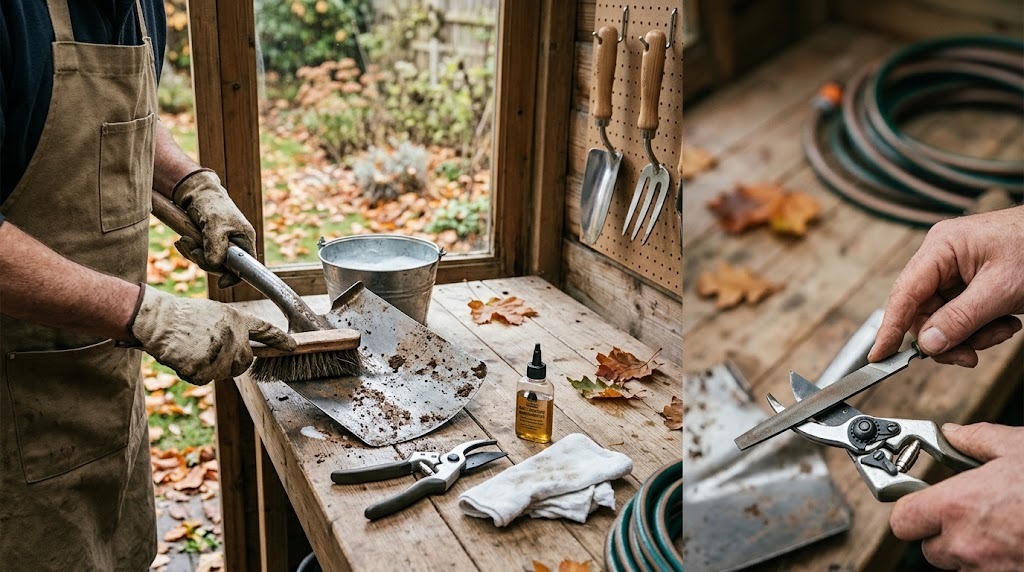
The short version: tools rust and blunt over winter because they are put away dirty and damp. The fix is a fixed order - scrub off the soil, dry completely, disinfect cutting blades, sharpen, oil the metal and the wood, store dry and off the floor. For a typical set of hand tools it takes about an hour once a year, and it matters more than what the tools cost in the first place.
You do not need a workshop. A stiff brush, a file, a rag and a bottle of oil cover most of it.
Start with soil and sap
Soil holds moisture against steel, and that is where rust begins. Knock off the dry lumps, then scrub spades, forks, hoes and trowels with a stiff brush and water. A putty knife or an old kitchen knife lifts caked clay from the angle where the blade meets the socket.
Pruners, loppers and saws carry a different kind of dirt: dried sap and resin. It makes blades stick and holds grime. Warm soapy water and a scouring pad handle most of it; a little rubbing alcohol on a rag dissolves the stubborn film. If your pruners come apart with one nut, take them apart - the gunk that matters is between the blades, where you cannot reach otherwise.
Then dry everything properly. An old towel first, then ten minutes in a warm, airy spot. Oiling over a damp tool traps the water underneath.
For rust that is already there, steel wool or a wire brush removes the loose layer. Light surface rust is cosmetic once it is rubbed back and oiled. Deep pitting on a cutting edge is a reason to replace the blade, which most quality pruners allow.
Disinfect what cuts living plants
Pruners and saws can carry fungal and bacterial problems from one plant to the next. End of season is a sensible moment to disinfect them, and it is worth doing during the season too after cutting anything visibly diseased.
University extension services generally point to two household options:
- Rubbing alcohol at about 70 percent - wipe or dip the blades, no dilution and no rinsing needed. It is quick and kind to steel, which is why many gardeners settle on it.
- Diluted household bleach, roughly one part to nine parts water - effective, but corrosive to metal. Tools need rinsing and drying afterwards, and the solution loses strength within hours.
Follow the label on whatever product you use, work with ventilation, and never mix bleach with other cleaners. Spades and hoes do not need disinfecting in an ordinary garden - clean and dry is enough.
Sharpen in the right order
Sharp tools are not a luxury. A blunt blade crushes a stem instead of slicing it, and a crushed cut heals slowly. A sharp spade takes noticeably less effort in heavy soil.
Pruners and loppers. Bypass pruners have one bevelled blade and one flat hook. Sharpen only the bevelled side, following the angle the maker ground - usually somewhere around 20 to 25 degrees. Use a small diamond file or sharpening stone, pushing from the base of the blade toward the tip in one direction. Ten to twenty strokes are normally plenty. Finish with one light pass flat across the back to remove the burr. Do not grind a bevel onto the flat side; the two faces must stay tight against each other.
Spades, hoes and edging tools. These want a tougher, blunter edge - about 45 degrees. Clamp the tool or brace it firmly, and push a flat mill file away from you along the existing bevel, on the front face only. You are aiming for a clean bright line of metal, not a knife edge. A razor-thin edge on a spade folds on the first stone.
Saws and hedge shears. Many modern pruning saws have hardened teeth that are not meant to be sharpened at home; the blade is replaced. Hedge shears take the same treatment as pruners, bevel side only.
Wear gloves and eye protection when filing, and always file away from the hand that holds the tool.
Oil the metal, feed the wood
Bare, freshly cleaned steel rusts quickly, so finish with a thin film of oil. A light machine oil or camellia oil on a rag works well for blades. Put one drop on the pivot of pruners and loppers and open and close them a few times to work it in. Wipe off the excess - a film protects, a puddle collects dust.
Wooden handles dry out, turn grey and start to splinter. Sand any rough patches with medium sandpaper, then rub in boiled linseed oil with a rag, let it soak for a quarter of an hour, and wipe off what has not been absorbed. One caution that is easy to miss: rags soaked in linseed oil can heat up as they dry and have been known to catch fire in a heap. Dispose of them as the product label describes.
Check handles while you are there. A cracked shaft on a fork or spade tends to fail under load, and replacement handles for common patterns are inexpensive.
Store them so the work lasts
Where tools spend the winter matters as much as how clean they are:
- Off the floor. Concrete draws and holds moisture. Hang long-handled tools on a rack, blade down or sideways.
- Dry and ventilated. An unheated shed is fine if it does not drip. A damp cellar is worse than a cold shed.
- Closed and latched. Store pruners shut, with the catch on.
- Hoses and cans emptied. Water left in a hose, sprayer or watering can expands when it freezes and splits seams.
The old sand bucket trick - a bucket of dry sand with a little oil mixed in, into which you plunge spades and trowels - still has its fans. It scours and oils in one move. It works best as a quick habit during the season, not as a replacement for a proper clean.
The mistakes worth avoiding
- Putting tools away wet “just this once”. One damp winter does more damage than a season of use.
- Sharpening both sides of a bypass blade. It leaves a gap that tears stems.
- Using a power grinder on thin blades. Heat ruins the temper of the steel and it will not hold an edge afterwards.
- Skipping the pivot. Stiff pruners are usually dirty and dry in the joint, not worn out.
- Forgetting the small things. Dibbers, hand forks and plant labels benefit from the same wash and dry.
Tool care is one item on a longer autumn list. Our fall garden checklist covers the rest of the season’s jobs, and the garden instruments guide explains which tool does what if you are still building a set. If you clean your pruners now, they will be ready when the fruit pruning calendar says it is time to use them.
🛒 Recommended Gear on Amazon
- Diamond sharpening file - browse current options and reviews on Amazon.
- Flat mill file - browse current options and reviews on Amazon.
- Boiled linseed oil - browse current options and reviews on Amazon.
- Wall-mounted tool rack - browse current options and reviews on Amazon.
As an Amazon Associate, we earn from qualifying purchases - at no extra cost to you. This helps us keep producing free, in-depth guides.