How to Overwinter Tender Plants
Tender plants do not need a greenhouse to survive winter - they need to be lifted or moved before the first hard frost and then kept cool, dark and barely damp. Here is the timing, the method for each plant type, and the mistakes that rot a tuber.
Tender plants are killed by wet cold more often than by cold alone, and plenty of them are lost in storage rather than in the ground. If you take one thing from this guide: lift or move them before the first hard frost, get them dry, and store them cool, dark and only slightly damp. A frost-free garage at 5-10C does the job for almost everything. You do not need a heated greenhouse.
Tender here means plants that survive a light touch of frost at best: dahlias, cannas, begonias, pelargoniums, fuchsias, salvias, citrus in pots, and most of the summer container regulars. In a mild maritime climate some of these survive outdoors under mulch. Further inland or north, they will not.
Get the timing right
The trigger is the first frost forecast, not the calendar. Two different rules apply depending on plant type:
Lift tuberous plants after the first light frost blackens the foliage. Dahlias and cannas are the main examples. That first frost is useful: it stops top growth and signals the plant to move energy down into the tuber. Waiting one light frost gives you a better tuber. Waiting for a hard, ground-penetrating freeze gives you a damaged one.
Move evergreen and woody tender plants indoors before any frost. Pelargoniums, citrus, tender fuchsias and salvias should come in while nights are still above about 5C. They do not benefit from a frost hit, they are simply set back by it.
In most of northern Europe and the northern US that means late September to late October for the first group, and mid to late September for the second. To pin the dates for your own area, check your zone with the hardiness zone lookup and then work backwards from your local average first frost date.
Dahlias, cannas and other tubers
This is where most losses happen, and almost all of them are rot.
Cut the stems back to about 10-15cm once the foliage has blackened. Dig well outside the crown, at least 30cm out, and lever upwards rather than pulling on the stem. Tubers snap at the neck easily and a tuber without its neck and crown will not sprout, however healthy it looks.
Wash the soil off or shake it off, your choice, but the next step is not optional: cure them. Leave the clumps upside down somewhere frost-free and airy for one to two weeks so the cut stems drain and the skin firms up. Hollow dahlia stems hold water, and water sitting in an upright stem runs straight into the crown and rots it.
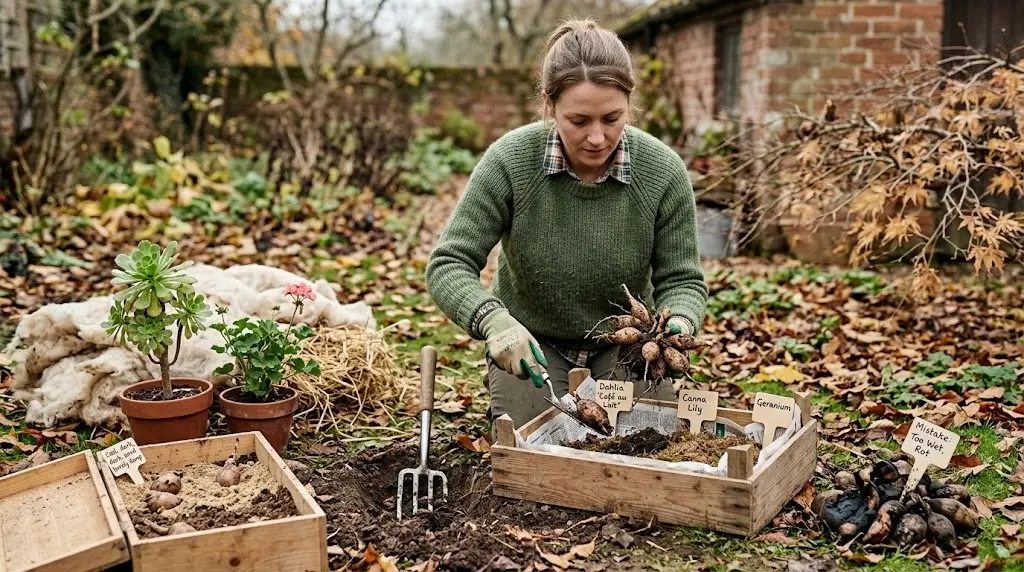
Once cured, pack them in crates or cardboard boxes with dry compost, vermiculite, wood shavings or shredded paper around them. Not sealed plastic. Store at 5-10C in the dark. Check monthly. Shrivelling means the store is too dry or too warm, so mist the packing material lightly. Soft brown patches mean rot, so cut the affected tuber away and let the cut surface dry before repacking.
Cannas are more forgiving. They can be stored as whole clumps with some soil still attached, and they tolerate slightly more moisture than dahlias do. Tuberous begonias are the fussiest of the group and want to be kept properly dry.
If you want more detail on the plants themselves, our dahlia profile covers the growing side.
Pelargoniums, fuchsias and woody tender plants
Most of these are kept alive rather than dormant, which means light matters. Fuchsias are the flexible exception: kept cool and dark they will drop their leaves and sit out the winter dormant, and either method works.
Cut them back by about a third to a half, remove all dead and yellowing leaves, and check carefully for pests before they come indoors. Whitefly and aphids brought in on a pelargonium in October will have colonised half your windowsill by January. A close inspection now saves a lot of trouble later.
Keep them somewhere cool and bright: an unheated porch, a spare room, a cold conservatory. Around 5-10C is ideal. Warm rooms are actively bad, because warmth pushes weak pale growth that the low winter light cannot support, and that growth is a magnet for pests.
Water sparingly. Once every two to four weeks is usually plenty, just enough that the compost never dries to dust. This is the single most common failure: a plant that would have sailed through winter drowns in a saucer of water in a cold room.
Pelargoniums are exceptionally tough here. They will survive being lifted bare-root, shaken clean and hung upside down in a frost-free shed, which is how gardeners overwintered them for a century.
What can stay outside
Not everything needs lifting, and moving a plant that did not need it wastes effort.
Borderline-hardy plants in the ground often survive with a thick dry mulch over the crown: 10-15cm of bark, leaf mould or straw, applied after the ground cools but before it freezes. The mulch is insulation, not warmth, so it works by keeping the soil temperature stable rather than raising it.
Container plants are the exception worth watching. Roots in a pot sit in the air rather than in insulating ground, and a pot can freeze solid when a border two metres away does not. Group pots together against a house wall, raise them on feet so they drain, and wrap the pot rather than the plant. Our guide on winter frost protection goes into the wrapping methods in more detail.
Terracotta needs its own thought: it absorbs water, and water expanding in the wall of a pot is what cracks it. Empty or wrap anything you care about.
The mistakes that cost you plants
- Sealed plastic bags or boxes. No airflow means condensation, and condensation means rot within weeks.
- Storing wet. Curing is skipped more often than any other step, and it is the one that matters most.
- A heated storage space. Anything above about 12C either dries tubers out or wakes them up early. Both are bad.
- No labels. Every dahlia tuber looks identical in March. Write the name on the tuber itself with a marker, not only on the crate.
- Never checking. One rotting tuber in a closed crate will take its neighbours with it. A five-minute look once a month is what separates a full crate in spring from an empty one.
Get the timing and the dryness right and overwintering is genuinely low effort. Most of the work is in October, most of the risk is in the first three weeks of storage, and most of the reward arrives when you unpack a crate in spring and find everything firm, plump and ready to start again. For everything else that needs doing this season, the fall garden checklist covers the rest of the autumn jobs.
Recommended Gear on Amazon
- Frost protection fleece - browse current options and reviews on Amazon.
- Min-max thermometer - browse current options and reviews on Amazon.
- Storage crates - browse current options and reviews on Amazon.
As an Amazon Associate, we earn from qualifying purchases - at no extra cost to you. This helps us keep producing free, in-depth guides.