Water Hyacinth
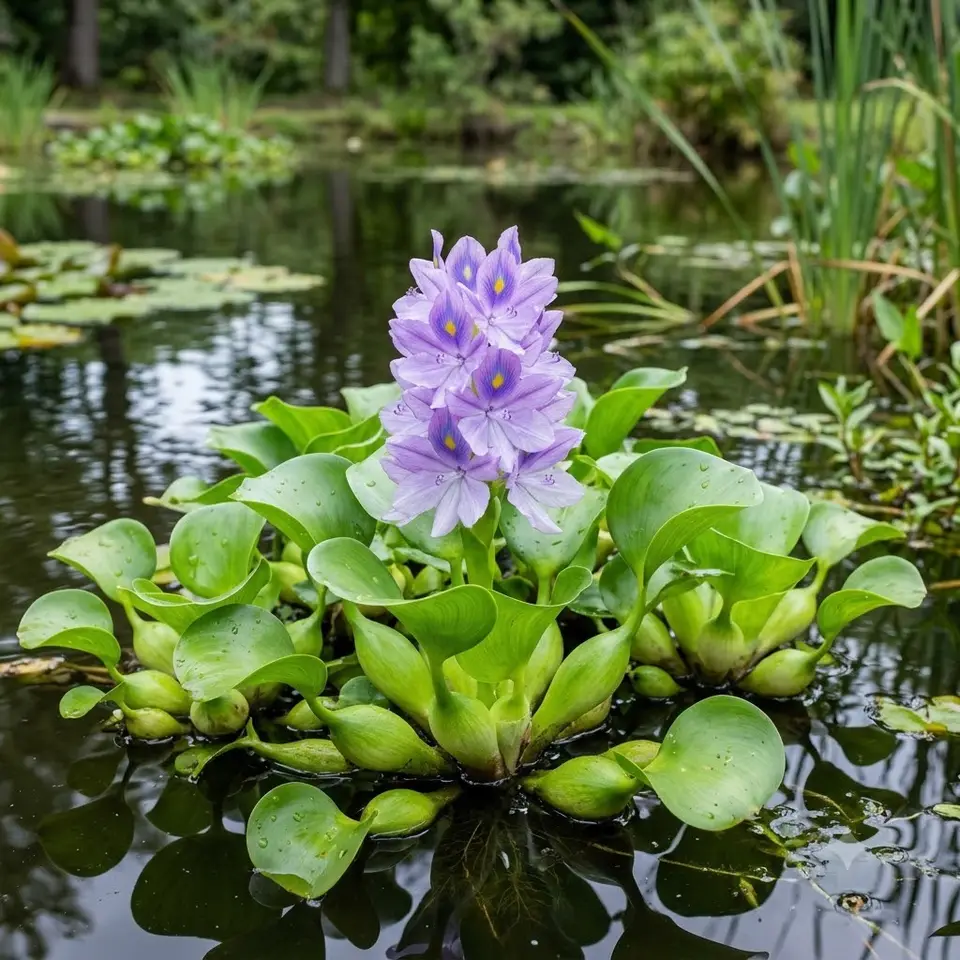
Water hyacinth is a striking pond floater - glossy paddle leaves on inflated, buoyant stalks that throw up spikes of lavender-blue orchid-like flowers.
Last reviewed: October 2026
 AI illustration
Overview
Water hyacinth is a striking pond floater - glossy paddle leaves on inflated, buoyant stalks that throw up spikes of lavender-blue orchid-like flowers. It is also one of the most destructive invasive plants on Earth, banned in many places, so it belongs only in a contained pond where it is legal: never in a natural waterway. (Eichhornia crassipes.)
Origin & Natural Habitat
Native to the Amazon basin; now a catastrophic invader of warm waterways across every continent but Antarctica.
Appearance
Rosettes of shiny rounded leaves on swollen, spongy floats, with feathery purple-black roots and tall spikes of lavender flowers.
Why People Grow It - Qualities & Benefits
- Dramatic flowers and form
- Enormous nutrient uptake in ponds
- Shade and fish cover
- Fast summer growth
Care
Light: Full sun - it is an outdoor pond plant.
Water: Warm ponds; frost kills it, which is one reason it stays contained in cool climates.
Substrate: None - floats.
CO₂ & feeding: Not needed.
Placement: Contained garden ponds only, where legal.
Extra: Water hyacinth is a prohibited/noxious weed in many US states and countries because it forms waterway-choking mats that wreck ecosystems and block boats. Only keep it if it is legal where you live, only in a contained pond, and dispose of it by composting or binning well away from any water - never let it reach a natural waterway.
Propagation
Spreads explosively by runners; must be thinned and contained. This is a liability, not a feature.
Common Problems & Pests
Illegal in many regions; frost-tender; overwhelms a pond in a season. Its invasiveness is the headline issue.
Toxicity & Safety
The plant's danger is ecological, not toxic. Never release it; check local law first. Where banned, do not keep it at all.
Best Suited For
- Contained warm-climate ponds (where legal)
- Pond nutrient export and shade
- NOT for anywhere it can escape
- NOT for regions where it is prohibited
FAQ
Can I put water hyacinth in my pond?
Only if it is legal where you live and the pond is fully contained. It is a prohibited invasive in many US states and countries - check first, and never let it reach natural water.
How do I dispose of it?
Compost it or bin it well away from any waterway, after it has dried out. Never dump pond plants into a lake, stream or ditch.
Sources
Pet toxicity: checked against the ASPCA Animal Poison Control Center lists of toxic and non-toxic plants for cats and dogs, entry "Water Hyacinth" (Eichhornia crassipes): non-toxic to cats and dogs. Lists read on 10 October 2026.
Gear for growing water hyacinth
Links go to Amazon or a partner store (such as Adagio Teas) and may earn us a commission at no extra cost to you. As an Amazon Associate we earn from qualifying purchases. We link gear types, not sponsors' picks: you choose the exact product.