Salvinia
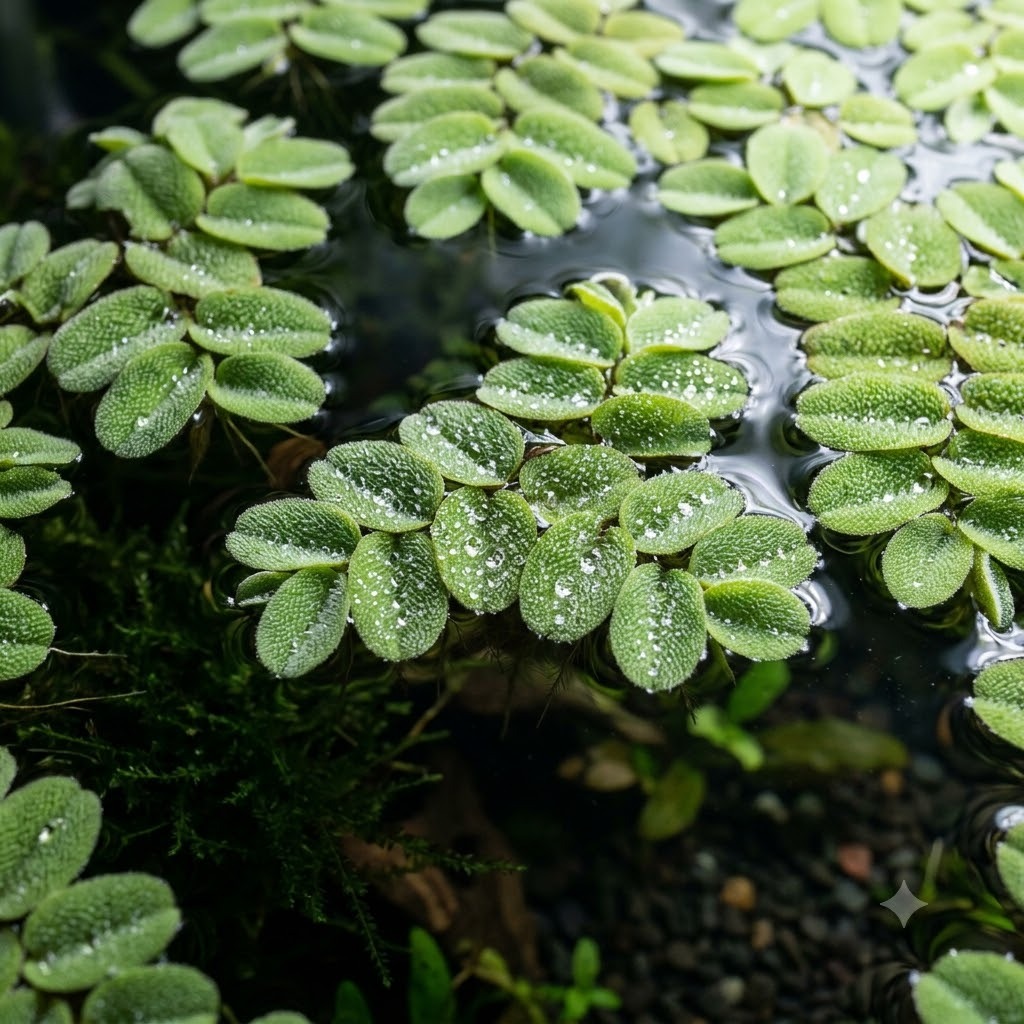
Salvinia is a floating fern with paired oval leaves covered in tiny water-repellent hairs, so droplets bead and roll off the surface like mercury.
🗓️ Last reviewed: July 2026
Overview
Salvinia is a floating fern with paired oval leaves covered in tiny water-repellent hairs, so droplets bead and roll off the surface like mercury. In the hobby it is usually sold as water spangles (Salvinia minima); stock labelled Salvinia auriculata carries a federally regulated name in the US and is in practice almost always misidentified S. minima. It multiplies fast, shades the tank, and strips nitrates - and it is exactly that vigour that makes several salvinia species serious regulated weeds outside the aquarium.
Origin & Natural Habitat
Tropical and subtropical America for Salvinia minima - still ponds, swamps and slow backwaters. Escaped plants have naturalised across the southeastern US, where salvinia is treated as an invasive weed, and the whole giant salvinia group - S. molesta, S. auriculata, S. biloba and S. herzogii - sits on the US Federal Noxious Weed List, so importing any of them or moving them across state lines requires a federal APHIS permit. Check your local rules before buying, keep it in the tank, and never release aquarium plants into waterways.
Appearance
Pairs of small, oval to boat-shaped leaves, fresh to olive green, with a velvety surface of fine bristly hairs that traps air. Chains of leaf pairs spread sideways across the surface; below hangs a fringe of feathery, root-like submerged growth (a modified third leaf, not a true root).
Why People Grow It - Qualities & Benefits
- Heavy nutrient uptake - a practical tool against algae
- Instant shade for fish that dislike bright, open tanks
- Dangling underwater fronds shelter fry and shrimp
- Grows with no substrate, no CO2 and no special equipment
Care
Light: Low to strong - it is not fussy. Strong light simply makes it double faster and, in some forms, cup the leaves upward.
Water: 18-28°C, pH 6.0-7.5, soft to hard. It needs a calm surface: constant ripple and spray sink the leaves and rot them.
Substrate: None - it floats. A floating corral (airline tubing or suction-cup barrier) keeps it away from filter outflows and off the rest of the tank.
CO₂ & feeding: No CO2 - the upper leaf surface takes CO2 from the air. Liquid fertiliser prevents pale, stunted plants in very clean tanks, but in most stocked tanks it feeds itself on fish waste.
Placement: Surface layer of calm tanks, shrimp setups and indoor pond tubs.
Extra: ⚠️ Plan on removing some every week. A closed salvinia mat will darken the tank enough to stall or kill the plants underneath, and thick cover also slows gas exchange at the surface.
Propagation
It propagates itself - chains branch and break apart, and each fragment becomes a new plant. That is also the reason it spreads so aggressively in the wild; surplus goes in the bin, never into ponds, drains or waterways.
Common Problems & Pests
Rotting leaves under dripping lids or filter spray; a mat so dense it shades out everything below; fragments hitchhiking into filters and overflow boxes; occasional aphids on the dry upper leaves in open-top tanks. Some fish nibble the trailing fronds, which does no harm.
Toxicity & Safety
Not known to be toxic to cats, dogs or aquarium livestock. Shrimp-safe, and the hanging fronds are a favourite grazing spot.
Best Suited For
- Calm, dim-preferring setups (bettas, some tetras, killifish)
- Shrimp and fry tanks needing surface cover
- Nutrient-heavy tanks fighting algae
- Not for tanks with turbulent surfaces, and not in regions where it is prohibited
FAQ
Is salvinia banned anywhere?
In places, yes. The giant salvinia group - S. molesta, S. auriculata, S. biloba and S. herzogii - is on the US Federal Noxious Weed List, so importing any of them or moving them across state lines requires a federal APHIS permit. Only Salvinia minima is traded legally in the US, and even that is a naturalised invasive across much of the southeast, restricted further in some states (Florida classes all exotic salvinia as Class I Prohibited Aquatic Plants) and countries. Verify your local list before ordering.
How do I stop it taking over the surface?
Scoop out roughly a third of it every week or two, and pen it into one part of the tank with a floating barrier. Left alone it doubles quickly and blocks the light your rooted plants need.