Sand Rose (Anacampseros rufescens)
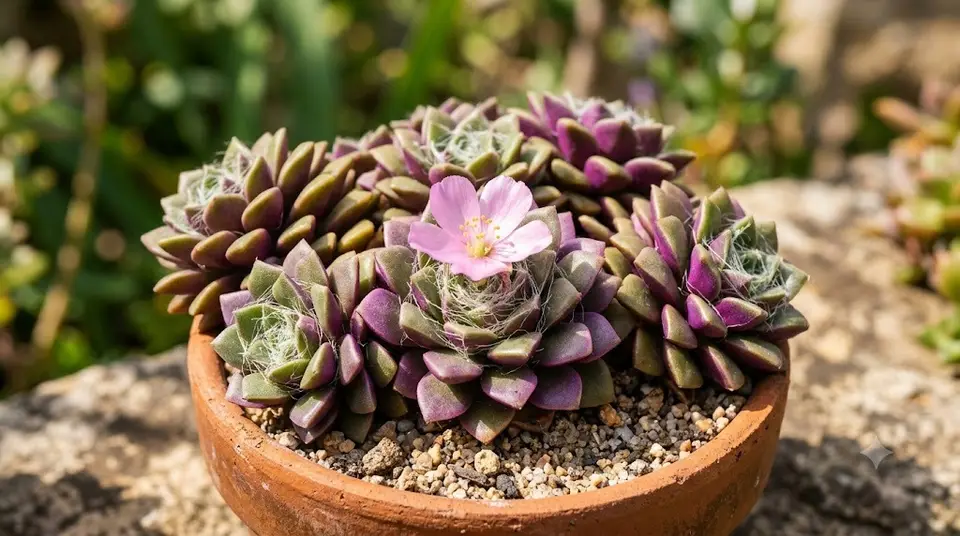
The sand rose is a small, slow, jewel-like succulent forming low clusters of pointed rosettes - olive-green above and vivid violet-purple beneath, threaded with fine white hairs.
Last reviewed: October 2026
 AI illustration
 Overview
The sand rose is a small, slow, jewel-like succulent forming low clusters of pointed rosettes - olive-green above and vivid violet-purple beneath, threaded with fine white hairs. Give it sun and restraint and it rewards you with silky pink flowers and some of the richest colour in the succulent world.
Origin & Natural Habitat
Anacampseros rufescens comes from rocky outcrops of South Africa, tucked among stones and grass. Its compact clusters and coloured undersides are adaptations to intense light.
Appearance
Tight clusters of small rosettes of pointed, fleshy leaves (olive to bronze-green on top, glowing violet-purple beneath, especially in sun) with fine cobweb-like white filaments between the leaves. Mature clumps send up stalks of silky, bright pink flowers in summer that open on sunny afternoons.
Why People Love It - Qualities & Benefits
People love the two-tone colour, the tidy jewel-box scale, and the surprising pink flowers. It suits shallow bowls and windowsill collections where a big plant would crowd.
Care
Light
Several hours of direct sun bring out the purple and keep the rosettes tight - a south or west sill is ideal. In shade it greens and stretches.
Watering
Soak when the soil is fully dry, then wait; keep much drier in winter. The small, fleshy rosettes rot quickly in damp soil.
Soil & Potting
A very gritty, sharply draining mix in a small, shallow pot with drainage.
Humidity & Temperature
Dry, airy conditions suit it; keep frost-free. It handles cool, bright winters well if dry.
Feeding
A very dilute succulent feed once in the growing season is ample - lean living keeps it compact and coloured.
Repotting
Rarely - every few years, in spring. Clumps can be gently divided at the same time.
Propagation
From seed (it self-sows readily in collections - the flowers set seed even when they barely open) or by dividing clumps. Individual leaves are less reliable.
Common Problems & Pests
Overwatering rot is the main danger; mealybugs occasionally hide in the woolly filaments. Stretching and lost purple mean too little sun.
Toxicity & Safety
The sand rose is not considered toxic to people or pets - one of the safer small succulents to grow around animals.
Pros & Cons
Pros: vivid purple undersides, compact and tidy, silky pink flowers, safe around pets. Cons: small and slow, colour depends on strong sun, rots if watered like a houseplant.
Best Suited For
For windowsill collectors who love saturated colour in miniature - a little gem for a bright, dry sill.
FAQ
Why isn't mine purple? It needs several hours of direct sun - shade keeps it plain green.
Do the flowers really open? On warm sunny afternoons, yes - and even shy flowers set seed, so babies often appear around the pot.
Gear for growing sand rose (anacampseros rufescens)
Links go to Amazon or a partner store (such as Adagio Teas) and may earn us a commission at no extra cost to you. As an Amazon Associate we earn from qualifying purchases. We link gear types, not sponsors' picks: you choose the exact product.