Peperomia Rosso
Peperomia Rosso is a compact, semi-succulent foliage plant prized for its deeply textured leaves and striking two-tone colouring.
Last reviewed: September 2026
 AI illustration
 Overview
Peperomia Rosso is a compact, semi-succulent foliage plant prized for its deeply textured leaves and striking two-tone colouring. A named cultivar of the emerald ripple peperomia (Peperomia caperata), it forms a tidy rosette that rarely outgrows its pot, making it a favourite for desks, shelves, and small collections. Its thick, water-storing leaves mean it tolerates a little neglect far better than it tolerates overwatering.
Origin & Natural Habitat
The parent species, Peperomia caperata, is native to the tropical rainforests of Brazil, where it grows on the forest floor and on mossy logs and rocks as a low, shade-loving groundcover. In that environment it sits beneath the canopy in warm, humid, dappled light, rooting shallowly into leaf litter and decaying wood rather than deep soil. The 'Rosso' cultivar was selected in cultivation for its intense red leaf undersides and pronounced surface texture, but it keeps the same rainforest-floor preferences: warmth, gentle light, and airy, fast-draining footing.
Appearance
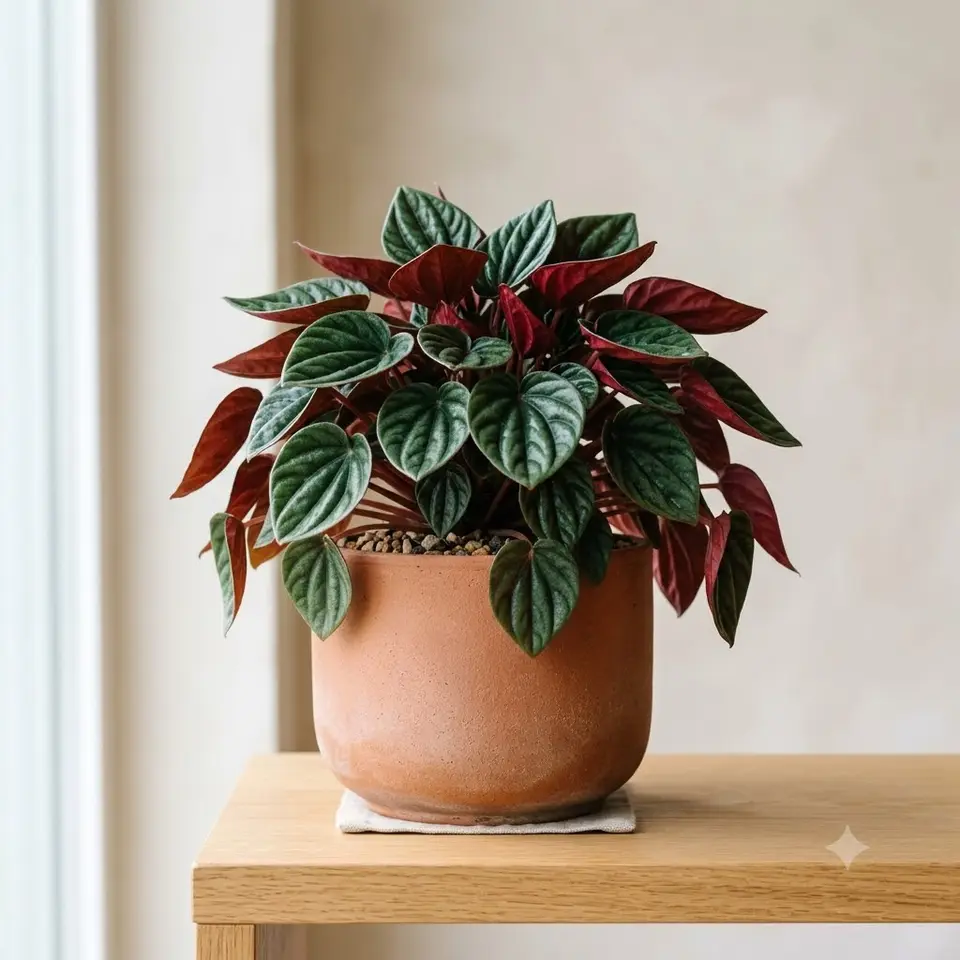
'Rosso' produces lance-shaped to oval leaves that are heavily corrugated, with deep grooves following the veins that give the surface a quilted, rugose look. The upper surface is a deep glossy green, while the underside and leaf edges flush a rich burgundy to wine-red, and the contrast is most vivid in bright light. Leaves are small, roughly 3 to 6 cm long, held on short reddish stems in a dense, mounding rosette. Mature plants stay compact at around 20 to 25 cm tall and wide. In good conditions it sends up slender, upright flower spikes that resemble thin rat-tails - unremarkable and greenish, grown for the foliage rather than the bloom.
Why People Grow It - Qualities & Benefits
- Bold texture and colour contrast in a small footprint, ideal where space is tight.
- Slow, compact growth that almost never needs repotting or pruning to stay in shape.
- Drought-forgiving thanks to thick, moisture-storing leaves and stems.
- Confirmed pet-safe, so it suits homes with curious cats and dogs.
Care
Light: Bright, indirect light. It handles medium light but the red tones fade and growth stretches in dim spots; keep it out of harsh direct midday sun, which scorches the leaves. Water: Let the top half of the soil dry out between waterings, then water thoroughly and drain fully. This plant is far more likely to die from overwatering than from drought - soggy soil causes rapid stem and root rot. Soil: A light, airy, fast-draining mix. A blend of standard potting soil with plenty of perlite, orchid bark, or coarse sand works well; avoid dense, water-holding mixes. Temperature & Humidity: Comfortable at 18 to 26°C. Keep it above 12°C and away from cold draughts. It enjoys moderate to high humidity (around 40 to 60%) but adapts to average room humidity better than many tropicals. Feeding: Feed lightly with a balanced houseplant fertiliser diluted to half strength, roughly once a month in spring and summer. It is a light feeder - do not overdo it, and stop feeding in winter. Extra: The stems and leaves are brittle and snap easily, so handle and repot gently. Good news for households with animals: Peperomia is listed as non-toxic to cats and dogs on the ASPCA pet-safe list.
Propagation
'Rosso' propagates readily from leaf or stem cuttings in spring or summer. Take a healthy leaf with a short piece of stem, let the cut end callous for an hour or two, then insert it into moist, airy propagation mix or a small cup of water. Keep it warm and in bright indirect light; roots and small plantlets usually appear over several weeks. Whole-leaf and leaf-half cuttings both work, though patience is required as this is a slow grower.
Common Problems & Pests
- Overwatering and rot: the most common killer, showing as mushy, blackened stems or a collapsing rosette. Ease off water and improve drainage.
- Brittle, snapped stems: leaves and stems break easily when knocked or handled roughly - site it somewhere it won't be brushed against.
- Pests: occasional mealybugs, spider mites, or fungus gnats (the last usually a sign of soil kept too wet). Wipe or treat early and let the soil dry more between waterings.
Toxicity & Safety
Peperomia Rosso is non-toxic to cats and dogs, and Peperomia appears on the ASPCA list of pet-safe plants. It is a genuinely low-risk choice for homes with pets and children. As with any houseplant, the soil, bark, and fertiliser are not meant to be eaten, so it is still sensible to discourage nibbling and keep fertiliser out of reach - but the plant itself poses no known toxic hazard.
Pros & Cons
Pros
- Compact and slow-growing, so it stays neat and needs little maintenance.
- Pet-safe and non-toxic, with eye-catching textured, two-tone foliage.
Cons
- Very sensitive to overwatering, with little margin for soggy soil.
- Brittle stems bruise and snap easily, so it dislikes high-traffic spots.
Best Suited For
- Beginners and pet owners who want a safe, forgiving plant that punishes only overwatering.
- Small-space growers, shelf and desk gardeners, and collectors who like textured foliage.
FAQ
Why are the red undersides fading to plain green?
The burgundy colour is strongest in bright, indirect light. Fading usually means the plant is too far from a window - move it somewhere brighter (but still out of harsh direct sun) and the contrast should return on new growth.
How often should I water Peperomia Rosso?
There is no fixed schedule - check the soil instead. Water only once the top half has dried out, roughly every one to two weeks depending on light and warmth, and always empty the drainage tray. When in doubt, wait; the thick leaves store water and forgive a missed watering far more than a soggy pot.
Sources
Pet toxicity: checked against the ASPCA Animal Poison Control Center lists of toxic and non-toxic plants for cats and dogs, entry "Emerald Ripple Peperomia" (Peperomia caperata): non-toxic to cats and dogs. Lists read on 10 October 2026.
Gear for growing peperomia rosso
Links go to Amazon or a partner store (such as Adagio Teas) and may earn us a commission at no extra cost to you. As an Amazon Associate we earn from qualifying purchases. We link gear types, not sponsors' picks: you choose the exact product.