Vanilla Strawberry Hydrangea
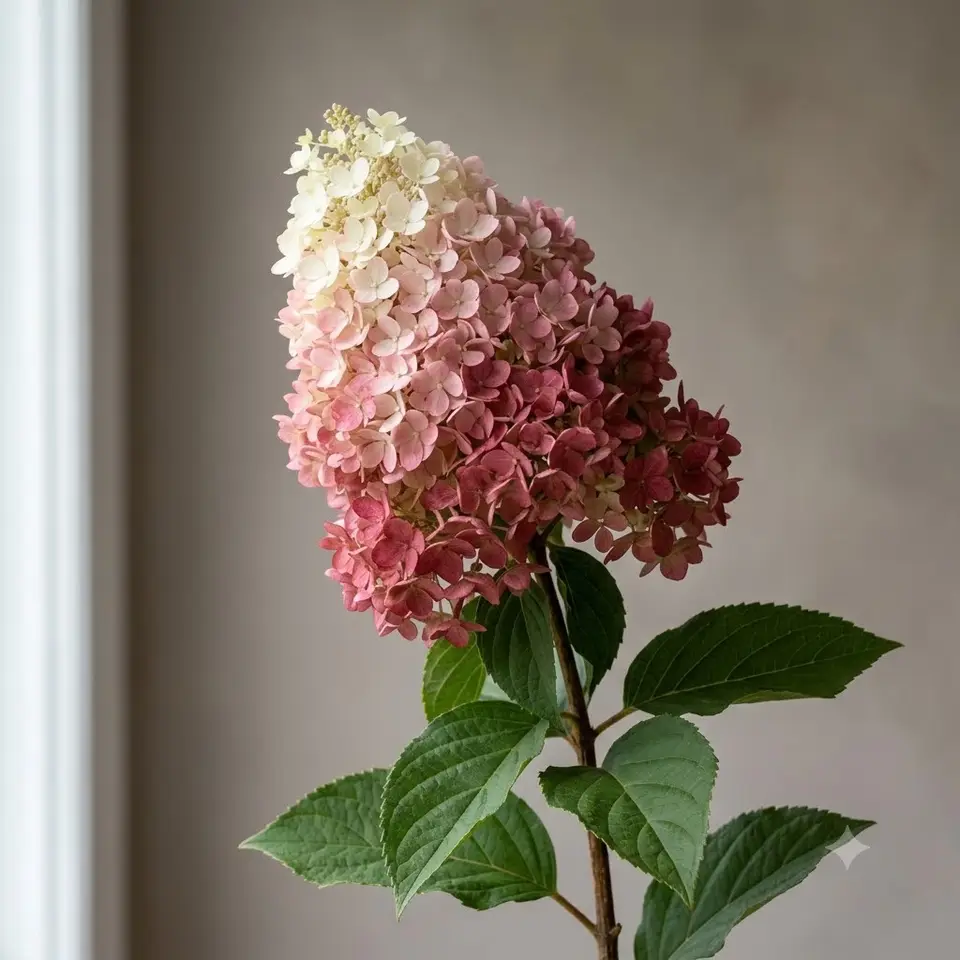
Vanilla Strawberry is a panicle hydrangea grown for large cone-shaped flower clusters that open creamy vanilla-white and slowly ripen to soft pink and deep strawberry red, so a single shrub can show all three colours at once in late summer (Hydrangea paniculata 'Renhy').
Last reviewed: October 2026
 AI illustration
 Overview
Vanilla Strawberry is a panicle hydrangea grown for large cone-shaped flower clusters that open creamy vanilla-white and slowly ripen to soft pink and deep strawberry red, so a single shrub can show all three colours at once in late summer (Hydrangea paniculata 'Renhy'). Unlike the mophead types, its colour change comes from the ageing of the blooms rather than soil chemistry, and it is far tougher in cold climates.
Origin & Background
The genus Hydrangea is native to eastern and southern Asia and the Americas, with the panicle hydrangea (Hydrangea paniculata) growing wild across China, Korea, Japan and the Russian Far East. This particular cultivar was bred in France by nurseryman Jean Renault, registered under the name 'Renhy' and introduced to gardens around 2010 under its Vanilla Strawberry trade name; it quickly became popular for the two-tone effect of its ageing flower heads.
Appearance
The flowers are held in dense, upright panicles roughly 15 to 20 cm long that open a clean creamy white in mid-summer. As they mature the lower florets flush pink and then deepen to a rich strawberry red, while fresh white panicles keep opening above them, giving the plant a layered pink-and-cream look. It forms a rounded, multi-stemmed shrub about 1.8 to 2.1 m tall and 1.2 to 1.5 m wide, with reddish stems and dark green leaves. In autumn the foliage takes on yellow tones and the spent blooms dry to a warm tan that can be left on the plant for winter interest.
Why People Grow It - Qualities & Benefits
- Long season of colour, with flower heads shifting from white to pink to red over many weeks
- Very cold hardy and reliable, blooming on new wood so late frosts rarely ruin the show
- More sun-tolerant and lower-fuss than bigleaf hydrangeas
- Cut and dried flowers hold their colour well for indoor arrangements
Care
Light: Full sun to part shade. It flowers best with at least six hours of direct sun, though afternoon shade is welcome in hot southern gardens. Water: Moderate and consistent. Keep the root zone evenly moist, especially through the first two seasons and during summer heat; it is not truly drought-proof. Soil: Adaptable but happiest in fertile, moisture-retentive, well-drained soil that is slightly acidic to neutral. Note that its flower colour does not shift with soil pH; that acid-blue to alkaline-pink effect belongs to bigleaf hydrangea (Hydrangea macrophylla), and here the pink-to-red change is simply the blooms ageing. Hardiness: USDA zones 4 to 8. Bloom or Season: Mid-summer into autumn, with the display lasting from roughly July through September as new panicles keep opening. Extra: Because it flowers on the current year's growth, prune in late winter or early spring to shape and encourage larger heads. The one common quirk is that heavy panicles can nod or flop after rain, so give it room or light support. Note for pet owners: hydrangea is toxic to cats, dogs and horses, so site it where curious animals are unlikely to chew the leaves or flowers.
Planting & Propagation
Plant in spring or autumn in a hole as deep as the root ball and twice as wide, setting the crown level with the surrounding soil, then water in well and mulch to conserve moisture. Propagate named cultivars vegetatively rather than from seed, since seedlings will not come true. Take softwood cuttings from non-flowering shoots in early summer, or hardwood cuttings in autumn, and root them in a gritty, free-draining mix. Simple layering also works well: bend a low, flexible stem to the ground, nick the underside, pin it down and cover with soil, then separate it once roots form.
Common Problems & Pests
- Powdery mildew and leaf spot in humid, crowded or poorly ventilated sites
- Aphids and spider mites, usually a minor issue treated with a strong water spray or insecticidal soap
- Flopping stems and leaf scorch, caused by heavy wet blooms, drought stress or too much harsh afternoon sun
Toxicity & Safety
Hydrangea is toxic to cats, dogs and horses. The leaves and flowers contain a cyanogenic glycoside, and when chewed or swallowed in quantity it can cause vomiting, diarrhoea and lethargy. Serious poisoning is uncommon because the bitter taste discourages large meals, but it is sensible to plant it away from pets that graze or nibble, and to contact a vet if you suspect ingestion.
Pros & Cons
Pros
- Reliable, long-lasting colour that changes through the season
- Cold hardy and easy to grow, flowering dependably each year
Cons
- Large panicles can flop after rain without support
- Toxic to cats, dogs and horses if eaten
Best Suited For
- Cold-climate gardeners who want a big, dependable summer-to-autumn bloomer
- Mixed borders, hedges and cutting gardens where a tall, colourful shrub earns its space
FAQ
Do I need to change the soil to get the pink and red colours?
No. The colour shift from white to pink to strawberry red happens naturally as the flowers age. That is different from bigleaf hydrangeas, whose blue-to-pink colour really does depend on soil pH.
When and how hard should I prune it?
Prune in late winter or early spring before new growth starts. Because it blooms on new wood, you can cut stems back by about a third to build a strong framework and encourage bigger flower heads without losing that year's blooms.
Gear for growing vanilla strawberry hydrangea
Links go to Amazon or a partner store (such as Adagio Teas) and may earn us a commission at no extra cost to you. As an Amazon Associate we earn from qualifying purchases. We link gear types, not sponsors' picks: you choose the exact product.