Waterfall Japanese Maple
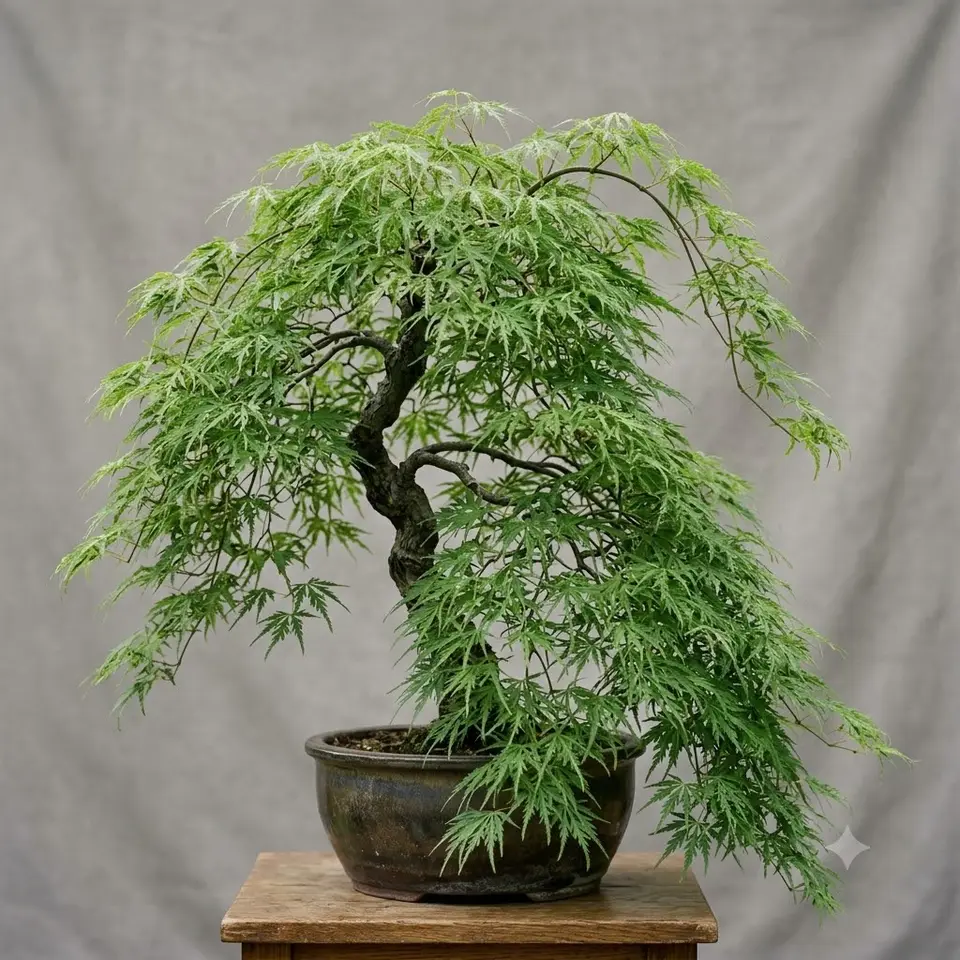
'Waterfall' is a green laceleaf Japanese maple prized for its strongly weeping habit and finely dissected, thread-like foliage that cascades in overlapping layers, much like falling water (Acer palmatum 'Waterfall').
Last reviewed: September 2026
 AI illustration
 Overview
'Waterfall' is a green laceleaf Japanese maple prized for its strongly weeping habit and finely dissected, thread-like foliage that cascades in overlapping layers, much like falling water (Acer palmatum 'Waterfall'). It is a dissectum-type cultivar, meaning each leaf is cut so deeply that the lobes look almost lace-like, and its spring-to-summer colour stays a clean, bright green rather than the reds of the purple-leaf forms. This combination of a fountain-like silhouette and vivid autumn colour makes it one of the more reliable green weeping maples for a focal position.
Origin & Background
The species Acer palmatum is native to Japan, Korea, and parts of China, where it grows as an understorey tree in cool, humid woodlands. Centuries of selection by Japanese and later Western nurseries produced hundreds of named cultivars, and 'Waterfall' belongs to the dissectum (laceleaf) group of these selections. It has long been grown in the nursery trade as a green, vigorous weeping form and is valued as one of the sturdier and faster-establishing laceleaf maples.
Appearance
'Waterfall' forms a low, dome-shaped mound of gracefully cascading branches, typically reaching around 2.5 to 3 m tall and often a little wider than it is high after many years, though its final height depends heavily on how the leader is trained when young. The leaves are deeply dissected into seven to nine narrow, feathery lobes, emerging and holding a fresh mid-green through spring and summer. Small reddish-purple flowers appear in spring and are followed by paired winged seeds (samaras), both more of botanical interest than a display. In autumn the foliage shifts to bright gold and yellow, often flushed with orange and crimson, giving a strong seasonal finish before leaf drop reveals the tiered, weeping branch structure in winter.
Why People Grow It - Qualities & Benefits
- Elegant, fountain-like weeping form that works as a living sculpture or focal point
- Bright green summer foliage that is cooler and more restful than the purple-leaf maples
- Reliable autumn display in shades of gold, orange, and crimson
- Compact, slow-spreading habit that suits smaller gardens, courtyards, and large containers
Care
Light: Prefers dappled shade or morning sun with afternoon shade; the fine laceleaf foliage scorches in hot, direct afternoon sun. Water: Needs consistent, even moisture, especially while establishing; never let the root zone dry out fully, but avoid waterlogging. Soil: Moist but well-drained, humus-rich soil that is slightly acidic, roughly pH 5.5 to 6.5. Hardiness: USDA zones 5 to 8. Bloom or Season: A foliage plant across spring and summer in green, with peak interest from its gold-to-crimson autumn colour and its bare, cascading winter branch structure. Extra: As a weeping laceleaf, it needs its leader staked and trained upright while young to gain height, or it stays a low mound; without training it naturally spreads sideways. Non-toxic to cats and dogs.
Planting & Propagation
Plant in a sheltered spot out of strong wind and harsh afternoon sun, setting the graft union at or just above soil level in well-drained ground, then mulch to keep the roots cool and moist. Like most dissectum cultivars, 'Waterfall' does not come true from seed and is propagated by grafting onto Acer palmatum seedling rootstock; hobbyists sometimes attempt layering, but grafting is the standard commercial method. Spring or early autumn planting gives roots time to settle before summer heat or hard frost.
Common Problems & Pests
- Leaf scorch and crisping of the fine foliage in too much sun, wind, or dry soil
- Verticillium wilt, a soil-borne fungal disease that can cause branch dieback
- Aphids, scale insects, and occasional mites on stressed or crowded plants
Toxicity & Safety
Non-toxic to cats and dogs. Acer palmatum is not listed as toxic to pets by the ASPCA, so a browsing dog or cat is not expected to be poisoned by contact with or nibbling on this maple.
Pros & Cons
Pros
- Distinctive weeping, cascading shape that anchors a planting design
- Strong autumn colour on a compact, garden-friendly frame
Cons
- Fine foliage scorches easily without shelter and steady moisture
- Slow to gain height and usually needs staking and training when young
Best Suited For
- Focal points in small gardens, courtyards, entryways, and large decorative containers
- Gardeners who can offer a sheltered, part-shade site with reliably moist, well-drained soil
FAQ
How big does Waterfall Japanese Maple get?
Expect roughly 2.5 to 3 m tall over many years, often a little wider than tall, with the final height strongly influenced by how the young leader is staked and trained.
Why are the leaf tips going brown and crispy?
That is usually leaf scorch from too much direct sun, drying wind, or inconsistent watering. Move it to a more sheltered, part-shade position and keep the soil evenly moist with a cool mulch layer.
Gear for growing waterfall japanese maple
Links go to Amazon or a partner store (such as Adagio Teas) and may earn us a commission at no extra cost to you. As an Amazon Associate we earn from qualifying purchases. We link gear types, not sponsors' picks: you choose the exact product.