Multi Blue Clematis
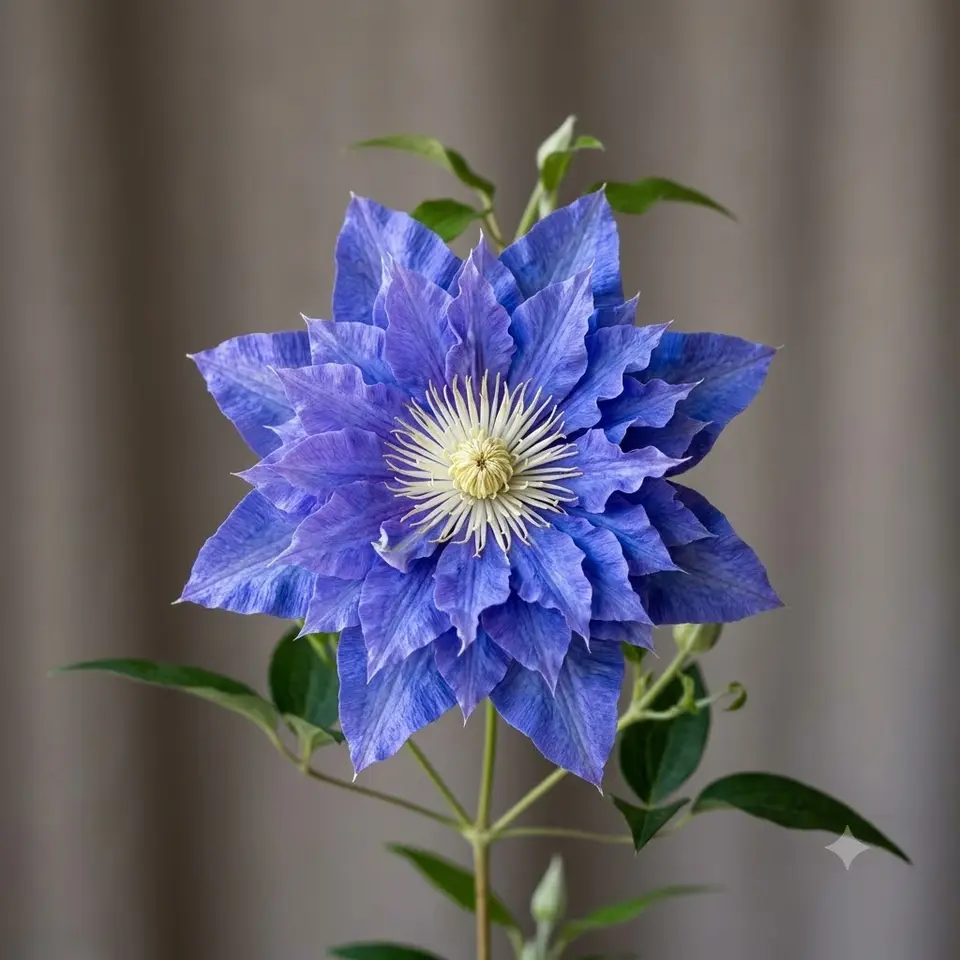
Multi Blue is a large-flowered climbing clematis grown for its unusual double bloom, where a ruff of broad outer tepals surrounds a dense, spiky pompom of shorter blue-violet petaloid segments (Clematis 'Multi Blue').
Last reviewed: July 2026
 AI illustration
 Overview
Multi Blue is a large-flowered climbing clematis grown for its unusual double bloom, where a ruff of broad outer tepals surrounds a dense, spiky pompom of shorter blue-violet petaloid segments (Clematis 'Multi Blue'). The layered, almost dahlia-like flower holds its shape for a long time and sets this cultivar apart from single-flowered blues. It is a compact, well-behaved climber that suits containers and small supports as readily as a garden fence.
Origin & Background
The genus Clematis is widespread across the temperate Northern Hemisphere, with species native to Europe, Asia and North America, and many climbers tracing back to Chinese and Japanese parentage. 'Multi Blue' arose as a sport (a spontaneous mutation) of the classic cultivar 'The President', selected in the Netherlands and introduced in the 1980s. It inherited that parent's vigour and rich colouring while producing its distinctive multi-layered, semi-double to double flowers.
Appearance
The flowers are deep blue to violet-blue, ageing to softer lavender-mauve tones as they mature. Each bloom is roughly 10 to 15 cm across and built from a flat outer collar of pointed tepals cradling a raised central boss of many narrow, spiky inner segments, giving a distinctly tufted, two-tier look. The main flush comes in late spring to early summer on the previous year's growth, often with a lighter repeat in late summer; second-flush blooms can appear more single. Mature plants reach about 1.8 to 2.4 m tall with a spread near 0.9 m, staying relatively compact. Fluffy seed heads may follow the flowers, and the plant dies back before returning in spring.
Why People Grow It - Qualities & Benefits
- Striking double flowers with a long-lasting, sculptural pompom centre rare among blue clematis
- Compact habit that thrives in large containers, on obelisks and against low fences or trellis
- Two flushes of bloom in a good season for extended colour
- Rich blue-violet tone that pairs well with roses, silver foliage and pale-flowered climbers
Care
Light: Full sun to partial shade; flowers best with at least half a day of sun while the roots stay cool and shaded. Water: Keep the soil consistently moist, especially in the first two seasons and during dry spells; never let it dry out completely. Soil: Fertile, humus-rich, well-drained soil that stays cool; near-neutral, slightly alkaline to slightly acidic pH suits it well. Hardiness: USDA zones 4 to 9. Bloom or Season: Main display late spring to early summer, with a lighter repeat in late summer to early autumn. Extra: This is a pruning group 2 clematis, so prune only lightly in late winter, removing dead and weak stems and shaping above a strong pair of buds to protect the early double flowers borne on old wood. Note for pet owners: clematis is toxic to cats and dogs, so keep pruned stems and curious pets apart.
Planting & Propagation
Plant in spring or autumn, setting the crown about 5 to 8 cm below the soil surface to encourage strong basal shoots and guard against clematis wilt, and shade the root zone with mulch, a slab or low planting. Give it a support to twine onto from the start. Being a named cultivar, it will not come true from seed, so propagate by semi-hardwood cuttings taken in early to mid summer or by layering a low stem into the ground and detaching it once rooted.
Common Problems & Pests
- Clematis wilt, a fungal dieback that can collapse stems suddenly; cut affected growth back to healthy tissue and it often recovers from the buried crown
- Aphids and earwigs, which can distort young shoots and nibble buds
- Powdery mildew and slug or snail damage to soft new growth in damp, crowded conditions
Toxicity & Safety
Clematis 'Multi Blue' is toxic to cats and dogs. Its sap contains protoanemonin, an irritant compound released when the plant is chewed or crushed. Ingestion can cause drooling, mouth and throat irritation, vomiting and diarrhoea. In practice the reaction is usually mild, because the bitter, burning taste discourages animals from eating much. Wear gloves if the sap irritates your skin, and if a pet has eaten a significant amount or seems unwell, contact a veterinarian.
Pros & Cons
Pros
- Unusual, long-lasting double flowers in a desirable deep blue
- Compact and container-friendly, easy to place in small gardens
Cons
- Group 2 pruning and correct planting depth take a little know-how
- Vulnerable to clematis wilt and needs cool, moist roots to perform
Best Suited For
- Gardeners wanting a showy climber for a patio pot, obelisk or small trellis
- Mixed borders and cottage-style schemes where it can scramble through roses or shrubs
FAQ
Why are some of my Multi Blue flowers single rather than double?
The fully double, pompom-centred blooms form on old wood in the first flush. Later flowers on new growth are often single or semi-double, which is normal for this cultivar.
How hard should I cut it back?
Treat it as pruning group 2: in late winter just tidy dead and weak stems and cut back to a strong pair of buds. Hard pruning would remove the old wood that carries the best double flowers.
Gear for growing multi blue clematis
Links go to Amazon or a partner store (such as Adagio Teas) and may earn us a commission at no extra cost to you. As an Amazon Associate we earn from qualifying purchases. We link gear types, not sponsors' picks: you choose the exact product.