Jackmanii Clematis
Jackmanii is the classic large-flowered purple clematis, prized for its saucer-sized, velvety violet-purple blooms that smother the vine through summer (Clematis 'Jackmanii').
Last reviewed: September 2026
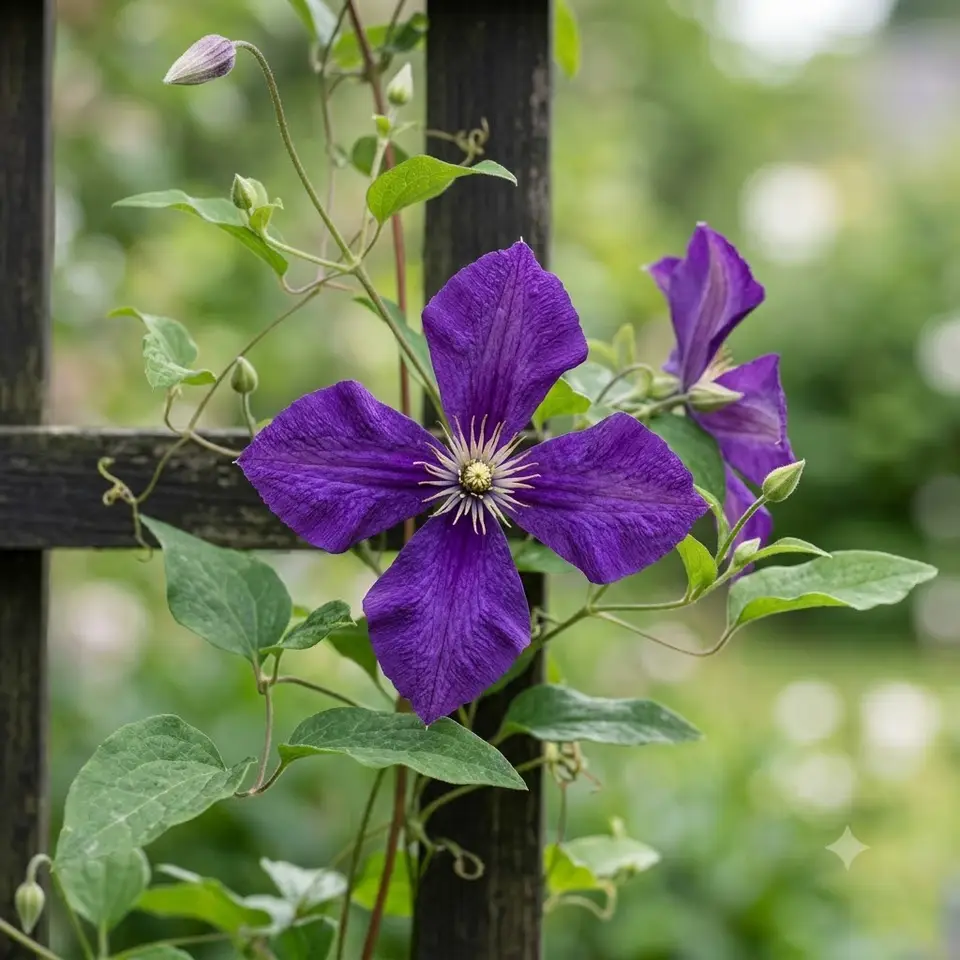 AI illustration
 Overview
Jackmanii is the classic large-flowered purple clematis, prized for its saucer-sized, velvety violet-purple blooms that smother the vine through summer (Clematis 'Jackmanii'). As the first large-flowered clematis hybrid ever raised, it remains one of the most widely grown and most forgiving climbers in the group. Its combination of vigour, colour saturation and simple pruning makes it a benchmark that newer cultivars are still measured against.
Origin & Background
The genus Clematis is broadly distributed across the temperate Northern Hemisphere, with many species native to China, Japan, the Himalayas, Europe and North America. This particular plant is a garden hybrid, not a wild species: it was raised by the nursery of George Jackman and Son in Woking, England, from a cross involving Clematis lanuginosa and forms of Clematis viticella. It first flowered in 1862 and was introduced to gardens in 1863, launching the whole class of large-flowered clematis.
Appearance
Jackmanii produces flowers roughly 10 to 13 cm across, usually with four broad, slightly overlapping sepals that have a soft, velvety texture and a subtly ribbed centre. The colour is a deep, rich violet-purple that can read almost blue-purple in cool light and fades gently to a softer mauve as each bloom ages; the flowers carry little to no scent. It blooms heavily from early summer into early autumn, roughly June to September, flowering on the current season's growth. As a twining climber it reaches about 2.5 to 3.7 m tall with a spread of around 1 to 1.5 m, dying back and being cut down each winter before flushing again in spring.
Why People Grow It - Qualities & Benefits
- Long, generous flowering period that covers midsummer, when many climbers pause
- Intense, saturated purple colour that works with almost any planting scheme
- Vigorous enough to clothe an arch, obelisk, fence or trellis in a single season
- Simple, beginner-friendly pruning (a single hard cut in late winter)
Care
Light: Full sun to partial shade on the top growth; it flowers best with at least six hours of sun, but the roots prefer to stay cool and shaded. Water: Keep consistently moist, especially in the first two seasons and during dry spells; never let it dry out fully at the root, but avoid waterlogging. Soil: Fertile, humus-rich, moisture-retentive but well-drained soil; neutral to slightly alkaline pH is ideal. Hardiness: USDA zones 4 to 8. Bloom or Season: Summer flowering, roughly June to September, over a long stretch of several weeks to a few months. Extra: This is a Pruning Group 3 (hard-prune) clematis: cut all stems back to around 20 to 30 cm above the ground in late winter or very early spring, since it blooms on new growth. Shade the root zone with mulch or a low companion plant to keep the roots cool. Note for pet owners: clematis is toxic to cats and dogs, so site it where pets are unlikely to chew the stems.
Planting & Propagation
Plant in spring or autumn, setting the crown about 5 to 8 cm deeper than it sat in its pot to encourage strong basal shoots and to help the plant recover if wilt strikes. Give it a support to twine onto and water it in well. Being a named hybrid, it does not come true from seed, so propagate it vegetatively: take semi-hardwood cuttings in summer, or peg down a low stem to layer it into the soil in summer and lift the rooted section the following season.
Common Problems & Pests
- Clematis wilt, a fungal problem that can cause whole stems to collapse suddenly; cut affected growth back to healthy tissue and the plant usually recovers
- Powdery mildew in humid, crowded conditions
- Aphids on soft new shoots, and slugs, snails and earwigs grazing emerging spring growth
Toxicity & Safety
Jackmanii clematis is toxic to cats and dogs. Its sap contains protoanemonin, an irritant compound; if a pet chews the leaves or stems it can cause drooling, mouth and throat irritation, vomiting and diarrhoea. Cases are usually mild, because the bitter, acrid taste discourages animals from eating much. It is sensible to plant it out of easy reach and to rinse any sap off skin after pruning.
Pros & Cons
Pros
- Reliable, long-lasting summer colour with very little fuss
- Easy Group 3 pruning that suits beginners
Cons
- Bare and unremarkable in winter after its hard cut-back
- Susceptible to clematis wilt and toxic to pets
Best Suited For
- Beginners who want a dependable, high-impact flowering climber
- Covering arches, pergolas, fences, obelisks and trellises, or scrambling through larger shrubs
FAQ
How and when should I prune Jackmanii?
It is a Group 3 clematis, so prune hard in late winter or early spring, cutting every stem down to a pair of strong buds about 20 to 30 cm from the ground. It flowers on new growth, so this yearly reset keeps it tidy and floriferous.
Why are the roots kept shaded while the flowers need sun?
Clematis performs best with "cool feet and a sunny head". Shaded, cool roots reduce stress and support steady growth, while the top growth needs plenty of sun to flower well. A mulch or a low leafy companion plant over the root zone achieves this.
Gear for growing jackmanii clematis
Links go to Amazon or a partner store (such as Adagio Teas) and may earn us a commission at no extra cost to you. As an Amazon Associate we earn from qualifying purchases. We link gear types, not sponsors' picks: you choose the exact product.