Japanese Forest Grass
Japanese Forest Grass is an ornamental grass for shade: a slow, elegant cascade of bamboo-like leaves that pours over walls, pots and path edges like green (or gold) water.
Last reviewed: October 2026
 AI illustration
 Overview
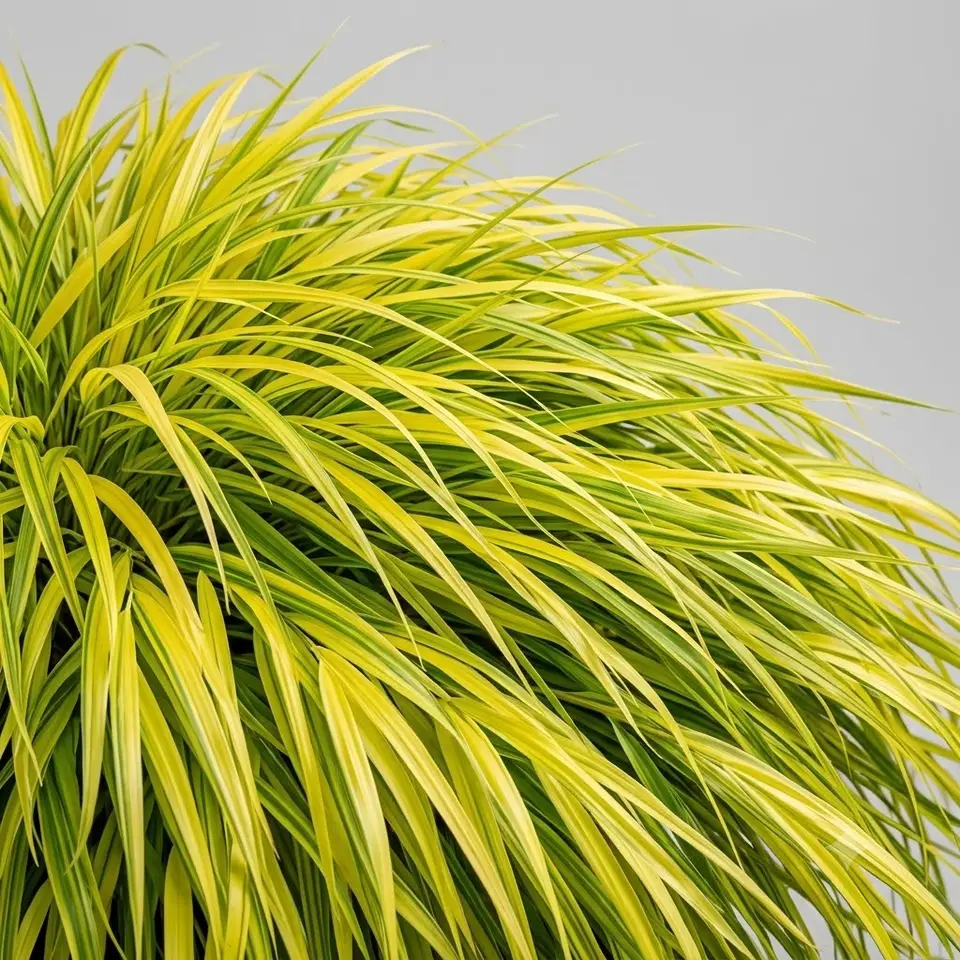
Japanese Forest Grass is an ornamental grass for shade: a slow, elegant cascade of bamboo-like leaves that pours over walls, pots and path edges like green (or gold) water. Where every other grass demands sun, hakone grass turns the dark side of the garden into its stage. (Hakonechloa macra.)
Origin & Natural Habitat
Moist mountain forests around Mount Hakone, Japan, growing on shaded rocky slopes. Hardy zones 5-9. The gold form 'Aureola' is among the most awarded perennials ever.
Appearance
A gracefully mounding cascade 25-45 cm tall, spreading slowly to 60+ cm; leaves all sweep one direction like combed hair. 'Aureola' is gold-striped, 'All Gold' pure chartreuse, the species deep green; all blush pink-bronze in autumn.
Why People Grow It - Qualities & Benefits
- The premier grass for shade: genuinely rare trait
- Liquid, flowing habit no other plant imitates
- Gold forms light up dark corners like lamps
- Slow, polite, never invasive
Care
Light: Morning sun or bright shade is ideal; deep shade thins gold to lime (still lovely); hot afternoon sun scorches.
Water: Consistent moisture - this is a woodlander, not a prairie plant; mulch and don't let it bake dry.
Soil: Rich, humusy, moist but drained - treat it like a hosta, not like a fescue.
Temperature & Hardiness: Zones 5-9; fully hardy, dying to the ground each winter.
Feeding: Spring compost or a light balanced feed - one of the few grasses that appreciates it.
Maintenance: Cut old foliage away in late winter. Then wait: hakone is famously slow to establish - 'sleep, creep, leap' over three years. Superb in containers, where it earns its price fastest.
Planting & Propagation
Division in spring - the shallow rhizome mat lifts and splits easily (the one easy thing about it). Slow from division to display; patience is the currency.
Common Problems & Pests
- Scorch in hot afternoon sun or drought
- Slowness mistaken for failure in years 1-2
- Practically pest-free otherwise: deer included
Toxicity & Safety
Non-toxic to dogs and cats - safe for shaded pet gardens.
Pros & Cons
Pros
- Thrives where grasses can't
- Unmatched flowing elegance
- Brilliant container plant
- Deer-proof, disease-free
Cons
- Slow and initially expensive
- Needs real moisture
- Full hot sun is off the table
Best Suited For
- Shaded borders with hostas and ferns
- Cascading over walls and steps
- Japanese-style and courtyard gardens
- Premium containers in shade
FAQ
Why is my gold hakone turning green-lime?
Too much shade - the gold saturates with a few hours of gentle morning sun. Full deep shade keeps it chartreuse-lime; scorched white-brown means too MUCH sun.
It's barely grown in a year - is it failing?
No - hakone's first two seasons happen underground. Year three is the leap; container culture shows results faster.
Can I grow it in full sun?
In cool northern climates with steady moisture, 'All Gold' can - elsewhere afternoon sun burns it. Shade is the assignment.
Gear for growing japanese forest grass
Links go to Amazon or a partner store (such as Adagio Teas) and may earn us a commission at no extra cost to you. As an Amazon Associate we earn from qualifying purchases. We link gear types, not sponsors' picks: you choose the exact product.