Honka Dahlia
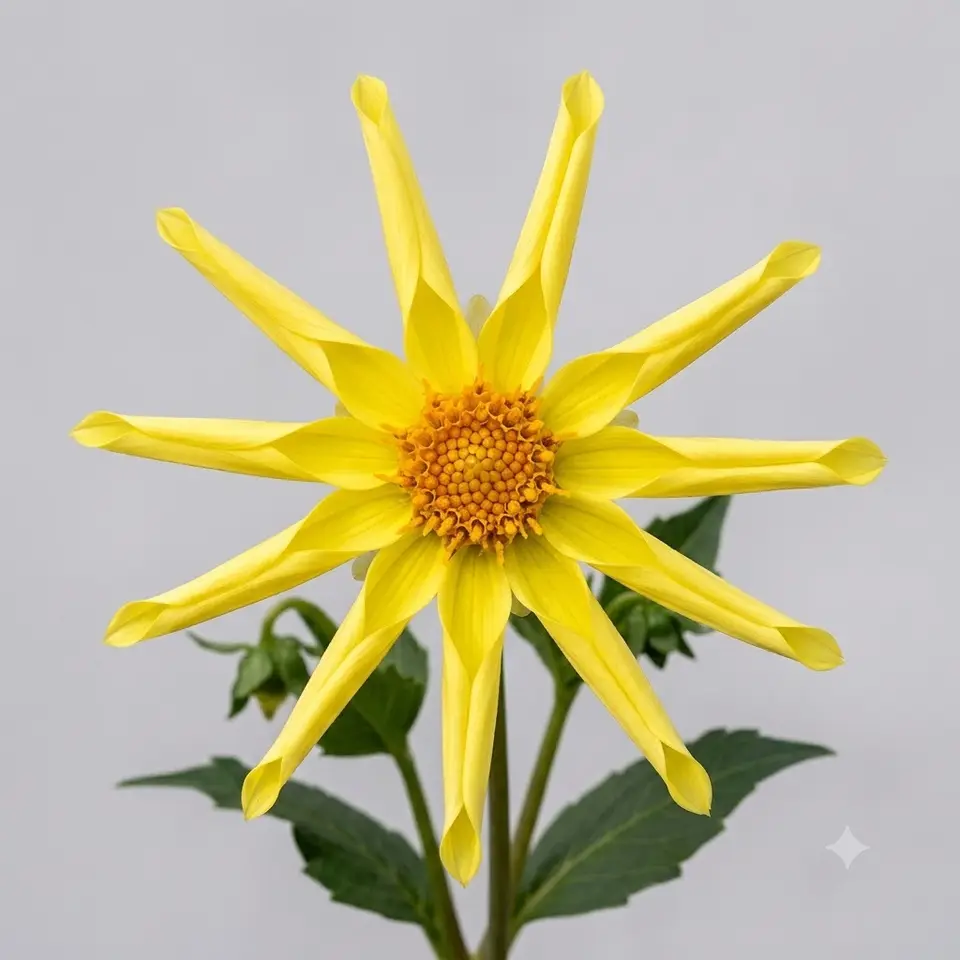
Honka is a star- or orchid-flowering dahlia grown for its clean, uncluttered single blooms, each formed from eight narrow, pointed ray florets that roll inward at the edges to create a crisp star shape.
Last reviewed: September 2026
 AI illustration
 Overview
Honka is a star- or orchid-flowering dahlia grown for its clean, uncluttered single blooms, each formed from eight narrow, pointed ray florets that roll inward at the edges to create a crisp star shape. The classic form is a bright, warm yellow with a small central disc, giving it an airy, almost daisy-like look that stands apart from the dense pompon and dinnerplate dahlias (Dahlia 'Honka'). Its open face is unusually good for pollinators and gives arrangements a wild, spidery texture.
Origin & Background
The garden dahlia descends from wild species native to the highlands of Mexico and parts of Central America, where the genus grows in seasonally dry, well-drained mountain soils; the dahlia is Mexico's national flower. 'Honka' belongs to the star or orchid-flowering group and is an established heirloom-style cultivar that has since anchored a small family of sports and selections sold under the Honka name (including pink, red, white and bicolour forms). Precise breeder records for the original yellow selection are not well documented, so it is best described honestly as a long-circulating star dahlia rather than a recent patented release.
Appearance
Honka forms an upright, bushy plant with mid-green, divided foliage, typically reaching 90 to 120 cm tall and spreading 45 to 60 cm. Each flower is a single, open star roughly 8 to 10 cm across, built from eight slender, pointed ray florets that curl at the margins, in clear yellow around a compact golden-yellow central disc. Blooms are held on long, wiry stems well above the leaves, appearing from mid or late summer and continuing until the first hard frost, with the plant growing steadily through the season and dying back to the tuber once cold arrives.
Why People Grow It - Qualities & Benefits
- Distinctive star-shaped, open flowers that read as more natural and modern than typical formal dahlias
- Long bloom run from summer to frost, especially when regularly deadheaded
- Open centres make it far more useful to bees and other pollinators than double-flowered dahlias
- Long, strong stems that cut well and add spidery movement to bouquets
Care
Light: Full sun, at least 6 to 8 hours daily, for strong stems and heavy flowering. Water: Moderate and consistent; deep watering once or twice a week in dry spells, avoiding waterlogging. Soil: Rich, fertile, well-drained loam with plenty of organic matter; slightly acidic to neutral pH around 6.5 to 7.0. Hardiness: USDA zones 8 to 11, where tubers can overwinter in the ground; in zone 7 and colder they are lifted and stored, or grown as annuals. Bloom or Season: Mid or late summer through to the first frost, often 8 to 12 weeks of continuous flowering with deadheading. Extra: Tall stems flower heavily and can flop, so stake or support plants early. Note that dahlias, including Honka, are mildly toxic to cats and dogs, so site and store tubers where pets cannot chew them.
Planting & Propagation
Plant tubers in spring after the last frost, setting them 10 to 15 cm deep with the growing eye facing up in a sunny, well-drained spot, and space plants about 45 to 60 cm apart. Named cultivars like Honka do not come true from seed, so propagate by lifting and dividing the tuber clumps in autumn or early spring, making sure each division carries a piece of the old stem with a visible eye; basal cuttings taken from sprouting tubers in spring are another reliable way to increase stock. In cold zones, lift tubers after the first frost blackens the foliage, dry them briefly, and store them cool, dark and frost-free over winter.
Common Problems & Pests
- Slugs and snails shredding young shoots in spring, plus aphids clustering on soft new growth
- Earwigs and thrips chewing petals and distorting buds, marring the clean flower shape
- Powdery mildew and tuber or crown rot in damp, poorly drained conditions or overwatered soil
Toxicity & Safety
Honka, like all dahlias, is mildly toxic to cats and dogs. Ingestion of leaves, stems or tubers can cause mild gastrointestinal upset such as drooling, vomiting or diarrhoea, and contact with the milky sap may cause mild skin irritation or dermatitis in sensitive pets and people. Reactions are usually mild and self-limiting, but keep pets from grazing on plants and wear gloves if you are prone to skin sensitivity when dividing tubers or cutting stems.
Pros & Cons
Pros
- Elegant, unusual star flowers on long cutting stems
- Pollinator-friendly open centres and a long blooming season
Cons
- Needs staking, deadheading and, in cold zones, annual lifting and storage
- Mildly toxic to pets and vulnerable to slugs, earwigs and rot
Best Suited For
- Cut-flower gardeners and cottage or pollinator borders wanting a lighter, wilder dahlia
- Growers in zones 8 to 11, or colder-zone gardeners willing to lift and store tubers each winter
FAQ
Is Honka a single or double dahlia?
It is a single, star or orchid-flowering type, with just one ring of eight rolled, pointed petals around an open central disc, which is why it looks airier than dense double dahlias.
Do I have to dig up the tubers every year?
Only in cold climates. In USDA zones 8 to 11 the tubers can stay in well-drained ground over winter, but in zone 7 and colder you should lift, dry and store them frost-free, then replant in spring.
Gear for growing honka dahlia
Links go to Amazon or a partner store (such as Adagio Teas) and may earn us a commission at no extra cost to you. As an Amazon Associate we earn from qualifying purchases. We link gear types, not sponsors' picks: you choose the exact product.