'Iceberg' Rose
'Iceberg' is a white floribunda bred by Reimer Kordes in Germany and introduced in 1958 as 'Schneewittchen', a name taken from the fairy tale.
Last reviewed: October 2026
 AI illustration
 Overview
'Iceberg' is a white floribunda bred by Reimer Kordes in Germany and introduced in 1958 as 'Schneewittchen', a name taken from the fairy tale. The World Federation of Rose Societies describes it as very floriferous, with large masses of white blooms through the season, and added it to its Rose Hall of Fame in 1983. (Rosa 'Iceberg' (Schneewittchen), floribunda.)
Origin & Natural Habitat
Its parents are 'Robin Hood', a red hybrid musk bred by Joseph Pemberton in England in 1927, and 'Virgo', a white hybrid tea bred by Charles Mallerin in France; NC State Extension gives the same pair. Kordes registered it as 'KORbin', and in France it is 'Fée des Neiges'. It won a Royal National Rose Society Gold Medal in 1958. The German ADR title it received in 1960 was withdrawn in 2004, because white varieties with similar qualities and less susceptibility to powdery mildew and black spot had appeared. The RHS notes that it was shortlisted for the Chelsea Plant of the Centenary for the decade 1953-1962.
Appearance
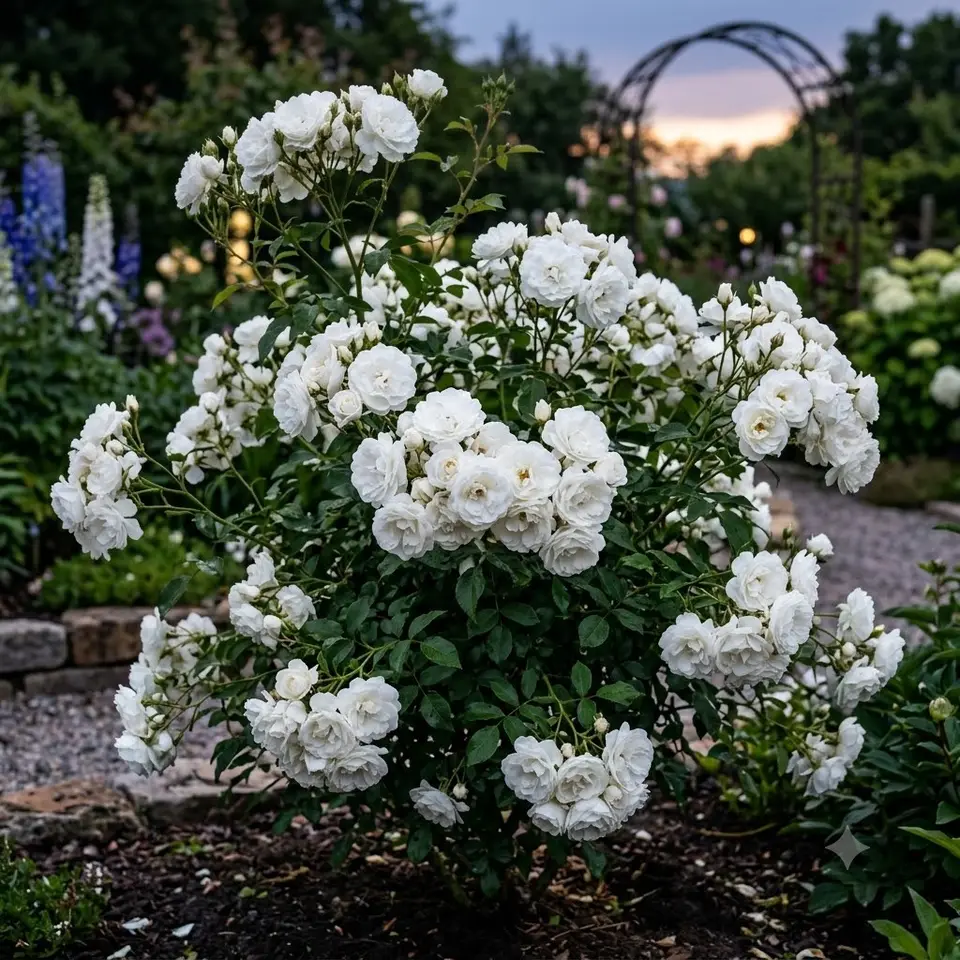
NC State Extension describes semi-double white flowers 2-3 inches across with 20-40 petals, sometimes tinged pink as they open, in clusters on long stems from long, pointed buds; the leaves are glossy and the canes have few prickles. Wikipedia gives a usual size of about 1.2 metres high and 1 metre wide, reaching 2 metres in hot climates, while the RHS lists 0.5-1 metres in British gardens.
Why People Grow It - Qualities & Benefits
- Large masses of white flowers through the season
- Tough leaves that, in the words of the WFRS, help it resist many diseases
- Bush, standard and climbing forms
- Few prickles on the canes
Care
Light: Full sun is best; Wikipedia and NC State Extension say it tolerates partial shade.
Water: A mulch holds moisture in and keeps weeds down, as NC State Extension advises. Black spot appears in humid climates and where air circulation is limited (Wikipedia), so space plants well and water at soil level.
Soil & Feeding: NC State Extension plants it in well-drained, fertile soil, and the RHS lists chalk, clay, loam and sand. The rose page describes feeding.
Temperature & Hardiness: Weeks Roses lists zones 4b-9b, and Wikipedia says it can be grown in USDA zones 4b and higher. RHS hardiness: H6. In Australia it suits all but the northern tropical areas.
Pruning & Maintenance: In late winter NC State Extension removes dead and diseased canes and, if needed, prunes it to 1/3 its size or more. The RHS places it in pruning group 16, with the floribundas. Lightly pruned, Wikipedia notes, it can become a graceful shrub.
Planting & Propagation
Weeks Roses supplies it budded and on its own roots. Wikipedia notes that the bush and the standard are produced by budding and that both can be grown in large containers. The RHS lists two methods of propagation: hardwood cuttings in autumn and chip budding in summer.
Common Problems & Pests
- In humid areas, black spot, the one disease NC State Extension tells growers to watch for
- Rust and powdery mildew, both on the RHS list of diseases it may get
- Caterpillars, aphids and rose leafhopper, among the pests the RHS mentions
Toxicity & Safety
Roses are non-toxic to dogs and cats - the thorns are the only hazard.
Pros & Cons
Pros
- Very free-flowering
- Bush, standard and climber to choose from
- Hardy to zone 4b by Weeks Roses' rating
Cons
- Light scent: the RHS calls the flowers slightly fragrant and NC State Extension mild
- Black spot in humid weather
- So widely planted that Wikipedia notes claims it is "overdone"
Best Suited For
- Hedges and mass plantings, both of which Weeks Roses recommends
- White and pale color schemes
- Large containers
- Cut flowers
FAQ
Bush or climbing 'Iceberg'?
The climbing form is a sport found by Cants of Colchester in England in 1968. Weeks Roses lists it at 8-15 feet, flowering on old wood only and more freely once established, and German Wikipedia describes it as almost thornless and about 3 m tall. The bush usually stays at about 1.2 metres.
Which David Austin roses descend from it?
Wikipedia lists 'Iceberg' as a parent of several of Austin's English roses, including Graham Thomas and 'Perdita' in 1983 and 'Heritage' in 1984. The WFRS gives 'Graham Thomas' the parentage 'Charles Austin' x ('Iceberg' x seedling).
Gear for growing 'iceberg' rose
Links go to Amazon or a partner store (such as Adagio Teas) and may earn us a commission at no extra cost to you. As an Amazon Associate we earn from qualifying purchases. We link gear types, not sponsors' picks: you choose the exact product.