Frances Williams Hosta
Frances Williams is one of the most recognisable large blue hostas, prized for its heavily puckered, blue-green leaves edged with a wide, irregular band of chartreuse to golden-yellow (Hosta 'Frances Williams').
Last reviewed: September 2026
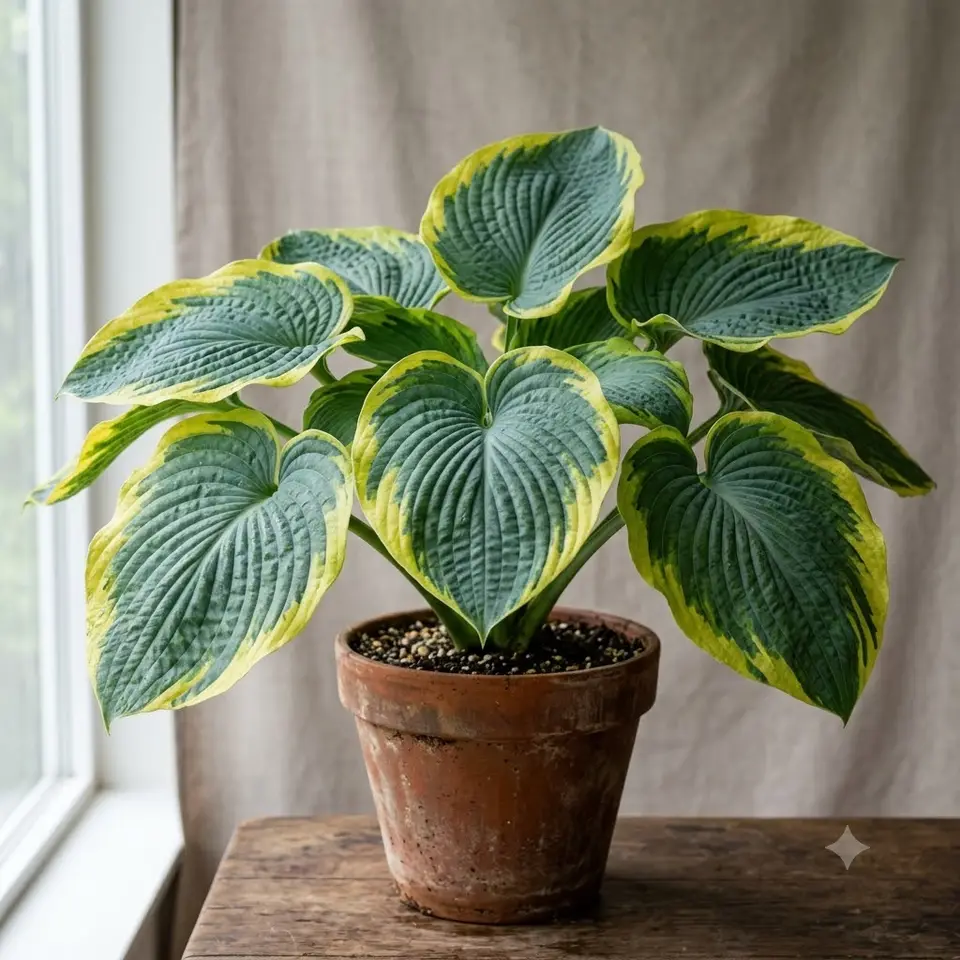 AI illustration
 Overview
Frances Williams is one of the most recognisable large blue hostas, prized for its heavily puckered, blue-green leaves edged with a wide, irregular band of chartreuse to golden-yellow (Hosta 'Frances Williams'). The strong two-tone contrast and substantial, textured foliage make it a classic anchor plant for shade gardens. It is a slow-growing, long-lived clump that can reach specimen size over several years.
Origin & Background
The genus Hosta is native to north-east Asia, mainly Japan, China, Korea and the Russian Far East, where the plants grow in woodland margins, stream banks and moist rocky slopes. Frances Williams is a naturally occurring sport of Hosta sieboldiana 'Elegans', spotted around 1936 by American gardener Frances Williams at a Connecticut nursery and later named in her honour. It was formally registered with the American Hosta Society in 1986 and has remained a staple of shade planting ever since.
Appearance
The leaves are large, broadly heart-shaped and deeply corrugated (seersuckered), with a matte blue-green to grey-green centre and a wide, uneven margin in chartreuse that deepens to gold as the season goes on. Mature clumps typically reach about 60 to 75 cm tall and spread roughly 90 to 120 cm wide, forming a bold mounded dome. In early to midsummer, short scapes carry near-white to very pale lavender bell-shaped flowers held just above or within the foliage. The blue tones are strongest in cool spring weather; the leaves hold their colour into autumn before dying back with the first hard frosts.
Why People Grow It - Qualities & Benefits
- Bold two-tone foliage that lights up shady corners without needing flowers
- Heavily textured, slug-resistant thick leaves compared with thinner-leaved hostas
- Reliable, low-maintenance perennial that returns and enlarges year after year
- Large scale makes it an excellent specimen or focal point in woodland and border plantings
Care
Light: Partial to full shade; morning sun with afternoon shade keeps colour bright, but hot direct sun scorches the yellow margins. Water: Consistent, even moisture; never let it dry out fully, especially in its first seasons and during heat. Soil: Rich, humusy, well-drained soil kept reliably moist, slightly acidic to neutral (pH about 6.0 to 7.0). Hardiness: USDA zones 3 to 8 (tolerates zone 9 in cooler microclimates). Bloom or Season: Foliage plant from spring to hard frost, with pale flowers in early to midsummer; no autumn colour, it simply melts down after frost. Extra: The wide gold margins are prone to marginal leaf scorch (often called "Frances Williams burn") in too much sun or dry heat, so siting matters. This plant is toxic to cats and dogs; the saponins it contains can cause vomiting, diarrhoea and depression if eaten.
Planting & Propagation
Plant in spring or early autumn, setting the crown level with the soil surface in enriched, moisture-retentive ground and spacing large clumps at least 90 cm apart. Water deeply after planting and mulch to conserve moisture and suppress weeds. Propagate by division in early spring as the shoots emerge (or in early autumn), slicing the crown into sections that each carry roots and several eyes, then replanting immediately and keeping well watered.
Common Problems & Pests
- Slugs and snails chew holes, though the thick leaves resist damage better than many hostas
- Deer and rabbits readily graze the foliage in unprotected gardens
- Marginal leaf burn, crown rot in soggy soil, and foliar nematodes causing brown stripes between veins
Toxicity & Safety
Frances Williams, like all hostas, is toxic to cats and dogs. The plants contain saponins, and ingestion of leaves, flowers or roots can cause vomiting, diarrhoea and depression. Signs are usually mild to moderate, but pets that nibble the foliage should be monitored, and a vet contacted if symptoms are severe or persistent.
Pros & Cons
Pros
- Striking blue-and-gold foliage that thrives where many plants struggle in shade
- Tough, thick, long-lived leaves with better slug resistance than thin-leaved hostas
Cons
- Golden margins scorch easily in sun or heat, so placement must be right
- Toxic to cats and dogs, and irresistible to deer and rabbits
Best Suited For
- Shade and woodland gardens wanting a large, colourful foliage focal point
- Gardeners in cool to temperate zones seeking a low-effort, long-lived perennial
FAQ
Why are the leaf edges turning brown or scorched?
This is "Frances Williams burn," a marginal leaf scorch triggered by too much direct sun, hot afternoon exposure or dry soil. Move or shade the plant, keep the soil evenly moist, and mulch to protect the roots.
How big will it get and how fast?
Expect a mature mound of roughly 60 to 75 cm tall and 90 to 120 cm wide, but it is slow to establish and may take four to six years to reach full specimen size.
Gear for growing frances williams hosta
Links go to Amazon or a partner store (such as Adagio Teas) and may earn us a commission at no extra cost to you. As an Amazon Associate we earn from qualifying purchases. We link gear types, not sponsors' picks: you choose the exact product.