Crimson Queen Japanese Maple
Crimson Queen is a weeping, laceleaf Japanese maple prized for holding its deep red-purple colour through the growing season better than many red-leaf cultivars, which often fade to green in summer heat (Acer palmatum var. dissectum 'Crimson Queen').
Last reviewed: September 2026
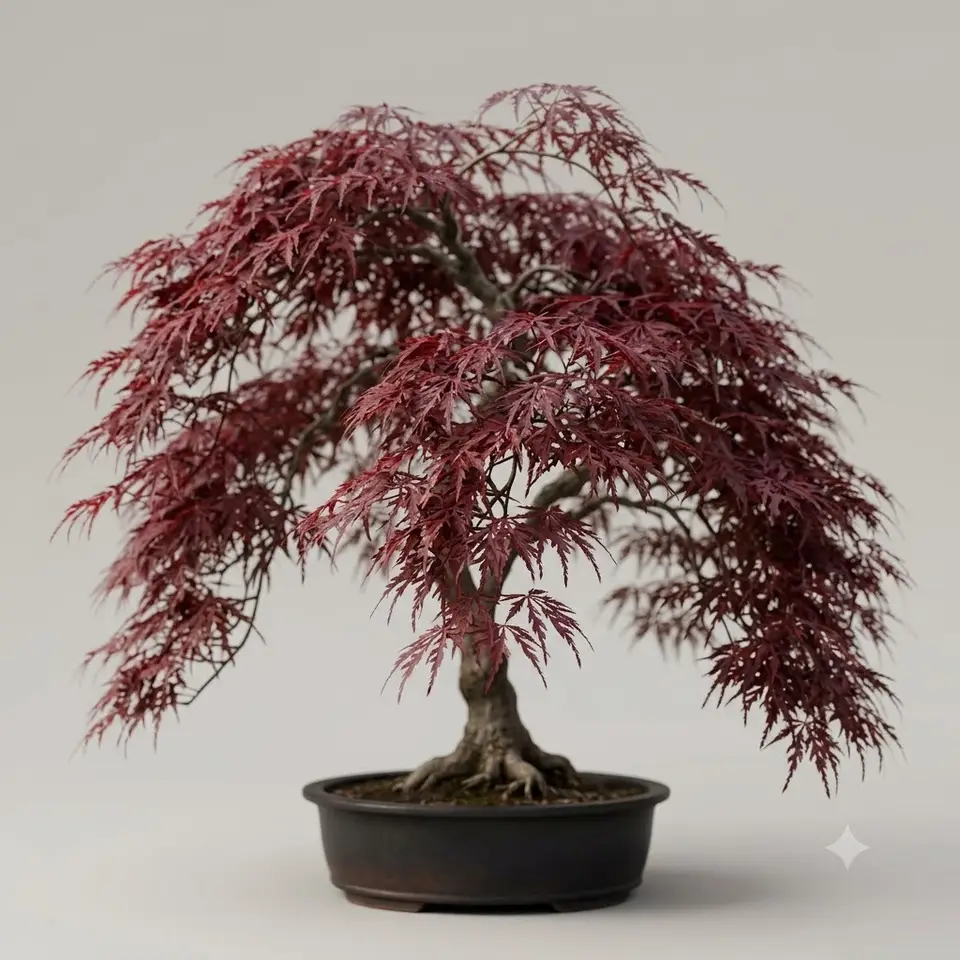 AI illustration
 Overview
Crimson Queen is a weeping, laceleaf Japanese maple prized for holding its deep red-purple colour through the growing season better than many red-leaf cultivars, which often fade to green in summer heat (Acer palmatum var. dissectum 'Crimson Queen'). It is a dissectum type, meaning its leaves are finely dissected into thread-like lobes, and it grows as a low, cascading dome rather than an upright tree. This combination of persistent colour, fine texture, and a mounding weeping habit makes it one of the most recognisable specimen maples in ornamental gardens.
Origin & Background
The species Acer palmatum is native to Japan, Korea, and parts of China, where it grows as an understorey tree in woodland settings. 'Crimson Queen' is a named cultivar within the dissectum group and was selected and introduced in the United States in the mid-twentieth century, credited to the Vermeulen nursery in New Jersey. Like nearly all laceleaf maples, it does not come true from seed and is propagated by grafting to preserve its exact leaf colour, texture, and weeping form.
Appearance
The foliage emerges crimson to purple-red in spring and holds a rich red-purple through summer, resisting the mid-season greening that affects some rivals, before turning bright scarlet to crimson in autumn. Leaves are deeply dissected into slender, feathery lobes that give the whole plant a lacy, waterfall-like texture. The habit is low and weeping, with cascading branches forming a broad mound; mature size is roughly 2.5 to 3 m tall and 3 to 3.5 m wide over many years, though it stays much smaller for a long time and is slow-growing. Small reddish-purple flowers appear in spring but are inconspicuous and secondary to the foliage, sometimes followed by winged samaras.
Why People Grow It - Qualities & Benefits
- Holds deep red-purple colour through summer better than many red laceleaf maples
- Elegant weeping, cascading form that works as a living sculpture or focal point
- Fine, lacy dissected foliage adds texture that contrasts with broad-leaved plants
- Reliable brilliant scarlet autumn display extends its seasonal interest
Care
Light: Full sun to part shade; in hot climates afternoon shade helps prevent leaf scorch, while some sun keeps the red colour strong. Water: Moderate and consistent; keep evenly moist but never waterlogged, and water deeply during dry spells as the shallow roots dislike drought. Soil: Fertile, well-drained soil rich in organic matter; prefers slightly acidic pH but tolerates neutral soils. Avoid heavy, soggy ground. Hardiness: USDA zones 5 to 8 (some sources extend to 9 with afternoon shade). Bloom or Season: Grown for foliage from spring leaf-out through a scarlet autumn; flowers are minor. Bare branch structure gives winter interest. Extra: The signature quirk is its persistent summer colour and weeping dome habit, so give it room to cascade and avoid heavy pruning that spoils the natural form. Non-toxic to cats and dogs.
Planting & Propagation
Plant in spring or early autumn in a sheltered spot protected from harsh afternoon sun and drying wind, setting the graft union at or just above soil level and mulching to keep roots cool and moist. Named laceleaf cultivars like this one are almost always propagated by grafting onto seedling Acer palmatum rootstock, since cuttings root poorly and seed does not reproduce the cultivar; air layering is occasionally used but is far less common than grafting.
Common Problems & Pests
- Leaf scorch from too much hot sun, drying wind, or inconsistent watering, showing as browned leaf margins
- Verticillium wilt and other fungal issues, plus root rot in poorly drained or waterlogged soil
- Aphids, scale, and mites, along with occasional damage from borers or deer
Toxicity & Safety
Non-toxic to cats and dogs. Japanese maple (Acer palmatum) is not listed as toxic to pets, so Crimson Queen is a safe choice for gardens where cats and dogs roam.
Pros & Cons
Pros
- Keeps its red-purple colour through summer better than many alternatives
- Graceful weeping shape makes a standout specimen without needing much space
Cons
- Slow-growing and often expensive because it must be grafted
- Sensitive to hot afternoon sun, drought stress, and poorly drained soil
Best Suited For
- Gardeners wanting a low-maintenance focal-point specimen or container maple
- Small gardens, entryways, and Japanese-style or woodland-edge plantings
FAQ
Does Crimson Queen keep its red colour all summer?
Yes, it is one of the better red laceleaf maples for holding a deep red-purple through summer, though very hot, sunny sites can still cause some fading or scorch. A spot with morning sun and afternoon shade gives the best colour without leaf burn.
How big does a Crimson Queen Japanese Maple get?
It is slow-growing and reaches roughly 2.5 to 3 m tall and 3 to 3.5 m wide at maturity, forming a low weeping mound. It stays compact for many years, which makes it well suited to smaller gardens and large containers.
Gear for growing crimson queen japanese maple
Links go to Amazon or a partner store (such as Adagio Teas) and may earn us a commission at no extra cost to you. As an Amazon Associate we earn from qualifying purchases. We link gear types, not sponsors' picks: you choose the exact product.