Coral Charm Peony
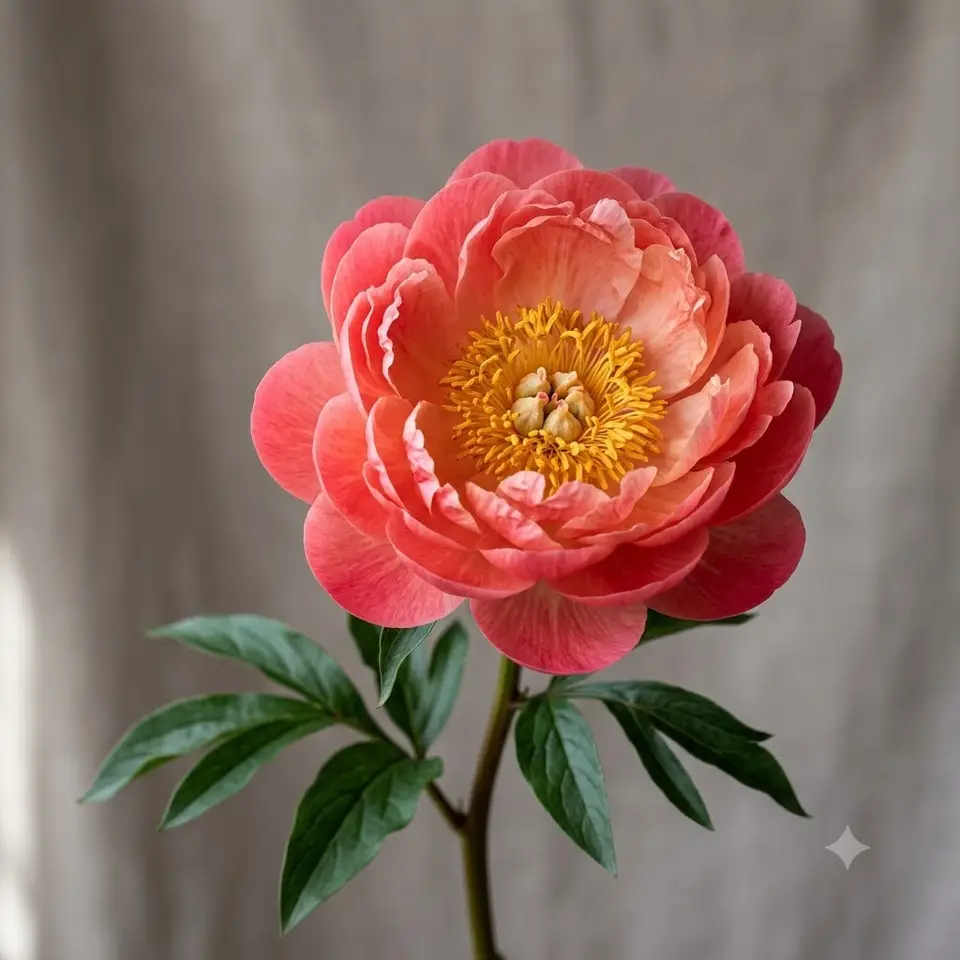
Coral Charm is a herbaceous coral-hybrid peony prized for large, semi-double blooms that open a vivid deep coral and soften to peachy apricot and cream as they age, so a single plant shows several shades at once.
Last reviewed: September 2026
 AI illustration
 Overview
Coral Charm is a herbaceous coral-hybrid peony prized for large, semi-double blooms that open a vivid deep coral and soften to peachy apricot and cream as they age, so a single plant shows several shades at once. It is one of the most recognised of the coral peonies, holding its flowers on strong, upright stems. Its botanical name is Paeonia 'Coral Charm'.
Origin & Background
The genus Paeonia is native across the temperate Northern Hemisphere, with wild species spread through Europe, the Caucasus, and much of Asia, alongside a few in western North America. Coral Charm itself is a modern garden hybrid raised by American breeder Samuel Wissing and introduced in the 1960s; it draws on the coral-toned interspecific crosses that gave this whole group its glowing warm colouring, and it later earned the American Peony Society Gold Medal for its garden performance.
Appearance
The flowers are large, often 15 to 18 cm across, semi-double with a loose ring of broad petals around a centre of golden stamens. They emerge from rounded buds a saturated coral-pink, then fade gracefully through salmon, apricot, and finally a soft peachy cream, so the plant looks different week to week. Blooming comes early to mid season in late spring, ahead of many lactiflora peonies. Mature clumps reach about 90 to 100 cm tall and around 90 cm wide, forming a bushy mound of glossy, deeply divided green foliage that turns bronzy in autumn before dying back for winter.
Why People Grow It - Qualities & Benefits
- Striking coral colour that shifts through several warm tones as each flower matures
- Strong, upright stems that hold the big blooms with little or no staking
- Early bloom time that extends the peony season and pairs well with late tulips and alliums
- Extremely long-lived and low maintenance, often thriving in the same spot for decades
Care
Light: Full sun is best, at least six hours a day; it tolerates light afternoon shade but flowers most freely and stands up straightest in open sun. Water: Moderate and even during spring growth and budding; established plants are fairly drought tolerant but resent waterlogged soil. Soil: Fertile, deep, well-drained loam with a neutral to slightly alkaline pH, roughly 6.5 to 7.0; enrich heavy clay with compost and grit before planting. Hardiness: USDA zones 3 to 8. Bloom or Season: Early to mid season in late spring, with a display of roughly one to two weeks per clump; cutting a few stems in tight bud extends enjoyment indoors. Extra: Plant the eyes no more than 3 to 5 cm below the surface, as burying peonies too deep is the most common reason they fail to flower. Note that peonies are toxic to cats and dogs, so site plants where pets are unlikely to chew the roots or foliage.
Planting & Propagation
Plant bare-root divisions in early autumn while the soil is still warm, setting the fleshy, tuberous roots so the pink growth eyes sit just below the surface. Propagate by lifting and dividing an established clump in early autumn, cutting the root mass into sections that each carry 3 to 5 healthy eyes and a good portion of root. Divisions may sulk for a year or two before hitting full stride. Growing from seed is possible but very slow and will not come true to the parent, so division is the reliable route.
Common Problems & Pests
- Botrytis blight, which blackens stems and buds in wet springs; improve airflow and clear old foliage in autumn
- Failure to bloom, almost always from planting too deep, too much shade, or a division that is still too young
- Occasional aphids or thrips on buds, and powdery mildew late in the season on crowded plants
Toxicity & Safety
Peonies are toxic to cats and dogs. They contain paeonol, a compound concentrated in the bark and roots, and ingestion can cause vomiting and diarrhoea. The risk is generally mild rather than life-threatening, but it is sensible to discourage pets from digging at or chewing the plant and to contact a vet if a large amount is eaten.
Pros & Cons
Pros
- Dramatic, colour-shifting coral blooms on sturdy, self-supporting stems
- Long-lived, cold-hardy, and low maintenance once settled
Cons
- Bloom season is short, only a week or two per plant
- Toxic to cats and dogs, and new divisions may take a year or two to flower
Best Suited For
- Cottage borders, cutting gardens, and mixed perennial beds in cool to temperate climates
- Gardeners wanting a reliable, long-lived spring focal plant with minimal fuss
FAQ
Why is my Coral Charm not flowering?
The usual cause is planting too deep. The eyes should sit only 3 to 5 cm below the soil surface. Too much shade or a very young division can also delay blooming for a season or two.
Does Coral Charm need staking?
Usually not. Its stems are noticeably stronger than many double peonies, though a light grow-through support can help keep the heavy blooms upright after spring rain.
Gear for growing coral charm peony
Links go to Amazon or a partner store (such as Adagio Teas) and may earn us a commission at no extra cost to you. As an Amazon Associate we earn from qualifying purchases. We link gear types, not sponsors' picks: you choose the exact product.