Beni Kawa Japanese Maple
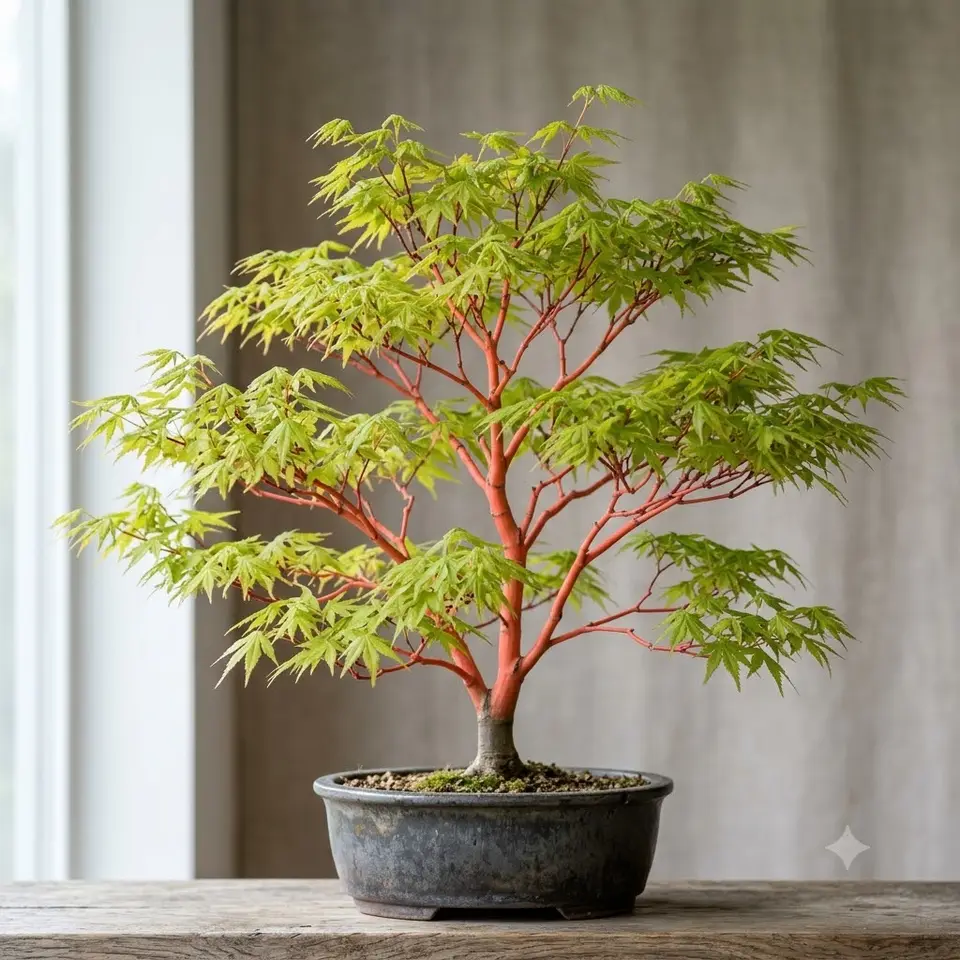
Beni Kawa is a coral-bark Japanese maple grown chiefly for its winter show: as temperatures drop, the young twigs and branches deepen to a warm salmon-red that glows against bare-season gardens (Acer palmatum 'Beni kawa').
Last reviewed: October 2026
 AI illustration
 Overview
Beni Kawa is a coral-bark Japanese maple grown chiefly for its winter show: as temperatures drop, the young twigs and branches deepen to a warm salmon-red that glows against bare-season gardens (Acer palmatum 'Beni kawa'). Compared with the better-known coral-bark types, its bark colour is a touch more subdued and pink-toned, but it is prized for holding that colour reliably and for a neat, upright habit. The name translates roughly as "red bark," which sums up the plant's headline feature.
Origin & Background
The parent species, Acer palmatum, is native to Japan, Korea, and parts of China, where it grows as an understorey and woodland-edge tree. 'Beni kawa' is one of the coral-bark selections grown for its winter stem colour; who first selected it is not well documented. Like nearly all named Japanese maple cultivars, it is propagated by grafting rather than seed so that its distinctive bark trait comes true.
Appearance
The five- to seven-lobed palmate leaves open a light, fresh green in spring, sometimes with a faint reddish edge, and hold green through summer. In autumn the foliage turns clear golden yellow, occasionally with orange highlights. The real display arrives once the leaves fall, revealing coral-red to salmon-pink young bark that intensifies through winter cold. It grows as an upright, vase-shaped small tree, reaching roughly 3 to 4.5 m tall and 2.5 to 3.5 m wide at maturity, though it is slow to get there. Spring flowers are small and reddish-purple, more curiosity than ornament.
Why People Grow It - Qualities & Benefits
- Standout coral-red winter bark that brings colour to the dormant garden
- Reliable golden-yellow autumn foliage on top of a long green summer season
- Compact, upright form that suits smaller gardens and courtyards
- Year-round interest across all four seasons from a single specimen tree
Care
Light: Full sun to part shade; some direct sun actually deepens the bark colour, but shelter from harsh afternoon sun in hot climates to prevent leaf scorch. Water: Consistent, even moisture; keep the root zone from drying out, especially in the first few years, and avoid waterlogging. Soil: Moist but well-drained, humus-rich soil; prefers slightly acidic to neutral pH. Hardiness: USDA zones 5 to 8. Bloom or Season: Green foliage spring through summer, golden-yellow autumn colour, then coral-red bark as the winter feature. Extra: The bark colour is strongest on young growth, so light annual pruning of older wood keeps fresh, brightly coloured stems coming. Non-toxic to cats and dogs; Japanese maple (Acer palmatum) is not listed as toxic to pets.
Planting & Propagation
Plant in autumn or early spring in a sheltered spot with well-drained soil, setting the graft union at or just above soil level and mulching to conserve moisture. Named cultivars like 'Beni kawa' do not come true from seed, so they are propagated commercially by grafting onto Acer palmatum seedling rootstock. Home gardeners can occasionally succeed with air layering, but grafting remains the standard, most reliable method.
Common Problems & Pests
- Leaf scorch from hot afternoon sun, drying wind, or inconsistent watering
- Verticillium wilt and dieback, favoured by poorly drained soil
- Aphids and scale, which can also lead to sooty mould on foliage
Toxicity & Safety
Non-toxic to cats and dogs. Japanese maple (Acer palmatum) is not listed as toxic to pets, making it a safe choice for gardens shared with animals.
Pros & Cons
Pros
- Bright winter bark provides colour when little else does
- Manageable size and tidy upright shape for tight spaces
Cons
- Slow-growing, so it takes years to reach full effect
- Young foliage can scorch in exposed, hot, or windy sites
Best Suited For
- Gardeners wanting four-season interest from a single small tree
- Courtyards, mixed borders, and winter-focused planting schemes
FAQ
How is Beni Kawa different from other coral-bark maples?
Nurseries describe it as similar to 'Sango kaku', with coral-red to pink-red young stems, and often as the more cold-hardy of the two. It is also a relatively compact, upright grower.
Will it grow in a container?
Yes. Its slow growth and modest size make it well suited to a large pot, provided you use free-draining compost, water consistently, and shelter it from extreme heat and cold.
Gear for growing beni kawa japanese maple
Links go to Amazon or a partner store (such as Adagio Teas) and may earn us a commission at no extra cost to you. As an Amazon Associate we earn from qualifying purchases. We link gear types, not sponsors' picks: you choose the exact product.