Best Orchid Pots, Compared
Which pot an orchid needs (clear plastic, slotted, terracotta, glazed ceramic, net pot or basket), from the American Orchid Society's repotting advice, plus five orchid pots compared from the seller's specs.
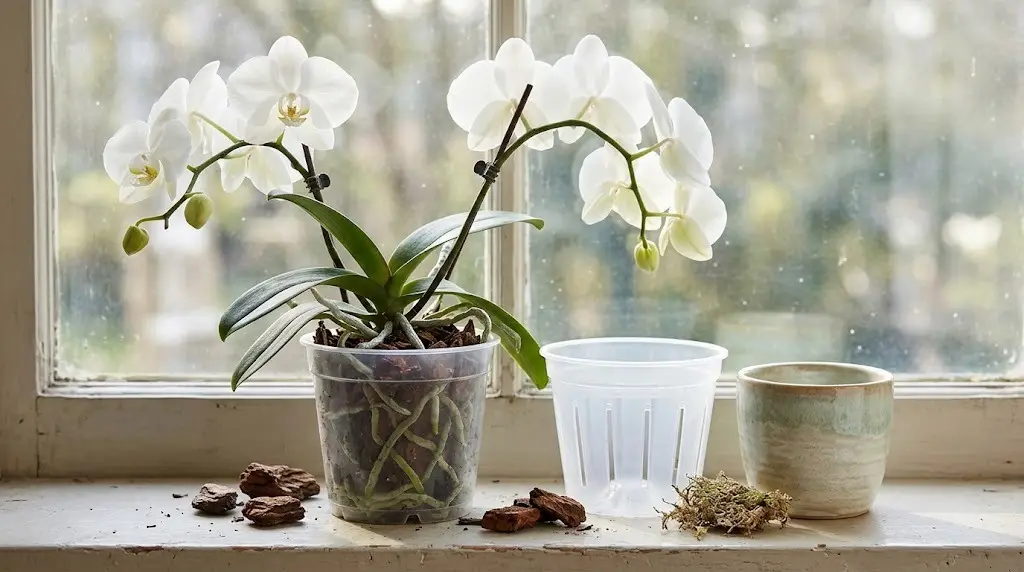
For most orchids grown indoors, the best pot is a clear plastic one with plenty of drainage holes. The American Orchid Society (AOS) says plastic dries the slowest and is recommended for most orchids, especially indoors, that most indoor plants should go in clear plastic pots so the roots can photosynthesize, and that you should always choose a pot with drainage holes (AOS). If you want a decorative pot, slip the clear one inside it.
Which Pot Material for Your Orchid?
The AOS repotting sheet sets out the trade-offs:
| Material | How fast it dries | What the AOS says |
|---|---|---|
| Plastic, ideally clear | Slowest | Recommended for most orchids, especially indoors; clear lets the roots photosynthesize. In a dark home it can keep the mix too wet, which leads to fungus gnats and root rot. |
| Terracotta | Fastest | Porous; good for very large plants or plants that like to dry quickly between waterings, but heavy, and a near death sentence indoors for orchids that need to stay moist, such as Miltoniopsis. |
| Glazed ceramic | Slower than terracotta | Stylish, but many have no drainage holes; best used as an outer pot around a clear plastic one. |
| Metal | - | Never, with no exceptions. |
The “slip pot” method is how the AOS squares looks and roots: the plant grows in a cheaper plastic pot, which sits inside a nicer ceramic one. The AOS adds that this can also help keep moisture around the roots.
Orchid Pots Compared
| Pot | Material and size | Drainage and airflow | Best for | Links |
|---|---|---|---|---|
| rePotme Crystal Clear Orchid Pot 5.75” | Clear plastic; 5.75 in across the top, 4.25 in at the base, 5 in tall; rolled rim | 13 holes in the base | The clear plastic pot the AOS recommends for most indoor orchids | See on Amazon · Seller’s page |
| rePotme Super Slot Pot | Clear or colored plastic; 3, 4, 5, 6 and 8 in | 4 in size: 10 slots in the sides, 18 in the base and 18 more on a raised inner core | Orchids that want more air at the roots than a plain pot gives | See on Amazon · Seller’s page |
| rePotme Net Pot 3.75” | Heavy plastic net; 3.75 in top, 2.75 in base, 3 in tall (also 5 and 6 in) | Open mesh for maximum drainage and airflow | An inner pot in the slip-pot method | See on Amazon · Seller’s page |
| rePotme Fluted Hexagon Ceramic Orchid Pot | Glazed ceramic; about 4 in wide and 6 in tall | Feet lift the pot above an attached drip tray | A decorative outer pot | See on Amazon · Seller’s page |
| rePotme Wooden Vanda Basket | Natural pine slats with a metal hanger; 4, 6 and 8 in | Roots grow out through the slats | Vanda orchids in humid conditions | See on Amazon · Seller’s page |
How we put this together. Which pot suits which orchid comes from the American Orchid Society’s repotting sheet, linked above. The five pots are all from rePotme, an orchid supply shop that designs its own slotted pots; we used one shop because its pages list the size and drainage of every pot, which lets the five be compared on the same terms. We checked the pages on 26 October 2026 and have not grown orchids in these pots side by side. There are no prices here: the Amazon link searches for the same kind of pot, and we may earn a commission if you buy through it.
rePotme’s own advice for the vanda basket matches the AOS on moisture: in lower humidity it suggests using a pot, such as a slotted one, so the potting mix does not escape through the slats.
When to Repot
The AOS says to repot when you first get a plant, and then about every year or two, as the potting mix breaks down and needs replacing. Choose the mix by your own habits, it adds: you can change the mix more easily than you can change how you water.
Questions About Orchid Pots
Do orchids need special pots? They need drainage, and the AOS says never to grow an orchid without it unless you are very experienced. For most indoor orchids, a clear plastic pot with holes is what the AOS recommends.
Why do orchids come in clear pots? So the roots get light: the AOS says most indoor orchids should be in clear plastic pots to let the roots photosynthesize.
Can I put an orchid in a ceramic pot without holes? Use it as an outer pot. The AOS suggests keeping the orchid in a clear plastic pot inside the decorative one.
Are terracotta pots good for orchids? For orchids that like to dry quickly, yes. For moisture-loving orchids indoors, such as Miltoniopsis, the AOS calls them a near death sentence.
See all our orchid profiles, genus by genus, and the Phalaenopsis care guide for the most common orchid.
Recommended Gear on Amazon
- Orchid bark mix - browse current options and reviews on Amazon.
- Sphagnum moss - browse current options and reviews on Amazon.
- Orchid clips and stakes - browse current options and reviews on Amazon.
As an Amazon Associate, we earn from qualifying purchases - at no extra cost to you. This helps us keep producing free, in-depth guides.