Begonia Soli-Mutata
Begonia soli-mutata is a small rhizomatous begonia prized by collectors for its heavily textured, bullate leaves that shift colour in response to light - the reason it is nicknamed the "sun-changing begonia."
Last reviewed: October 2026
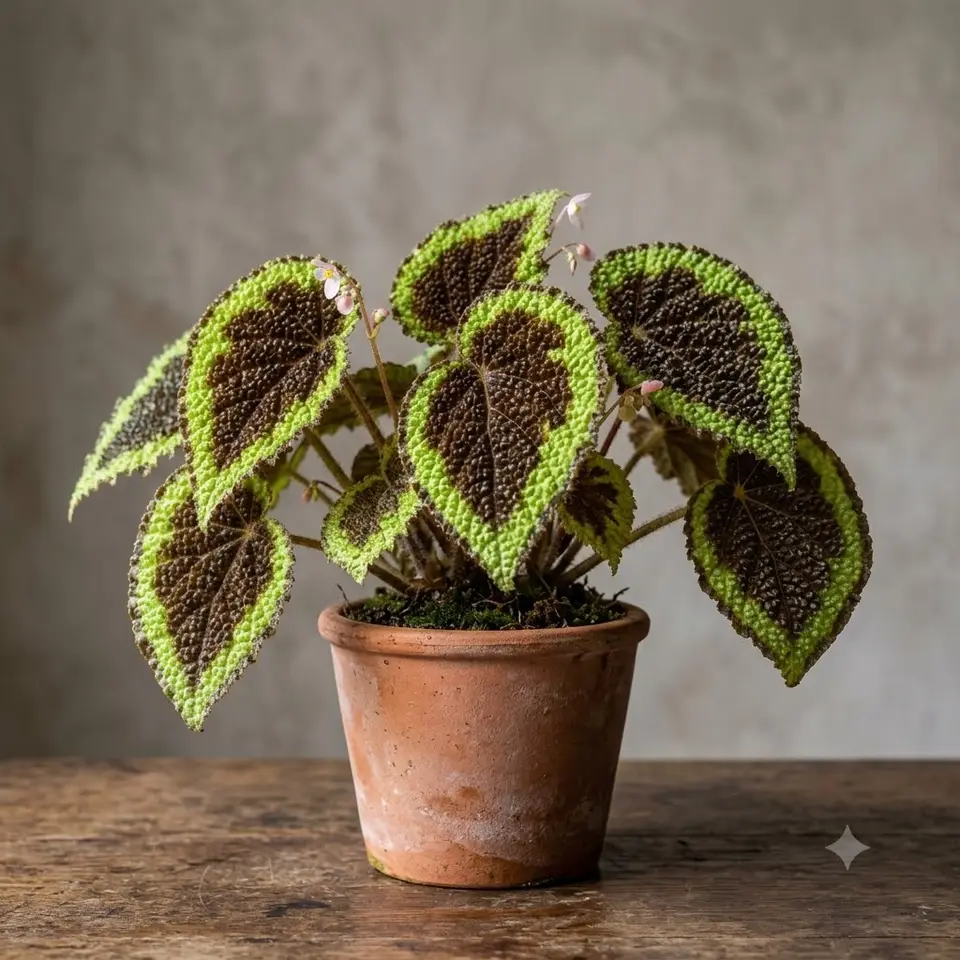 AI illustration
 Overview
Begonia soli-mutata is a small rhizomatous begonia prized by collectors for its heavily textured, bullate leaves that shift colour in response to light - the reason it is nicknamed the "sun-changing begonia." Grown in brighter conditions the foliage deepens to bronze and near-chocolate tones, while shadier spots keep it a richer green, all threaded with pale lime veins. It is a compact, terrarium-friendly species that rewards attentive growers (Begonia soli-mutata).
Origin & Natural Habitat
This species is native to Brazil, where it grows in warm, humid tropical forest understory in the north of the country. In the wild it creeps along shaded, leaf-littered ground and rock in consistently moist, sheltered conditions.
Appearance
The leaves are roughly rounded to broadly ovate with a slightly puckered, deeply quilted (bullate) surface covered in fine hairs, typically reaching 8 to 13 cm across. Colour ranges from olive and emerald green to bronze and coppery-brown depending on light, always accented by contrasting light-green veining. It is a low, spreading plant that grows from a creeping rhizome and usually stays under about 20 to 30 cm tall, making it well suited to terrariums and small pots.
Why People Grow It - Qualities & Benefits
- Striking bullate, hairy foliage with a texture unlike most common houseplants
- Colour-shifting leaves that respond visibly to light levels
- Compact size that fits terrariums, cloches and small shelves
- A genuine collector's begonia that stays interesting without growing unwieldy
Care
Light: Bright, indirect light. Direct sun scorches the leaves, but too little light mutes the colour and stretches the plant, so a spot near an east window or a metre or so back from a brighter one works well.
Water: Keep the mix lightly and evenly moist, letting only the top layer approach dryness before watering again. It dislikes both soggy roots and full drying out, and cold or hard water can spot the foliage.
Soil: A light, airy, fast-draining mix - for example peat or coco-based potting soil cut with perlite and a little fine bark or leaf mould. Good aeration around the shallow rhizome is important.
Temperature & Humidity: Warmth-loving; happiest around 18 to 27°C and unhappy below roughly 16°C. This is the honest sticking point: it wants high humidity, ideally 60% or more, and can crisp or sulk in dry indoor air, which is why many growers keep it in a terrarium or on a humidity tray.
Feeding: Feed with a balanced, diluted liquid fertiliser roughly every 2 to 4 weeks during active growth in spring and summer, and pause in winter.
Extra: It can slow markedly or partially die back in winter's low light and cooler temperatures - do not panic, just ease off water and let it rest, and it should push new growth again in spring. Toxic to cats and dogs (soluble calcium oxalates, most concentrated in the rhizome and underground parts) - keep out of reach of pets and children.
Propagation
Propagate from rhizome divisions or leaf cuttings. A healthy leaf, or a wedge of leaf with a vein cut, laid on or pinned to moist mix in a humid, enclosed environment will form plantlets; rhizome sections with roots can simply be potted up separately.
Common Problems & Pests
- Powdery mildew and botrytis in stagnant, damp air - keep airflow moving and avoid wetting the foliage
- Rhizome and root rot from overwatering or a heavy, waterlogged mix
- Crispy leaf edges and stalled growth from low humidity, plus occasional mealybugs, spider mites or fungus gnats
Toxicity & Safety
Begonia is toxic to cats and dogs. The plant contains soluble calcium oxalates, most concentrated in the rhizome and underground parts, which can cause oral irritation, drooling, difficulty swallowing and vomiting if chewed or eaten. The sap can also irritate sensitive skin, so it is sensible to keep the plant away from curious pets and children and to wash your hands after handling or dividing it.
Pros & Cons
Pros
- Unusual, high-texture foliage that shifts colour with light
- Compact and terrarium-friendly, ideal for small collector setups
Cons
- Fussy about humidity and prone to sulking in dry rooms
- Can die back or stall in winter and is sensitive to overwatering and rot
Best Suited For
- Terrarium and cloche growers who can provide steady warmth and humidity
- Collectors ready to fuss a little in exchange for a distinctive, texture-forward begonia
FAQ
Why are my Begonia soli-mutata leaves changing colour?
That is expected behaviour and the source of its name. More light drives bronze and coppery tones, while shadier conditions keep it greener, so the colour is a live readout of how much light it is getting.
Do I really need a terrarium for this plant?
Not strictly, but it makes life much easier. It can grow in the open with a pebble humidity tray and careful watering, yet it looks its best and stays trouble-free in the stable, humid air of a terrarium or covered case.
Sources
Pet toxicity: checked against the ASPCA Animal Poison Control Center lists of toxic and non-toxic plants for cats and dogs, genus-wide entry "Begonia" (Begonia spp.): toxic to cats and dogs. Lists read on 10 October 2026.
Gear for growing begonia soli-mutata
Links go to Amazon or a partner store (such as Adagio Teas) and may earn us a commission at no extra cost to you. As an Amazon Associate we earn from qualifying purchases. We link gear types, not sponsors' picks: you choose the exact product.