Bladderwort
Bladderworts run the fastest traps in the plant kingdom (underground/underwater bladders that vacuum prey in under a millisecond), while the surface shows only grassy leaves and disproportionately lovely orchid-like flowers.
Last reviewed: October 2026
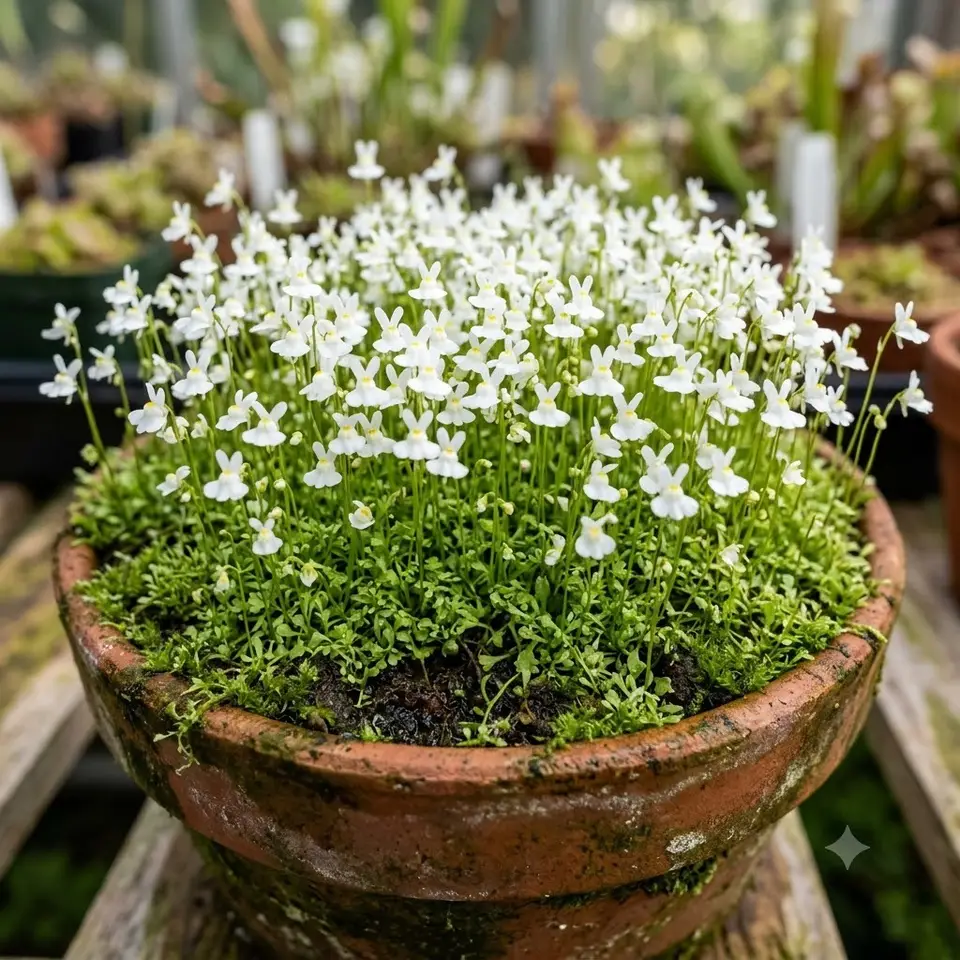 AI illustration
 Overview
Bladderworts run the fastest traps in the plant kingdom (underground/underwater bladders that vacuum prey in under a millisecond), while the surface shows only grassy leaves and disproportionately lovely orchid-like flowers. You grow the flowers; the massacre is invisible. (Utricularia.)
Origin & Natural Habitat
Worldwide - terrestrial species in wet peat, aquatics in ponds; one of the two largest carnivorous genera (~240 species, alongside the sundews).
Appearance
Terrestrial pots read as mossy grass 2-10 cm until sprays of snapdragon-ish blooms rise - purples, yellows, whites (U. sandersonii's 'angry bunnies' bloom nearly nonstop); traps are microscopic bladders in the medium.
Why People Grow It - Qualities & Benefits
- Nearly everblooming flowers (sandersonii famously)
- The fastest predation on earth in your pot (0.5 ms)
- Carpeting terrarium groundcover
- Zero trap-maintenance: it's all hidden
Care
Light: Bright indirect to some sun; blooming follows light.
Water: Rain, distilled or RO water ONLY - tap-water minerals poison carnivorous roots within months. The tray method (pot standing in 1-2 cm of pure water) is standard.
Soil: Nutrient-FREE mix: sphagnum peat + perlite/silica sand (roughly 1:1). Never potting soil, never fertilized media - fertility burns their roots. Kept WETTER than most. Many stand permanently in the tray.
Temperature & Dormancy: Common terrestrials (sandersonii, bisquamata): 15-28°C year-round, no dormancy - easy room residents.
Feeding: Micro-prey in the wet medium self-supplies; nothing to do - genuinely zero-touch.
Propagation
Division of the mat - tear a clump, pot it wet, done; it carpets onward.
Common Problems & Pests
- Drying out even briefly (the wettest-loving of the easy carnivores)
- Algae/moss competition in old pots: refresh occasionally
- No blooms = more light
- That's all: it's near-foolproof
Toxicity & Safety
Non-toxic to cats, dogs and people - carnivorous plants digest insects, not pets; the only real risk runs the other way (cats batting the traps).
Pros & Cons
Pros
- Flowers all year (species-dependent)
- Effortless once sited
- Spreads to share
Cons
- Traps invisible (drama-free)
- Looks like plain grass between blooms
- Needs standing pure water
Best Suited For
- Terrarium carpets
- Flower-first carnivore fans
- Zero-maintenance collections
- Science-fascination growers
FAQ
Where are the traps?
Buried: microscopic bladders on root-like stolons vacuum protozoa and micro-bugs in half a millisecond - high-speed cameras made the genus famous; your eyes get the flowers instead.
Why 'angry bunnies'?
U. sandersonii's little white blooms wear two upright 'ears' and a scowl - the internet's favorite carnivore flower, produced practically without pause.
Gear for growing bladderwort
Links go to Amazon or a partner store (such as Adagio Teas) and may earn us a commission at no extra cost to you. As an Amazon Associate we earn from qualifying purchases. We link gear types, not sponsors' picks: you choose the exact product.