Spirea
This page covers spirea by flowering group, light, soil, pruning time, hardiness and the invasive risk of Japanese spirea.
Last reviewed: November 2026
 AI illustration
Overview
This page covers spirea by flowering group, light, soil, pruning time, hardiness and the invasive risk of Japanese spirea. Clemson Extension counts spireas among the easiest flowering shrubs to grow (Clemson HGIC). Some bloom in spring and others in summer, and that difference decides when you prune (Clemson HGIC). Japanese spirea and its bumalda hybrids need a separate decision: NC State says alternatives should be considered, and Clemson does not recommend them as landscape plants (NC State, Japanese spirea, Clemson HGIC).
Origin & Natural Habitat
Spireas form a genus of over 80 shrubs in the rose family, native to the Northern Hemisphere in North America and Asia (NC State Extension). The name comes from the Greek word speira, meaning wreath, after the showy flower clusters (NC State Extension). Thunberg spirea comes from Japan and China and is often found on rocky hillsides (NC State, Thunberg), while bridal wreath comes from China and Taiwan, on sunny hillsides or in stony, barren places (NC State, bridal wreath). Japanese spirea is native to Japan and China (NC State, Japanese spirea). Vanhoutte spirea is a garden hybrid of S. trilobata and S. cantoniensis (NC State, Vanhoutte), and the bumalda spireas are crosses within the Japanese group (Clemson HGIC). North America has its own species too, such as steeplebush (S. tomentosa), native to wet meadows from Nova Scotia south to Louisiana and Georgia (NC State, steeplebush).
Appearance
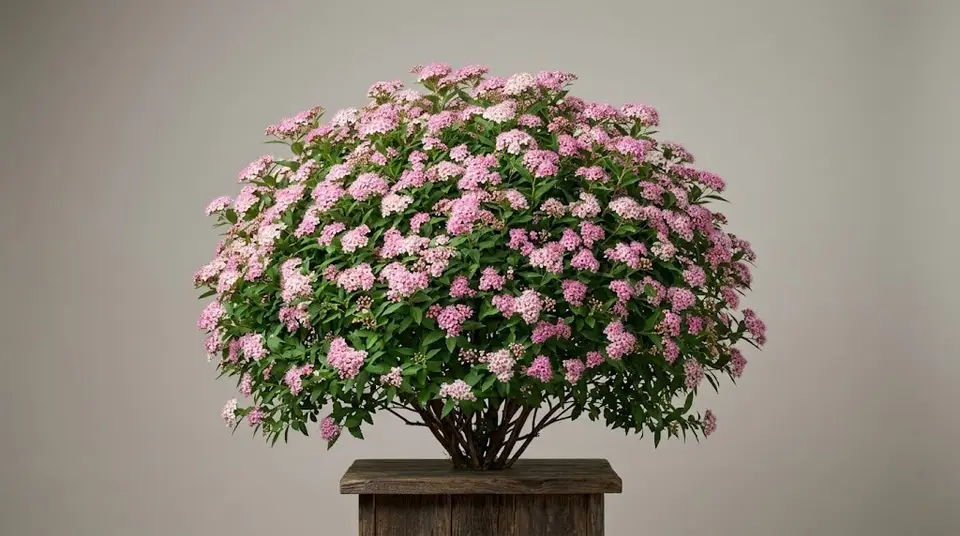
Spireas are deciduous shrubs with small five-petalled flowers in white, pink or red (RHS, Thunberg spiraea, NC State Extension). The spring group carries white flowers along arching branches, and the summer group carries flat-topped clusters, mostly pink or red (Clemson HGIC, NC State, bumalda).
| Spirea | Flowers | Height | Spread | Source |
|---|---|---|---|---|
| Thunberg or baby's breath (S. thunbergii) | White, early spring | 3 to 5 feet | 3 to 5 feet | Clemson HGIC |
| Bridal wreath (S. prunifolia) | Double white, early spring | About 6 feet | About 6 feet | Clemson HGIC |
| Vanhoutte (S. x vanhouttei) | White, spring | 5 to 8 feet | 7 to 10 feet | Clemson HGIC |
| 'Snowmound' (S. nipponica) | White, late spring | 2 to 4 feet | 2 to 4 feet | Clemson HGIC |
| 'Anthony Waterer' (S. x bumalda) | Carmine-red, summer | 2 to 3 feet | 3 to 4 feet | Clemson HGIC, NC State, bumalda |
| Japanese spirea (S. japonica) | Pink, June and July | 4 to 6 feet | 4 to 6 feet | NC State, Japanese spirea |
In metric, 2 to 8 feet is about 61 to 244 cm and the widest spread above, 10 feet, about 305 cm, computed from the figures in feet.
Why People Grow It - Uses & Benefits
- Easy flowering: Clemson names spireas among the easiest flowering shrubs, and RHS calls 'Arguta' easy to grow in most moist soils (Clemson HGIC, RHS, 'Arguta').
- Hedges and borders: Clemson lists them as specimens, hedges, screens and borders, with smaller cultivars as accents in a perennial border (Clemson HGIC).
- Butterflies: spirea flowers are often visited by butterflies (Clemson HGIC).
- Deer: Clemson calls spireas generally deer resistant (Clemson HGIC), but NC State warns that Japanese spirea may be damaged by deer (NC State, Japanese spirea).
- Fall color: Thunberg spirea turns orange in late fall, and bridal wreath turns red to orange (Clemson HGIC).
Care
Light & Position
Spireas should get full sun for the best flowering, and Clemson says they grow denser and bloom more there, although they can tolerate partial shade (Clemson HGIC). NC State gives 6 or more hours of sun for the genus (NC State Extension). In hot-summer climates, 'Snowmound' can also take light afternoon shade (NC State, 'Snowmound').
Soil
Clemson says spireas tolerate many soils except extremely wet ones (Clemson HGIC). NC State describes Vanhoutte spirea as growing easily in average, well-drained soil and doing well in a wide range of soils, including clay (NC State, Vanhoutte). RHS lists chalk, loam, sand and clay for Thunberg spirea, at acid, alkaline or neutral pH (RHS, Thunberg spiraea). Steeplebush is the exception here, because it needs moist, acidic soil (NC State, steeplebush).
Watering
NC State describes Thunberg, 'Snowmound' and bumalda spireas as drought-tolerant (NC State, Thunberg, NC State, 'Snowmound', NC State, bumalda), but a newly planted shrub still depends on water more than on fertilizer (Clemson, fertilizing shrubs). Clemson says spireas respond well to summer watering and mulch (Clemson HGIC). It also warns that overhead watering makes foliar fungal disease more likely and calls drip irrigation the best choice (Clemson HGIC).
Feeding
Clemson's shrub guide says to use a soil test or plant tissue analysis to decide whether a shrub needs fertilizer (Clemson, fertilizing shrubs). Too much nitrogen pushes leafy growth at the expense of flowers, and that lush growth is more open to cold injury, drought and pests (Clemson, fertilizing shrubs). When a test does call for fertilizer, Clemson times it from spring to early summer or from late summer to early fall (Clemson, fertilizing shrubs).
Temperature & Humidity
RHS rates Thunberg spirea and 'Arguta' H6, hardy in all of the UK and northern Europe, at -20 to -15 °C (RHS, Thunberg spiraea, RHS, 'Arguta'). In Fahrenheit that is about -4 to 5 °F, computed from the Celsius figures. These sources give no humidity figure for spireas.
Pruning - depends on the type
Find out when yours blooms before you cut. Spring-flowering spireas bloom on last year's wood, and pruning them in fall or winter removes next spring's flower buds (Colorado State Extension). Summer-flowering spireas bloom on the current year's growth (Iowa State Extension).
| Group | Examples | Flowers on | When to prune | Source |
|---|---|---|---|---|
| Spring-flowering | Thunberg, bridal wreath, Vanhoutte | Last year's stems | Right after flowering | RHS, bridal wreath, Colorado State Extension |
| Summer-flowering | Japanese, bumalda | Current year's stems | Late winter or early spring | Iowa State Extension, Colorado State Extension |
On any spirea, removing the faded flowers stimulates a second flush of growth and more flowers (Clemson HGIC). For spring bloomers, Clemson also suggests thinning old and weak canes to the ground each year, and it says bumalda spireas generally need less severe pruning than other species (Clemson HGIC).
The sources differ on 'Snowmound': Clemson says to prune it after flowering (Clemson HGIC), while NC State's card says late winter or early spring (NC State, 'Snowmound'). It blooms in spring, and Iowa State's rule for healthy spring-flowering shrubs is to prune immediately after flowering (Iowa State Extension), so that is the timing that keeps the display.
For an overgrown shrub, Illinois Extension describes a renewal and a rejuvenation. A renewal removes one third of the oldest stems each year for three years, and a rejuvenation cuts all stems to within 4 to 6 inches (about 10 to 15 cm, computed) of the ground in early spring, which it says works well on spirea (Illinois Extension). Colorado State adds that a spring-flowering shrub will not bloom in the year of rejuvenation and that this is done no more than every three to five years (Colorado State Extension). RHS times it differently for spring-flowering spireas and cuts back hard immediately after flowering (RHS, Thunberg spiraea, RHS, 'Arguta').
Hardiness zones & winter care
Clemson and NC State give these USDA zones (Clemson HGIC, NC State, Japanese spirea):
| Spirea | USDA zones | Source |
|---|---|---|
| Thunberg spirea | 4 to 8 | Clemson HGIC |
| Bridal wreath | 5 to 8 | Clemson HGIC |
| Vanhoutte | 3 to 8 | Clemson HGIC |
| 'Snowmound' | 3 to 8 | Clemson HGIC |
| 'Anthony Waterer' | 4 to 8 | Clemson HGIC |
| Japanese spirea | 3a to 8b | NC State, Japanese spirea |
| Steeplebush | 3a to 8b | NC State, steeplebush |
Checked: 22 November 2026
Spireas are deciduous, so bare stems in winter are normal (RHS, Thunberg spiraea), and the stems of steeplebush often die down to the ground (NC State, steeplebush). The sources we read name no winter protection for spireas in these zones.
Repotting & Containers
None of the sources we read gives a repotting schedule for spirea. NC State suggests a large container for 'Goldmound', a Japanese spirea cultivar (NC State, 'Goldmound'), so the invasive warning below applies to it as well. Any pot needs drainage holes, so that the roots do not stand in water and develop root rot (NC State handbook).
Planting & Propagation
Clemson names fall as the best planting time, and says spireas are easy to dig and move, best in late fall after the leaves drop (Clemson HGIC).
RHS propagates Thunberg spirea and bridal wreath by softwood or semi-ripe cuttings from spring to late summer or by hardwood cuttings in winter (RHS, Thunberg spiraea, RHS, bridal wreath), and 'Arguta' by softwood cuttings in summer (RHS, 'Arguta'). Steeplebush, which suckers, can be divided in late autumn or early spring (RHS, steeplebush).
Common Problems & Pests
- Few flowers: spireas bloom best in full sun (Clemson HGIC), and pruning a spring bloomer in late summer, fall or winter removes its flower buds (Illinois Extension).
- Overgrown shrub: use the renewal or rejuvenation described under pruning (Illinois Extension).
- Wet ground: root rots can occur in poorly drained, wet soils (Clemson HGIC).
Pests at a glance
Clemson says spireas can get various pests and diseases, most of them not serious (Clemson HGIC):
| Problem | What the source says | Source |
|---|---|---|
| Aphids | Occasionally a problem in spring | Clemson HGIC |
| Phytophthora and Pythium root rots | Can occur in poorly drained, wet soils | Clemson HGIC |
| Leaf spot | Reported on bumalda cultivars but uncommon; rake up and dispose of fallen diseased leaves in late winter | Clemson HGIC |
| Powdery mildew, fire blight, leaf roller, scale | Named among the rose-family problems that can affect spireas | NC State, Vanhoutte |
| Spider mites | Named on the genus card | NC State Extension |
| Honey fungus | Spireas may be susceptible | RHS, Thunberg spiraea |
Checked: 22 November 2026
Invasive risk of Japanese spirea
NC State marks Japanese spirea (S. japonica) as problematic and says alternatives should be considered (NC State, Japanese spirea). It lists the plant as invasive in Virginia, Georgia, South Carolina, Tennessee, Kentucky and elsewhere, and the NC Invasive Plant Council classifies it as invasive (NC State, Japanese spirea). It can self-seed aggressively and spreads by suckers into dense thickets that displace other plants (NC State, Japanese spirea).
Clemson does not recommend Japanese spirea or its cultivars as landscape plants, and says bumalda spireas are also Japanese spireas and may be invasive (Clemson HGIC). Many names sold in nurseries belong to this group, including 'Anthony Waterer', 'Goldflame', Limemound and Golden Sunrise (Clemson HGIC). These warnings come from the eastern US, so check the invasive plant list for your own state, province or country before planting one. For its region, NC State names native alternatives such as Itea virginica, Fothergilla gardenii and Physocarpus opulifolius (NC State, Japanese spirea).
Toxicity & Safety
No pet or poison mark. NC State's cards for the genus Spiraea and for Japanese, Vanhoutte, Thunberg and bridal wreath spirea carry no pet or poison mark, which does not prove the plant is safe (NC State Extension, NC State, Japanese spirea, NC State, Vanhoutte, NC State, Thunberg, NC State, bridal wreath). We found no other checked source, so treat it as unknown and keep pets and children from chewing it. If a pet may have eaten some, call your vet or a pet poison helpline, and if a person has, call a poison center. For other plants, see our plant list for cats and dogs.
Best Suited For
Good fit if:
- you want an easy flowering shrub for a sunny spot (Clemson HGIC);
- you need a hedge, screen or border shrub (Clemson HGIC);
- your soil is average and well-drained, even clay (NC State, Vanhoutte);
- you want butterflies around the flowers (Clemson HGIC).
Think twice if:
- your soil stays very wet, unless you choose a wet-soil native such as steeplebush (Clemson HGIC, NC State, steeplebush);
- your spot is mostly shaded, because spireas flower best in full sun (Clemson HGIC);
- you garden in the eastern US and are looking at Japanese or bumalda spirea (Clemson HGIC, NC State, Japanese spirea).
FAQ
Is Japanese spirea invasive? In parts of the US, yes. NC State marks it as problematic, lists it as invasive in several eastern states and suggests considering alternatives (NC State, Japanese spirea), and Clemson does not recommend it or its cultivars as landscape plants (Clemson HGIC). Check your local list before you plant one.
When should I prune my spirea? Right after flowering for spring bloomers (Clemson HGIC, Iowa State Extension), and in late winter or early spring for summer bloomers such as Japanese spirea (Iowa State Extension).
How do I tell which type I have? Note when it blooms: spring bloomers flower on last year's stems, and summer bloomers on the current year's growth (Colorado State Extension).
Why isn't my spirea flowering well? The two causes these sources name are too little sun (Clemson HGIC) and pruning a spring bloomer in late summer, fall or winter, which removes the flower buds (Illinois Extension).
Can I cut an old spirea back hard? Yes. Illinois Extension says rejuvenation works well on spirea, by cutting all stems to within 4 to 6 inches of the ground in early spring (Illinois Extension). On a spring bloomer that means no flowers that year (Colorado State Extension).
Is spirea a problem for pets? NC State's cards carry no pet or poison mark for spirea, which does not prove it is safe (NC State Extension). If a pet chews it and seems unwell, call your vet or a pet poison helpline.
Is spirea a good shrub for beginners? Clemson counts spireas among the easiest flowering shrubs to grow (Clemson HGIC), and NC State rates the genus low for maintenance (NC State Extension). The one thing to learn first is the pruning time for your type (Iowa State Extension).
Sources
The facts on this page link to these sources:
- Clemson HGIC (hgic.clemson.edu)
- NC State, Japanese spirea (plants.ces.ncsu.edu)
- NC State Extension (plants.ces.ncsu.edu)
- NC State, Thunberg (plants.ces.ncsu.edu)
- NC State, bridal wreath (plants.ces.ncsu.edu)
- NC State, Vanhoutte (plants.ces.ncsu.edu)
- NC State, steeplebush (plants.ces.ncsu.edu)
- RHS, Thunberg spiraea (rhs.org.uk)
- NC State, bumalda (plants.ces.ncsu.edu)
- RHS, 'Arguta' (rhs.org.uk)
- NC State, 'Snowmound' (plants.ces.ncsu.edu)
- Clemson, fertilizing shrubs (hgic.clemson.edu)
- Colorado State Extension (extension.colostate.edu)
- Iowa State Extension (yardandgarden.extension.iastate.edu)
- RHS, bridal wreath (rhs.org.uk)
- Illinois Extension (extension.illinois.edu)
- NC State, 'Goldmound' (plants.ces.ncsu.edu)
- NC State handbook (content.ces.ncsu.edu)
- RHS, steeplebush (rhs.org.uk)
General information only. If you suspect poisoning, call a poison control center, a doctor or a vet straight away.
Gear for growing spirea
Links go to Amazon or a partner store (such as Adagio Teas) and may earn us a commission at no extra cost to you. As an Amazon Associate we earn from qualifying purchases. We link gear types, not sponsors' picks: you choose the exact product.