Fennel
This guide covers herb fennel as a garden plant and tea herb, from telling it apart from look-alikes to sowing, harvesting and safe picking.
Last reviewed: November 2026
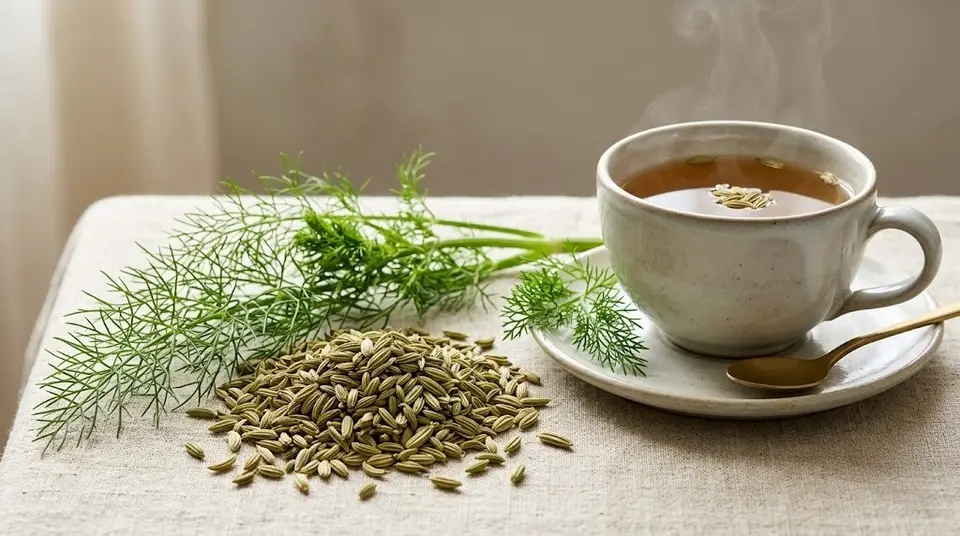 AI illustration
Overview
This guide covers herb fennel as a garden plant and tea herb, from telling it apart from look-alikes to sowing, harvesting and safe picking. RHS rates it as hardy, simple to grow and able to handle drought, and says its leaves, flowers and seeds can all be infused for tea (RHS, how to grow fennel). NC State describes a perennial usually kept as an annual, with a sweet taste of anise or licorice (NC State, fennel). One warning matters more than any growing tip: do not pick wild plants unless you are certain what they are, because poison hemlock also has fine, ferny young leaves and umbrella-shaped flower clusters, and it can kill people and livestock (NC State, poison hemlock).
Identification & Appearance
Fennel forms a clump of tall stems with soft, feathery leaves cut into needle-like segments, green or yellow-green in the common form and purple-bronze in 'Purpureum' (RHS, how to grow fennel, NC State, fennel). Its height depends on which line you read: the NC State text says 3 to 5 feet (91-152 cm, computed), the data field on the same card says 4 to 6 feet (122-183 cm, computed), and RHS says up to 2 m (roughly six and a half feet) (NC State, fennel, RHS, how to grow fennel). The card gives a spread of 1 ft 6 in to 3 ft 3 in (NC State, fennel). Tiny yellow flowers sit in big, flat, compound umbels, and leaves, flowers and seeds all carry the scent and taste of aniseed (NC State, fennel, RHS, how to grow fennel).
Look-alikes
RHS says fennel resembles dill and is often sold under the same name as the bulb vegetable, while the dangerous look-alike in the wild is poison hemlock (RHS, how to grow fennel, NC State, poison hemlock):
| Plant | How it differs | Source |
|---|---|---|
| Herb fennel (Foeniculum vulgare) | Yellow umbels, needle-like leaf segments, smell of aniseed | NC State, fennel, RHS, how to grow fennel |
| Florence fennel (F. vulgare var. azoricum) | The closely related bulb vegetable, so check the label if you want leaf and seed | RHS, how to grow fennel |
| Dill (Anethum graveolens) | A self-seeding annual; RHS says fennel grows far taller, stronger and for longer | NC State, dill, RHS, how to grow fennel |
| Poison hemlock (Conium maculatum) | White flowers, smooth hollow stem with purple spots, foul smell when crushed. Highly toxic | NC State, poison hemlock |
Checked: 22 November 2026
Where It Grows
NC State gives its origin as southern Europe and the Mediterranean, with a worldwide distribution today (NC State, fennel). Garden plants are known to escape and naturalize, and RHS warns that where fennel is happy it can turn into a nuisance in some areas (NC State, fennel, RHS, how to grow fennel). For where other plants come from, see our plant origins page.
How to Grow at Home
RHS prefers sowing straight into the final spot in mid- to late spring, because fennel dislikes having its roots disturbed (RHS, how to grow fennel). You can also start it indoors in modules, one seed each, about 1 cm (half an inch) deep, and move the young plants out while they are still small, before the tap root forms (RHS, how to grow fennel). For a pot, RHS asks for a heavy, stable container at least 30 cm (1 ft) wide and deep in a sheltered place, since a plant this tall is easy to blow over (RHS, how to grow fennel). When you buy, make sure the packet says herb fennel, not Florence fennel (RHS, how to grow fennel).
Propagation Steps
RHS gives this order for raising fennel from seed (RHS, how to grow fennel):
- In mid- to late spring, choose a warm, sunny, sheltered spot with light, free-draining soil (RHS, how to grow fennel).
- Sow the seed about 1 cm (half an inch) deep where the plant will stay (RHS, how to grow fennel).
- Thin the seedlings in stages until plants stand at least 30 cm (1 ft) apart, and eat the thinnings in salads (RHS, how to grow fennel).
- Guard the seedlings against slugs and snails (RHS, how to grow fennel).
- Water regularly through dry spells in the first growing season (RHS, how to grow fennel).
- To keep your own seed, gather it in late summer once it is ripe and dry, and sow it the next spring (RHS, how to grow fennel).
Checked: 22 November 2026
Growing Conditions
Light
Give fennel full sun. NC State and RHS both ask for it (NC State, fennel, RHS, how to grow fennel).
Watering
Water young plants regularly in dry spells during their first season; after that, fennel in the ground is drought tolerant and needs no watering (RHS, how to grow fennel). In a container it wants a steady supply, so check every few days and keep the compost just moist (RHS, how to grow fennel).
Soil & Temperature
NC State says it does best in moist, rich, well-drained soil and puts up with clay and sand, while RHS favors light, free-draining ground and warns that roots may rot where the soil is waterlogged (NC State, fennel, RHS, how to grow fennel). The card accepts acid, neutral and alkaline soil and rates it for USDA zones 4a to 9b (NC State, fennel). RHS says it needs no feeding (RHS, how to grow fennel). In autumn the stems die back, and new ones come from the base each spring (RHS, how to grow fennel).
When It Blooms
NC State lists June to August for the flowers, with seeds following in late summer and early fall (NC State, fennel). The umbels draw bees and butterflies, and the plant feeds the caterpillars of certain swallowtails (NC State, fennel).
Checked: 22 November 2026
Harvesting & Brewing
How to Harvest Fennel
RHS counts the leaves, flowers and seeds as edible, and says you can take sprigs of young leaves as needed from early summer to autumn (RHS, how to grow fennel). If you only want leaves, cut off the flower stems as they form, or trim the whole plant to about 30 cm (1 ft) several times in the season for fresh growth (RHS, how to grow fennel). For seed, cut whole heads in late summer once they ripen (RHS, how to grow fennel). Pick only from plants you grew yourself or can identify with certainty, because of poison hemlock (NC State, poison hemlock).
Drying and Storing
RHS drops the cut seedheads into a paper bag, lets the seeds dry and fall, then keeps them in an airtight container (RHS, how to grow fennel). For leaves, NC State's Wilkes County center suggests small bundles, screens or a dehydrator on low heat, below 100-110 °F (NC State Extension, Wilkes County). That is below about 38-43 °C, computed from the Fahrenheit figures. Leaves are ready when they crumble easily, and kept sealed, away from heat, damp and light, tea herbs stay good for up to one year (NC State Extension, Wilkes County).
Brewing
RHS confirms that the leaves, flowers and seeds can be infused for tea, but gives no amount or steeping time, and we found no checked source that does (RHS, how to grow fennel). So this guide does not name a dose or a time. To mix herbs, see our tea blends.
Health & Safety
- Poison hemlock. NC State marks every part of hemlock as poisonous and warns it may be fatal if eaten, and it is also a problem for cats, dogs and horses (NC State, poison hemlock). If you think someone has eaten it, call emergency services or a poison center at once.
- No health claims. We found no checked health-agency page on fennel tea, so this guide makes no health claims.
- Pregnancy, medicines, children. If you are pregnant, breastfeeding, taking medicine, managing a health condition or brewing for a child, ask a doctor or pharmacist first.
- As food. RHS and NC State both list the leaves, flowers and seeds as edible (RHS, how to grow fennel, NC State, fennel).
- Pets. NC State tags fennel itself as non-toxic for cats, dogs and horses (NC State, fennel). If a pet has eaten a lot of a plant you cannot name and seems unwell, call your vet.
Common Problems
- Self-seeding - it scatters seed freely, so deadhead or pull unwanted seedlings early (RHS, how to grow fennel, NC State, fennel).
- Stem rot and root rot - NC State links these to poorly drained soil, and RHS warns about waterlogged sites (NC State, fennel, RHS, how to grow fennel).
- Slugs and snails - they can eat young seedlings and new shoots, so protect plants early (RHS, how to grow fennel).
- Aphids - they may settle on fresh spring growth, though RHS says they do no significant damage (RHS, how to grow fennel).
- Moved seedlings dying - once the tap root is long a transplant may fail, so move seedlings very young (RHS, how to grow fennel).
- Stems falling over - in windy places the tall flower stems may need a cane (RHS, how to grow fennel).
Best Suited For
Good fit if:
- you have a sunny, free-draining spot (RHS, how to grow fennel);
- you want leaves, flowers and seeds for the kitchen and for tea (RHS, how to grow fennel);
- you want flowers for bees and butterflies (NC State, fennel);
- you want a plant that asks for little care once settled (RHS, how to grow fennel).
Think twice if:
- your soil stays wet (RHS, how to grow fennel);
- you do not want seedlings coming up around the garden (RHS, how to grow fennel);
- you only have a small, windy balcony, since tall plants in pots can blow over (RHS, how to grow fennel);
- you were hoping to pick it wild without being sure of the plant (NC State, poison hemlock).
FAQ
Is herb fennel the same as the fennel bulb I buy? No. RHS separates herb fennel from the vegetable Florence fennel and warns that shops often label both just as fennel, so check the packet (RHS, how to grow fennel).
Can I use leaves or seeds for tea? RHS says the leaves, flowers and seeds can all be infused (RHS, how to grow fennel).
When are the seeds ready? RHS says they ripen from late summer onwards, which is the time to cut whole seedheads (RHS, how to grow fennel).
How do I stop it spreading? NC State advises removing spent flowers and stems before any seed forms (NC State, fennel).
Can I pick wild fennel? Only if you are certain what it is. Poison hemlock also grows on roadsides, has umbrella-shaped flower clusters and can be fatal, NC State warns (NC State, poison hemlock).
Sources
The facts on this page link to these sources:
- RHS, how to grow fennel (rhs.org.uk)
- NC State, fennel (plants.ces.ncsu.edu)
- NC State, poison hemlock (plants.ces.ncsu.edu)
- NC State, dill (plants.ces.ncsu.edu)
- NC State Extension, Wilkes County (wilkes.ces.ncsu.edu)
General information only. If you suspect poisoning, call a poison control center, a doctor or a vet straight away.
Grow it or brew it: fennel
Links go to Amazon or a partner store (such as Adagio Teas) and may earn us a commission at no extra cost to you. As an Amazon Associate we earn from qualifying purchases. We link gear types, not sponsors' picks: you choose the exact product.