Dwarf Sagittaria
Dwarf sagittaria is the low-tech lawn - a grassy rosette plant that spreads by runners and can carpet a foreground without CO2, fancy lights or soft water.
🗓️ Last reviewed: July 2026
Overview
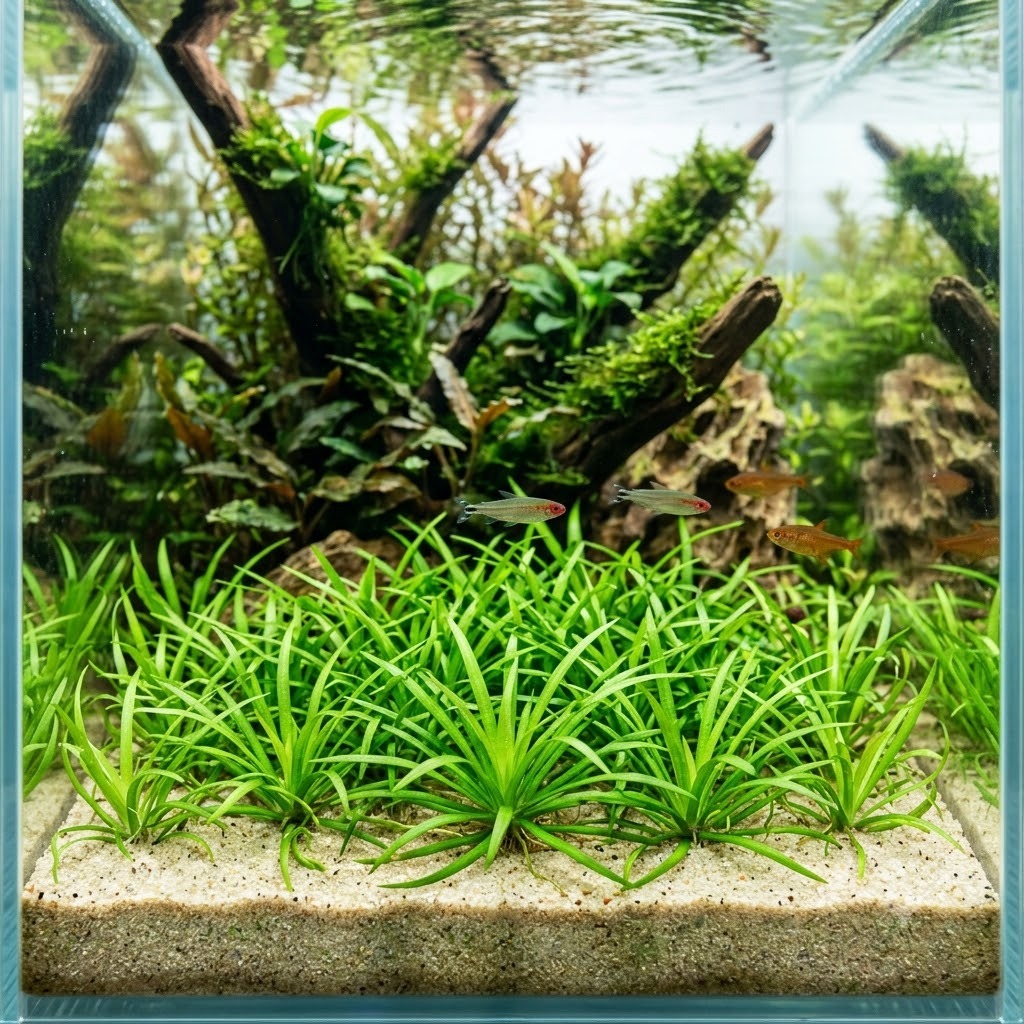
Dwarf sagittaria is the low-tech lawn - a grassy rosette plant that spreads by runners and can carpet a foreground without CO2, fancy lights or soft water. It looks like a slightly wilder, taller cousin of dwarf hairgrass and is considerably easier. The honest catch: "dwarf" is negotiable - in some tanks it stays at 5 cm, in others the same plant pushes 15-20 cm and stops being a foreground plant. (Sagittaria subulata.)
Origin & Natural Habitat
The Americas - shallow coastal rivers, marshes and tidal fresh waters of the eastern US and northern South America (Colombia and Venezuela), rooted in sand and mud. It is hardy enough that escaped aquarium stock has naturalised in parts of Europe, including Britain, so the standing rule applies: never release aquarium plants into natural waterways.
Appearance
Narrow, slightly arching grass-like leaves in fresh green, growing as tufted rosettes that link up via runners into a lawn. Established plants sometimes send a thin stalk to the surface with tiny white three-petalled flowers.
Why People Grow It - Qualities & Benefits
- Real carpet effect without CO2 injection
- Spreads itself by runners - plant once, get dozens
- Tolerates hard, alkaline water better than most carpets
- Tough enough to survive rooting fish and clumsy hands
Care
Light: Moderate. It survives less but spreads slowly and grows taller; good light keeps it short, dense and spreading.
Water: 20-28°C, pH 6.5-8.0, soft to hard - one of the few carpeting plants genuinely happy in hard tap water.
Substrate: Sand or fine gravel, ideally with root tabs - it is a heavy root feeder. Plant small tufts a few centimetres apart and let runners fill the gaps.
CO₂ & feeding: CO2 not required. Root tabs every few months make an obvious difference; water-column fertiliser matters less.
Placement: Foreground to midground lawn; also useful as a taller grassy band in front of hardscape.
Extra: Expect a sulk after planting - some older leaves melt while the roots establish, then runners appear. Height depends on light and crowding, so do not promise yourself a 5 cm carpet.
Propagation
Runners. Established plants push out daughter plantlets on horizontal shoots; leave them to fill the carpet, or cut and replant them where you want new coverage.
Common Problems & Pests
Melt shortly after planting (normal, it regrows); pale, stalled growth when the substrate is sterile - answer with root tabs; unexpected height in lower light; runners invading parts of the scape where you did not want grass. Pests are rare; healthy leaves are too tough for most snails.
Toxicity & Safety
Not known to be toxic to cats, dogs or aquarium livestock. Shrimp-safe, and sturdy enough for tanks with small cichlids that dig.
Best Suited For
- Low-tech keepers who want a carpet without CO2
- Hard-water tanks where picky carpets fail
- Beginners moving beyond stem plants
- Tanks with mildly disruptive fish
FAQ
Why is my dwarf sagittaria growing tall instead of carpeting?
Light and crowding. In weaker light the leaves stretch toward the surface; dense, well-lit stands stay shorter. More light plus thinning usually brings the height back down, but some stock simply runs tall.
How fast will it carpet the foreground?
With moderate light and root tabs, small tufts planted a few centimetres apart typically knit into a usable lawn in two to three months. Without root feeding it can stall almost indefinitely.