Little Lime Hydrangea
Little Lime is a compact, dwarf panicle hydrangea (Hydrangea paniculata 'Little Lime') that packs the cone-shaped, colour-changing blooms of full-size panicle types into a shrub roughly half the size.
Last reviewed: September 2026
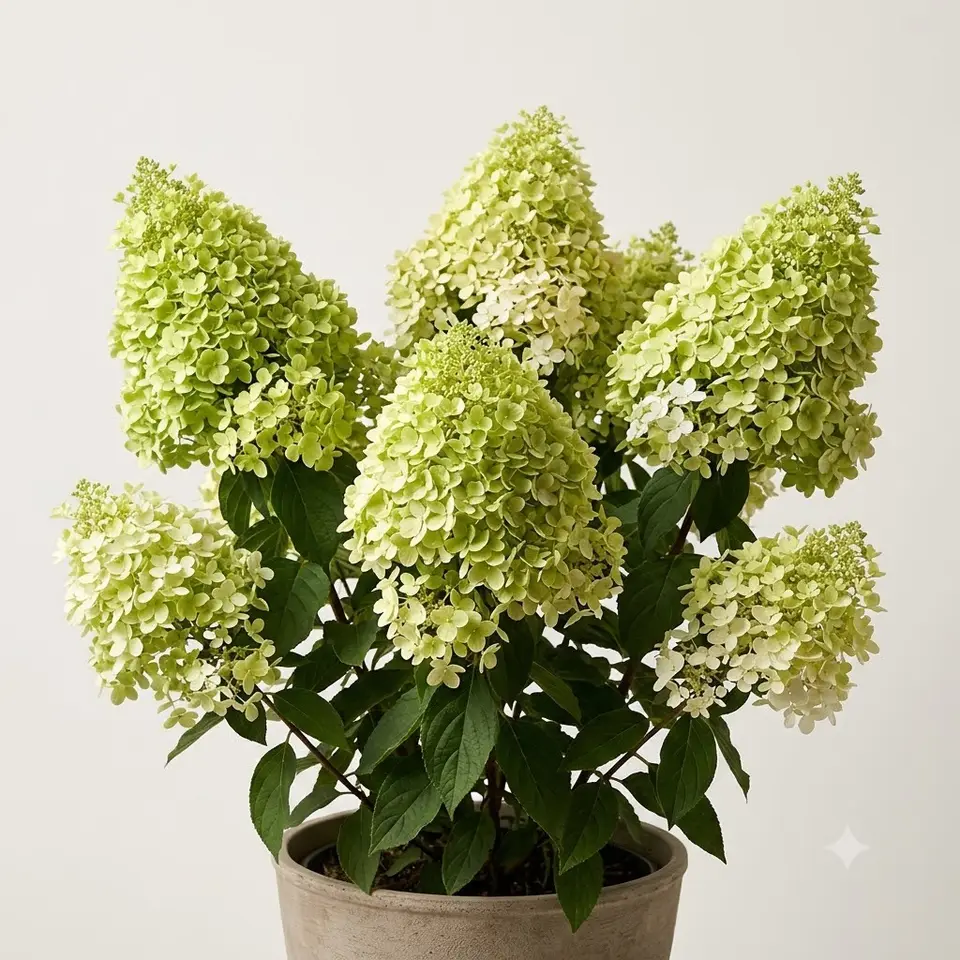 AI illustration
 Overview
Little Lime is a compact, dwarf panicle hydrangea (Hydrangea paniculata 'Little Lime') that packs the cone-shaped, colour-changing blooms of full-size panicle types into a shrub roughly half the size. It stands out for its soft lime-green summer flowers that mature to pink and rose, held on strong stems that rarely flop. Because it blooms on new wood, it is one of the more reliable and forgiving hydrangeas for a smaller garden.
Origin & Background
The genus Hydrangea is native to eastern Asia and the Americas, with the panicle hydrangea species (Hydrangea paniculata) growing wild in Japan, Korea, China and far-eastern Russia, where it thrives in open woodland and mountain slopes. Little Lime is a dwarf selection of the popular 'Limelight' panicle hydrangea, introduced commercially in 2012 as a smaller-scale version bred to bring the same flower show to tighter spaces and containers.
Appearance
Little Lime opens its large, cone-shaped panicles in midsummer in a fresh lime-green, which slowly deepens to soft pink and finally rich rose-burgundy as autumn nights cool. The flower heads are dense and upright, held on sturdy stems above dark green, oval leaves. Mature height and spread land around 90 to 150 cm tall and wide, giving a rounded, mounded shape. In autumn the foliage can take on burgundy tints, and the faded blooms dry to a tan-parchment colour that holds through much of winter.
Why People Grow It - Qualities & Benefits
- Compact size fits small gardens, foundation plantings and large containers where full-size panicle hydrangeas would overwhelm
- Long season of interest, with flowers shifting from green to pink to rose over many weeks
- Blooms dependably on new growth, so a hard winter or a spring prune will not cost you the flowers
- Strong stems resist flopping, keeping the heavy blooms upright without staking
Care
Light: Full sun to part shade; at least 6 hours of sun gives the best flowering and the strongest pink autumn colour, though light afternoon shade is welcome in hot climates. Water: Moderate and even; keep the soil consistently moist, especially in the first two years and during summer heat, but avoid waterlogged ground. Soil: Adaptable to most soils as long as drainage is good; it prefers moist, fertile loam and tolerates a range of pH. Unlike bigleaf hydrangeas, panicle types like Little Lime do not change flower colour with soil pH, so no soil tinkering is needed. Hardiness: USDA zones 3 to 9, making it one of the cold-hardiest hydrangeas available. Bloom or Season: Blooms from midsummer into autumn, with the colour show stretching over roughly two to three months as the panicles age. Extra: Prune in late winter or early spring since it flowers on new wood; cutting back by about a third builds a fuller shape and larger blooms. Please note that hydrangeas are toxic to cats, dogs and horses if eaten, so site or supervise accordingly.
Planting & Propagation
Plant in spring or autumn in a hole as deep as the root ball and twice as wide, setting the crown level with the soil surface and watering in well. Propagation of this named cultivar is done vegetatively rather than from seed, which would not come true. Take softwood cuttings in early summer or hardwood cuttings in late autumn, dip in rooting hormone and keep in a humid, sheltered spot; simple layering also works well, pinning a low flexible stem to the ground until it roots.
Common Problems & Pests
- Wilting or scorched leaf edges in dry spells or hot afternoon sun, usually solved with mulch and steadier watering
- Powdery mildew or leaf spot in humid conditions with poor air circulation
- Occasional aphids on new growth, which can be rinsed off or left to natural predators
Toxicity & Safety
Hydrangea leaves and flowers contain a cyanogenic glycoside, making the plant toxic to cats, dogs and horses if ingested. Eating parts of the plant can cause vomiting, diarrhoea and lethargy. Serious poisoning is uncommon because the bitter taste discourages large amounts, but it is sensible to keep curious pets from grazing on the foliage and to contact a vet if you suspect ingestion.
Pros & Cons
Pros
- Reliable bloomer on new wood with a long, colour-shifting flower season
- Very cold hardy and compact enough for small spaces and containers
Cons
- Toxic to cats, dogs and horses if eaten
- Needs consistent moisture and can wilt quickly in hot, dry sites
Best Suited For
- Small gardens, foundation beds and mixed borders needing a tidy flowering shrub
- Container growing on patios and gardeners in cold zones wanting dependable late-summer colour
FAQ
When and how should I prune Little Lime Hydrangea?
Prune in late winter or early spring before new growth starts. Because it flowers on new wood, you can cut it back by up to a third to encourage a bushier plant and larger blooms without sacrificing that season's flowers.
Why are my Little Lime flowers staying green instead of turning pink?
The green-to-pink shift is driven by maturity and cooling temperatures, not soil pH. More sun and the natural progression into late summer and autumn deepen the colour, so plants in shadier or very warm spots may hold their lime tone longer.
Gear for growing little lime hydrangea
Links go to Amazon or a partner store (such as Adagio Teas) and may earn us a commission at no extra cost to you. As an Amazon Associate we earn from qualifying purchases. We link gear types, not sponsors' picks: you choose the exact product.