Catmint (Nepeta)
Catmint is a soft, romantic, hard-working perennial that earns its place in almost any sunny garden.
🗓️ Last reviewed: October 2026
Overview
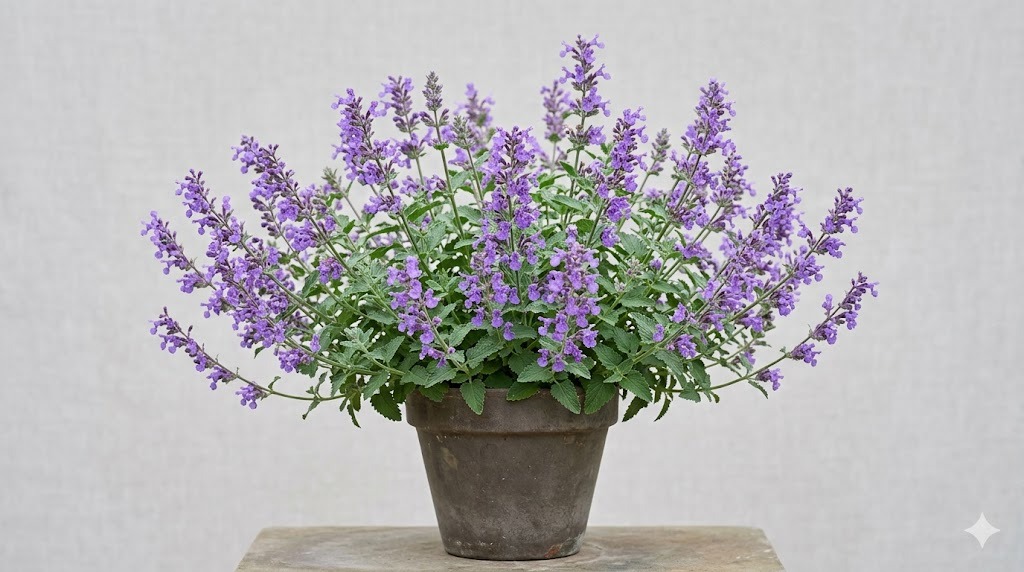
Catmint is a soft, romantic, hard-working perennial that earns its place in almost any sunny garden. It forms billowing, cloud-like mounds of small grey-green aromatic leaves, smothered for months in a haze of lavender-blue (sometimes pink or white) flowers. It is one of the easiest, toughest, and most pollinator-friendly plants there is - drought-proof, undemanding, long-flowering, and largely pest-free. Catmint is a brilliant border filler and edging plant, and a classic companion to roses. Its one quirk is in the name: many cats are drawn to it and may roll, chew, and flatten it - usually charming, occasionally a nuisance.
Origin & Natural Habitat
Nepeta is a genus in the mint family, native to sunny, dry regions across Europe, Asia, and North Africa. Garden catmints grow wild on dry hillsides, rocky slopes, and open grassland in well-drained, often poor soil. This sun-loving, drought-adapted origin is the basis of its care - and, like other mint relatives, its aromatic foliage helps it resist heat, drought, and grazing. The true catnip beloved by cats is a close relative, Nepeta cataria; the popular ornamental garden catmints (such as Nepeta x faassenii and 'Six Hills Giant') attract cats to varying, usually milder, degrees.
Appearance
Catmint is a clump-forming herbaceous perennial, generally 25-90 cm tall depending on the variety, forming a loose, spreading, billowing mound. The small leaves are soft, grey-green, slightly downy, and aromatic when brushed. From late spring through summer (and often into autumn) the plant is covered in slender spikes of small, tubular, two-lipped flowers in soft lavender-blue - the overall effect a gentle, smoky haze. Compact varieties make tidy edging; large ones like 'Six Hills Giant' form generous flowing masses.
Why People Grow It - Qualities & Benefits
- Very long bloom: months of soft color, especially if cut back mid-season.
- Outstanding for pollinators: one of the best bee and butterfly plants.
- Effortlessly easy: drought-tolerant, hardy, undemanding, almost pest-free.
- Soft, romantic effect: the hazy mounds soften borders, edges, and paths.
- Classic rose companion: the airy blue sets off roses beautifully and hides their bare legs.
- Deer- and rabbit-resistant: aromatic foliage is generally left alone by them.
- Versatile: edging, mass planting, gravel gardens, and containers.
Care
Light & Position
Full sun for the best flowering and the most compact, sturdy growth. Catmint tolerates light shade but becomes floppier and flowers less there. Good air movement suits it.
Soil
Well-drained soil - light, even poor or gritty soil is ideal. Catmint dislikes heavy, wet ground; rich soil produces lush, floppy growth. It is a plant that genuinely prefers lean conditions.
Watering
Water while establishing; thereafter catmint is highly drought-tolerant and rarely needs watering in the ground.
Feeding
Do not feed, or feed very sparingly - rich conditions make catmint flop and produce fewer flowers. A poor diet keeps it tidy and floriferous.
The Mid-Season Cut-Back
The key technique: after the first big flush of flowers begins to fade and the plant looks tired or sprawling, cut the whole plant back hard - by about a half to two-thirds. It looks drastic, but catmint responds with a flush of fresh foliage and a strong second wave of flowers, keeping it neat and blooming into autumn.
Hardiness & Winter Care
Most garden catmints are reliably hardy, commonly to around USDA zone 4-5, and need no winter protection. They die back over winter; cut down old growth in late autumn or early spring.
Planting & Propagation
Plant in spring or autumn in full sun and well-drained soil. Propagate easily by division in spring, or from softwood cuttings in early summer. Some catmints self-seed gently; sterile hybrids like N. x faassenii do not, staying well-behaved.
Common Problems & Pests
- Floppy, sprawling, open-centered plants: caused by too much shade, soil too rich, or skipping the mid-season cut-back; a hard cut-back after the first flush is the cure.
- Cats flattening the plant: some cats roll in and chew catmint, crushing it - usually harmless and the plant recovers, but it can be a nuisance with prized specimens.
- Few flowers / second flush missing: not cutting back after the first flush, or too much shade.
- Pests/disease: remarkably trouble-free; aromatic foliage deters most pests.
Toxicity & Safety
The ASPCA lists catnip (Nepeta cataria, also called catmint) as toxic to cats - many cats love it, but it can cause vomiting and diarrhea. It is famously attractive to cats: many cats enjoy rolling in and nibbling it, and it makes some cats sedated and others stimulated. Catmint is a popular choice for family and wildlife gardens, with outstanding pollinator value.
Pros & Cons
Pros
- Very long bloom, especially with a mid-season cut-back.
- One of the best pollinator plants; bees love it.
- Extremely easy, hardy, drought-tolerant, and pest-free.
- Soft romantic effect; superb rose companion.
Cons
- Flops and sprawls without full sun, lean soil, and a mid-season cut-back.
- Cats may roll in and flatten it.
- Foliage and effect are soft and informal - not for crisp formal designs.
- Some species self-seed; out-of-bloom it is unremarkable.
Best Suited For
- Sunny borders, path and bed edging, gravel gardens.
- Pollinator and wildlife gardens.
- Underplanting and fronting roses (the classic pairing).
- Low-maintenance and low-water planting schemes; containers.
Not ideal for deep shade, heavy wet soil, crisp formal layouts, or gardeners who want a tidy plant but won't do the mid-season cut-back.
FAQ
Why is my catmint flopping open in the middle? Usually too much shade, soil that is too rich, or - most often - you skipped the mid-season cut-back. After the first flush fades, cut the whole plant back hard by half or more; it will regrow neat and flower again.
How do I get catmint to flower twice? Cut it back mid-season: when the first big flush of flowers fades, cut the whole plant back hard. It responds with fresh foliage and a strong second wave of bloom that carries on into autumn.
Will catmint attract cats to my garden? It can. Catmint is related to catnip, and many cats are drawn to it - rolling in it and nibbling it. The plant usually recovers, though enthusiastic cats can flatten a prized specimen.
Is catmint safe for pets? Not entirely - the ASPCA lists catnip (Nepeta cataria, also called catmint) as toxic to cats: many cats love it, but it can cause vomiting and diarrhea.
Is catmint good for bees? Excellent - it is one of the best pollinator plants you can grow, covered in bees and butterflies throughout its long flowering season.
🪴 Gear for growing catmint (nepeta)
Links go to Amazon or a partner store (such as Adagio Teas) and may earn us a commission at no extra cost to you. As an Amazon Associate we earn from qualifying purchases. We link gear types, not sponsors' picks: you choose the exact product.