Smart Plant Monitors 2026
Smart plant monitors explained - what the moisture, light and fertility readings mean, the kinds of sensor on sale, what to check before buying, and when a finger in the soil is enough.
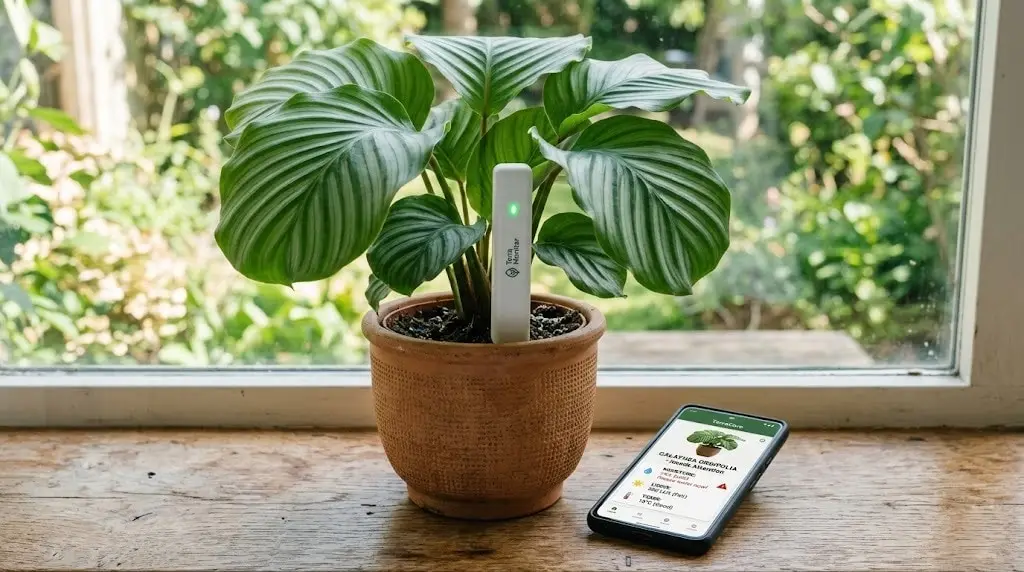
A smart plant monitor is a probe you push into a pot: it reads the soil and the light around it and sends the readings to an app on your phone. This page explains what such a sensor measures, what it cannot tell you, which kinds are on sale, and when a finger in the soil does the job as well.
We have not tested any monitor ourselves, so there is no ranking here, no accuracy score and no model-by-model comparison. The facts about watering, light and salts come from university extension services, listed under Sources at the end.
What Smart Plant Monitors Measure
What a monitor reports depends on the model; these are the readings you will meet:
- Soil moisture - the reading you will use most.
- Light - how much reaches the plant where it stands, which is hard to judge by eye.
- Soil “fertility” - usually the electrical conductivity of the damp soil, an indirect sign of how much dissolved fertilizer is in it. Treat it as a rough guide.
- Temperature - easy to measure, rarely a reason to act on its own.
The app then compares the readings with what it holds on file for your plant and tells you whether the pot looks too wet, too dry or too dim.
Why “fertility” is only an estimate: Colorado State University Extension explains that water with salts dissolved in it conducts electricity roughly in proportion to the amount of salt, which is how soil tests gauge soluble salts, and University of Maryland Extension describes soluble salts in pots as minerals, fertilizer among them, dissolved in water. So the number reflects the total of dissolved salts, not which nutrients are there.
How far to trust the numbers is a fair question. Clemson University’s extension service says of soil moisture meters in general that these products vary widely in accuracy. A sensible habit is to check a new sensor against your own finger for the first few weeks, and to watch trends, not single readings.
What They Don’t Do
- They don’t read moisture alone. Clemson’s extension service warns that a meter’s readings can be influenced by factors other than soil moisture, and names fertilizer and soil type.
- They don’t replace looking. A monitor can report wet soil; only you can spot the yellow leaf, the pest or the leaning stem.
- One probe, one pot. Thirty plants would mean thirty sensors; more realistically, you would put one in the two or three plants you worry about.
- A probe in the soil is not a room hygrometer. If dry air is your problem, a separate humidity meter tells you more.
Who Gets the Most From One
A monitor earns its keep with:
- Fussy plants - calathea, ferns, fiddle-leaf fig - where watering by guesswork goes wrong quickly.
- Dim rooms, where you cannot tell by eye whether the light is enough. University of Maryland Extension notes that light intensity drops quickly as a plant moves away from the light source, and that curtains, weather, the season and the state of the window all change it.
- People who are learning. University of Maryland Extension says many houseplants are lost to overwatering and underwatering and that watering on a schedule is not the best method. A few months of readings show how fast a pot really dries out, after which many people manage by feel.
- People who travel, if a plant-sitter can see the same readings.
It adds little for:
- Tough, easy houseplants - snake plant, ZZ plant, pothos.
- Garden plants in open ground.
- Anyone with two or three plants and a finger.
The Kinds of Monitor
Bluetooth probe with an app
A stake that talks to your phone when the phone is nearby. One example is the stick sold as “Mi Flora” or “Flower Care” (model HHCCJCY01): the open-source Home Assistant software picks up its Bluetooth broadcasts, and its documentation says that after a firmware update through the maker’s app, the Flower Care account and app are no longer needed. That matters if you would like your readings somewhere other than the maker’s app.
Suits: plants in rooms you are in every day.
Probe with a Wi-Fi hub
A Bluetooth probe only reports when a phone is in range. Add a mains-powered hub and the readings go online, so you can see them from anywhere.
Suits: people who are away often, and plants in a room the phone rarely visits. It costs more, and it is one more device on your network.
Plain moisture meter
A probe with a needle or a small display and no app. It answers one question, wet or dry, at the moment you push it in. The caution from Clemson’s extension service applies here most of all: such meters vary widely in accuracy, and fertilizer and soil type can sway the reading.
Suits: a quick second opinion on a deep pot.
App with no hardware
Plant-care apps will identify a plant from a photo and remind you to water on a schedule. They have no idea how wet the soil is, and University of Maryland Extension warns that watering on a schedule can give plants too much or too little water. We compare the identification side of these apps in Plant ID Apps Compared.
Suits: reminders. Not a substitute for checking the soil.
The Free Alternative: Finger, Weight, Wooden Stick
Clemson’s extension service gives the classic test: push a finger into the mix up to the first joint, and if the mix is dry at the fingertip, it is time to water. The same page notes that a pot loses weight noticeably as the mix dries, and University of Maryland Extension suggests lifting the plant, pot and all, because a pot with dry mix weighs much less than one that still holds water.
For a deep pot, gardeners push in a wooden skewer or chopstick and pull it out again: damp soil darkens the wood and clings to it, dry soil leaves it clean.
None of these measures light or fertilizer, and none tells you what to do next; they show only the state of the soil. To turn that into an interval, our watering calculator factors in pot size and plant type.
For most houseplants, this is all you need.
What to Check Before Buying
- Is the app still maintained? Look at the date of the last update in your app store.
- Bluetooth or Wi-Fi? Bluetooth is enough if your phone is near the plant most days. Remote readings need a hub.
- Is your plant in the database? Search the app for the plants you own before you buy the sensor.
- What battery does it take, and can you replace it? A sealed battery ends the sensor’s life when it runs down.
- Does it work without an account or a subscription? Read the maker’s terms; a sensor tied to a cloud service stops being useful if the service does.
- Where is it meant to be used? Check whether the maker rates it for outdoor use before putting it in a garden bed.
Mistakes to Watch For
- Guessing the position. Follow the maker’s instructions for depth and for distance from the stem and the pot wall.
- Acting on one reading. Watch how the numbers move over days.
- Feeding by the fertility number alone. It is an estimate. Read it alongside how the plant looks and when you last fed it; University of Maryland Extension lists brown leaf tips, lost lower leaves and a crust of salts around the pot among the signs of salt build-up.
- Buying a sensor for every plant. Start with the two or three that give you trouble.
Frequently Asked Questions
Are smart plant monitors actually accurate?
There is no single figure we can give you, and we have not tested them. Clemson’s extension service says that soil moisture meters vary widely in accuracy. Use a sensor for trends, and check it against your finger at first.
Do I need a smart plant monitor for an easy plant like a pothos?
No. Easy plants tolerate enough variation that the finger test is enough. Keep monitors for fussy plants such as calathea, ferns and fiddle-leaf fig.
What’s better - Bluetooth or Wi-Fi plant sensors?
Bluetooth is simpler and reports whenever your phone is near. A Wi-Fi hub adds readings while you are away, at extra cost. Choose by whether you need to see the readings from elsewhere.
Can a plant monitor really replace experience?
It can speed up learning, by showing you how quickly a pot dries between waterings. Once you know the pattern for your plants and rooms, the sensor becomes optional.
Do plant monitors work outdoors?
Only if the maker says so. Check the product’s rating before using one in the garden.
Sources
- Clemson University Home and Garden Information Center, Indoor Plants: Watering (HGIC 1459, reviewed June 2024). Read 15 November 2026.
- University of Maryland Extension, Watering Indoor Plants (updated March 2023). Read 15 November 2026.
- University of Maryland Extension, Lighting for Indoor Plants (updated March 2023). Read 15 November 2026.
- Colorado State University Extension, Saline Soils (published October 2015, reviewed August 2022). Read 15 November 2026.
- Home Assistant documentation, Xiaomi BLE (software documentation about its own integration). Read 15 November 2026.
Recommended Gear on Amazon
- Smart plant moisture sensor - browse current options and reviews on Amazon.
- Bluetooth hygrometer - browse current options and reviews on Amazon.
- Smart plug - browse current options and reviews on Amazon.
As an Amazon Associate, we earn from qualifying purchases - at no extra cost to you. This helps us keep producing free, in-depth guides.