Houseplants Safe for Cats and Dogs
Spider plant, Boston fern, parlor palm, calathea, peperomia and 19 more houseplants the ASPCA lists as non-toxic to cats and dogs - each linked to its ASPCA entry, plus the toxic look-alikes sold under similar names.
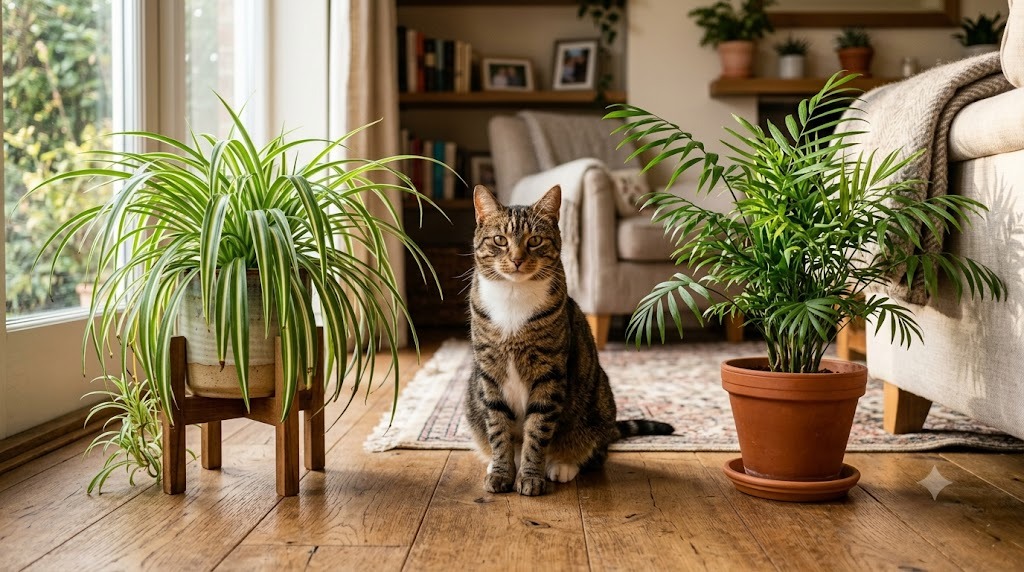
The ASPCA Animal Poison Control Center lists spider plant, Boston fern, parlor palm, areca palm, calathea, prayer plant, peperomia, African violet, moth orchid and Christmas cactus as non-toxic to both cats and dogs - along with 14 more houseplants in the tables below. Every row links to the ASPCA entry it comes from, so you can check the verdict rather than take our word for it.
We checked all 24 against the ASPCA cat list and dog list on 29 September 2026. That check also removed a few plants that pet-safe lists routinely include, an earlier version of this one among them: bird’s nest fern, string of hearts, Chinese money plant and air plants have no ASPCA entry at all. They may well be harmless, but “not listed” is not the same as “listed as non-toxic”, so they have their own section further down.
What “non-toxic” means here
It means the ASPCA knows of no poisoning from the plant. It does not mean the plant is food.
The ASPCA’s own entries show the difference. The money tree is listed as non-toxic to cats and dogs, and the same entry still notes nausea, vomiting and loose stool. The polka dot plant entry notes mild vomiting and diarrhoea. A cat that eats enough of any leaf may bring it back up.
Fertiliser, leaf-shine sprays, pesticides and the water in a vase are separate questions that no plant list answers.
The list: 24 houseplants the ASPCA lists as non-toxic
All 24 are listed as non-toxic to both cats and dogs. The first column links to our care profile, the second to the ASPCA entry.
Palms and floor plants
| Plant | ASPCA entry | Light and what to know |
|---|---|---|
| Areca palm | Areca Palm, Dypsis lutescens | Bright indirect light. Tall and soft. Fronds at cat height tend to get chewed ragged. |
| Parlor palm | Parlor Palm, Chamaedorea elegans | Low to medium light. Slow and compact, the easy palm for a dim room. |
| Kentia palm | Kentia Palm, Howea forsteriana | Low to bright indirect light. Elegant and slow-growing, which is why it costs more. |
| Ponytail palm | Pony Tail, Beaucarnea recurvata | Bright light. Not a true palm. Stores water in its swollen base, so it forgives missed waterings. |
| Money tree | Money Tree, Pachira aquatica | Bright indirect light. Listed non-toxic, yet the entry still notes stomach upset (see above). |
| Cast iron plant | Cast Iron Plant, Aspidistra elatior | Low light. Tolerates deep shade and irregular watering. |
Ferns
| Plant | ASPCA entry | Light and what to know |
|---|---|---|
| Boston fern | Boston Fern, Nephrolepis exaltata | Medium to bright indirect light. Wants humidity and sheds leaflets when the air is dry. |
| Staghorn fern | Common Staghorn Fern, Platycerium bifurcatum | Bright indirect light. Grown mounted on a board, which also puts it out of reach. |
Patterned and compact foliage
| Plant | ASPCA entry | Light and what to know |
|---|---|---|
| Calathea | Calathea, Calathea spp. | Medium indirect light. The ASPCA lists the whole genus. Needs humidity and soft water. |
| Prayer plant | Prayer Plant | Medium indirect light. Folds its leaves up at night. The entry names it “Prayer Plant” and “Red Veined Prayer” and files it under Calathea insignis. |
| Peperomia | Baby Rubber Plant, Peperomia obtusifolia | Medium to bright indirect light. Listed species by species, not as a genus - among them ripple and watermelon peperomia. |
| Polka dot plant | Polka Dot Plant, Hypoestes phyllostachya | Bright indirect light. The second entry that notes mild stomach upset despite the non-toxic listing. |
| Nerve plant | Nerve Plant, Fittonia verschaffeltii | Medium indirect light. Collapses when dry and recovers after watering. Happiest in a terrarium. |
Trailing and hanging
| Plant | ASPCA entry | Light and what to know |
|---|---|---|
| Spider plant | Spider Plant, Chlorophytum comosum | Medium to bright indirect light. Cats are drawn to the dangling plantlets. Hang it if you want it to keep its leaves. |
| Hoya | Honey Plant (Wax Plant), Hoya carnosa | Bright indirect light. Hoya kerrii and Hoya pubicalyx have their own entries. The sap can irritate skin. |
| Swedish ivy | Swedish Ivy, Plectranthus australis | Bright indirect light. Not an ivy. English ivy is on the toxic list. |
Flowering
| Plant | ASPCA entry | Light and what to know |
|---|---|---|
| African violet | African Violet, Saintpaulia spp. | Bright indirect light. Compact, and flowers on a windowsill for much of the year. |
| Moth orchid | Phalaenopsis Orchid | Bright indirect light. The orchid sold in supermarkets. A pet-household alternative to a lily bouquet. |
| Christmas cactus | Christmas Cactus, Schlumbergera bridgesii | Bright indirect light. Flowers in winter. Segments snap off easily when knocked. |
| Bromeliad | Blushing Bromeliad, Neoregelia | Bright indirect light. The ASPCA lists Neoregelia, Guzmania and Cryptanthus bromeliads. We found no entry for Aechmea. |
Succulents and one carnivore
| Plant | ASPCA entry | Light and what to know |
|---|---|---|
| Haworthia | Haworthia, Haworthia species | Bright indirect light. Looks like a small aloe - and aloe is on the toxic list. |
| Echeveria | Blue Echeveria, Echeveria glauca | Bright light, some direct sun. Several Echeveria species are listed by name. |
| Burro’s tail | Burro’s Tail, Sedum morganianum | Bright light. Leaves drop at the lightest touch, so keep it where nothing brushes past. |
| Venus flytrap | Venus Fly Trap, Dionaea muscipula | Full sun. Needs rainwater or distilled water and a cool winter rest. |
One more plant on the same list, which we have no profile for: the friendship plant, Pilea involucrata.
Same name, different verdict
Most mix-ups happen at the garden centre, where a shared word on the label hides two unrelated plants. In each row the left plant is on the ASPCA non-toxic list and the right one is on its toxic list for both cats and dogs.
| On the label | Listed non-toxic | Listed toxic |
|---|---|---|
| ”Palm” | Areca, parlor, kentia palm | Sago palm - a cycad, not a palm. The entry names liver failure and death among the signs. |
| ”Fern” | Boston fern, staghorn fern | Asparagus fern - not a fern |
| ”Ivy” | Swedish ivy | English ivy |
| ”Rubber plant” | Baby rubber plant, a peperomia | Weeping fig, also entered as “Indian rubber plant”. Jade plant is sold as “dwarf rubber plant”. |
| ”Money plant” | Money tree (Pachira) | Jade plant. Pothos carries the same nickname. |
| Strappy green leaves | Spider plant | Dracaena |
| Small spiky rosette | Haworthia | Aloe |
| Fleshy succulent | Echeveria, burro’s tail | Jade plant, kalanchoe |
| Trailing vine | Hoya | Pothos, heartleaf philodendron |
| Patterned leaves | Calathea, prayer plant | Dieffenbachia |
Other common houseplants on the ASPCA toxic list for cats and dogs include snake plant, peace lily, monstera and cyclamen. Our table of plants toxic to cats and dogs covers every plant we have a profile for, toxic and non-toxic, with search and filters.
Lilies, if you have a cat
Lilies usually arrive as a bouquet or a gift pot, not as a houseplant you chose. The ASPCA lists the Easter lily as toxic to cats and non-toxic to dogs. Its entry names kidney failure among the signs, says death is possible, and notes that cats are the only species known to be affected. Daylilies (Hemerocallis) carry the same listing for cats.
The peace lily is not a true lily. It is on the toxic list for a different reason: insoluble calcium oxalates, with irritation of the mouth as the main sign.
We do not advise on exposure. The ASPCA and your vet do.
Popular plants the ASPCA does not list
None of these appear on the ASPCA cat or dog lists under any name we could find. The middle column is what our own profile says, written from other references.
| Plant | Our profile says | ASPCA |
|---|---|---|
| Bird’s nest fern | Non-toxic | No entry. A relative, the mother fern (Asplenium bulbiferum), is listed non-toxic. |
| String of hearts | Non-toxic | No entry |
| Chinese money plant | Non-toxic | No entry for this species. Other Pilea are listed non-toxic. |
| Air plant | Generally considered non-toxic | No entry |
| ZZ plant | Mildly toxic | No entry |
| String of pearls | Toxic | No entry under this name |
| Fiddle leaf fig | Toxic | No entry. The ASPCA’s “Fiddle-Leaf” is a philodendron. |
We keep the first four off the verified list above, and our profiles flag the last three as toxic. If one of them matters in your home, your vet is the person to ask.
Keeping plants and pets apart
A non-toxic plant can still be shredded, dug up or knocked over. These are about the plant’s survival as much as the pet’s.
- Hang the trailing ones. Spider plant, hoya and Swedish ivy do well in a ceiling hook or wall bracket, above swatting range.
- Use heavy pots on the floor. Terracotta or concrete stays upright when a dog leans on it.
- Cover the soil. A layer of large pebbles discourages digging and stops a cat treating the pot as a litter tray.
- Offer a decoy. Many cat owners keep a tray of cat grass so there is something that is meant to be chewed.
- Save the numbers before you need them. Your vet, the nearest emergency clinic, and in the US the ASPCA Animal Poison Control Center on (888) 426-4435 (a consultation fee may apply) or the Pet Poison Helpline on (855) 764-7661 (an incident fee applies, $89 when we checked).
The pet-safe houseplants collection shows every profile of ours with an explicit non-toxic statement, and the plant finder narrows any shortlist by light and watering.
Frequently Asked Questions
Which houseplants are safe for cats?
The ASPCA lists spider plant, Boston fern, areca palm, parlor palm, kentia palm, calathea, prayer plant, peperomia, hoya, African violet, moth orchid and Christmas cactus as non-toxic to cats, among others. The tables above give all 24 with a link to each entry.
Is the spider plant safe for cats?
The ASPCA lists the spider plant (Chlorophytum comosum) as non-toxic to cats and dogs. Cats tend to chew it anyway, so hang it if you want the plant to look good.
Are succulents safe for cats?
It depends on the species. Haworthia, echeveria and burro’s tail are on the ASPCA non-toxic list. Aloe, jade plant and kalanchoe are on its toxic list for both cats and dogs.
Is the snake plant safe for cats?
No. The ASPCA lists the snake plant as toxic to cats and dogs.
Are indoor palms safe for cats?
The true palms sold as houseplants - areca, parlor and kentia - are listed non-toxic. The sago palm is a cycad, not a palm, and the ASPCA lists it as toxic to dogs, cats and horses.
My cat chewed a plant from the non-toxic list. What now?
We cannot advise on that. The ASPCA’s own entries note stomach upset for some plants it lists as non-toxic. If you are worried, call your vet.
Sources
- ASPCA Animal Poison Control Center, plants toxic and non-toxic to cats and to dogs. Both lists and every linked entry checked on 29 September 2026.
- Pet Poison Helpline, poison list.
- The “Toxicity & Safety” section of each Plantvale profile linked above.
🛒 Recommended Gear on Amazon
- Cat grass growing kit - browse current options and reviews on Amazon.
- Ceiling hook hanging planter - browse current options and reviews on Amazon.
- Spider plant (live) - browse current options and reviews on Amazon.
As an Amazon Associate, we earn from qualifying purchases - at no extra cost to you. This helps us keep producing free, in-depth guides.