12 Best Evergreen Shrubs
Twelve evergreen shrubs for hedges, screens and house fronts: size, zones, light and problems from NC State, pruning from Clemson, pet safety from the ASPCA.
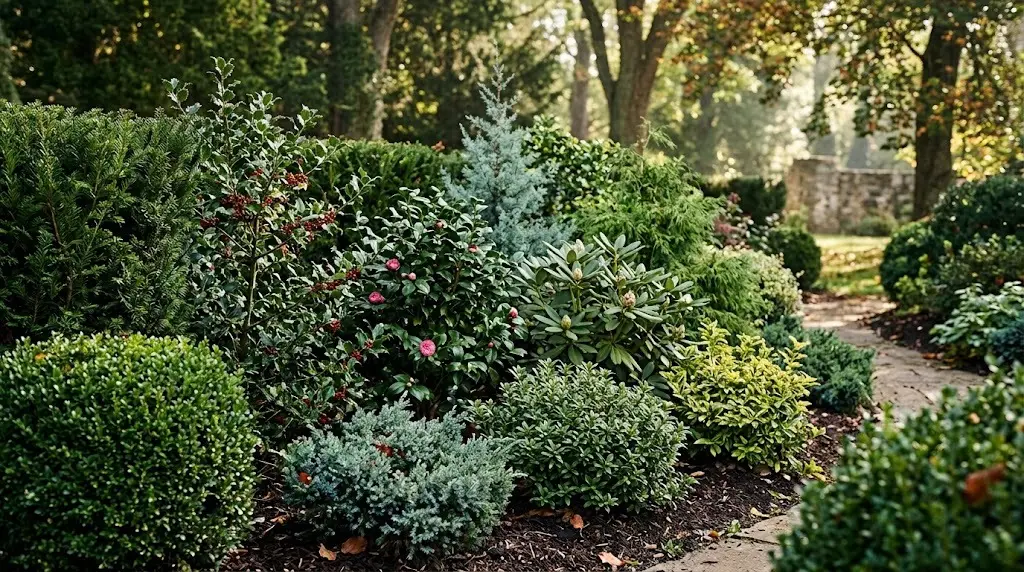
The twelve evergreen shrubs below are littleleaf boxwood, foundation yew, Japanese holly, sasanqua camellia, rhododendron and azalea, Chinese fringe flower, inkberry, Japanese pittosporum, Fraser photinia, winter daphne, Japanese skimmia and laurustinus viburnum. We picked them because each one’s record in NC State Extension’s Plant Toolbox lists it as evergreen and names a hedge, a screen or a foundation planting among its design uses. Other shrubs in the Toolbox may pass both tests too; these twelve cover formal shapes, flowers, screens, winter interest and shade, and the order follows those jobs, not a ranking.
Evergreens give a foundation planting its basic year-round structure, says Clemson Extension’s foundation plantings fact sheet, which describes evergreen shrubs as the long-standing mainstays of foundation plantings and asks for shrubs that are generally low and moderate in growth rate, to reduce maintenance. Clemson writes for South Carolina conditions, which may not apply to other areas (Clemson).
The Twelve Shrubs at a Glance
Sizes, zones, light and problems come from each shrub’s NC State Extension Plant Toolbox record, linked in its name and read on 15 November 2026:
| Shrub | Height × width | USDA zones | Light | Watch for |
|---|---|---|---|---|
| Littleleaf boxwood (Buxus microphylla) | 3-4 × 2-4 ft | 6-9 | Full sun to part shade | Boxwood leaf miner and boxwood mites; some susceptibility to leaf spot and boxwood blight; root rot in poorly drained soil |
| Foundation yew (Taxus × media) | 2-20 × 2-12 ft, by cultivar | 4-7 | Full sun to part shade | Root rot without good drainage; needle and twig blight |
| Japanese holly (Ilex crenata) | 5-10 × 5-8 ft | 5-8 | Full sun to part shade | No serious pests or diseases; spider mites and nematodes now and then; yellow leaves on alkaline soil |
| Sasanqua camellia (Camellia sasanqua) | 6-14 × 5-7 ft | 7-9 | Full sun to part shade | Scale; fungal diseases, petal blight among them; intolerant of alkaline soil |
| Rhododendron and azalea (Rhododendron) | 6-10 × 5-8 ft | 4-8 | Dappled light, part shade or deep shade | Lace bugs, mites and scale; root rot, leaf spot and powdery mildew; frequently damaged by deer |
| Chinese fringe flower (Loropetalum chinense) | 6-8 × 6-8 ft | 7b-9 | Full sun to part shade | Root rot in poorly drained soil; chlorosis on neutral to alkaline soil |
| Inkberry (Ilex glabra) | 5-10 × 5-8 ft | 4-11 | Full sun to part shade | Holly leafminer, Japanese wax scale and southern red mites |
| Japanese pittosporum (Pittosporum tobira) | 8-13 × 4-8 ft | 8-10 | Full sun to part shade | Root rot in wet or poorly drained soil; frequently damaged by deer |
| Fraser photinia (Photinia × fraseri) | 10-20 × 10-15 ft | 7-9 | Full sun to part shade | Leaf spot where it is humid and moist; fireblight and powdery mildew |
| Winter daphne (Daphne odora) | 3 ft to 6 ft 6 in × 2-4 ft | 7-9 | Full sun to part shade | No significant problems; needs very well-drained soil |
| Japanese skimmia (Skimmia japonica) | 2-7 × 3-5 ft | 7-8 | Dappled light, part shade or deep shade | Spider mites in very warm, dry climates; scale and aphids |
| Laurustinus viburnum (Viburnum tinus) | 6-12 × 6-10 ft | 8-10 | Full sun to part shade | Fungal and algal leaf spot, powdery and downy mildew; aphids, thrips and spider mites |
NC State notes that size varies by cultivar for several of them, including foundation yew, Japanese holly and sasanqua camellia, so check the label of the one you buy.
For Formal Shapes: Boxwood, Yew and Japanese Holly
Littleleaf boxwood
Littleleaf boxwood has the smallest leaves of the boxwoods, which NC State says makes it easy to shape into a medium-size hedge, topiary or bonsai; it prunes very well, but the record advises waiting until the risk of a late spring frost has passed, to protect the new growth. Its roots are shallow, so the record suggests a thick mulch to hold moisture, plus some shelter from wind and winter weather, which can turn the foliage orange-brown on some varieties (NC State). Our boxwood guide covers the genus in more detail.
Foundation yew
Foundation yew is a hybrid of English and Japanese yew that grows best in well-drained soil in full sun to part shade, does not tolerate wet conditions and does well in most urban settings, according to NC State. Its height varies by cultivar and can be managed by pruning, and the record lists foundation plantings, hedges, topiaries and screens among its uses (NC State). NC State rates the poison severity of its bark, leaves and seeds as high, with symptoms that may be fatal (NC State), and the ASPCA lists yew as toxic to dogs and cats. Our yew guide has more on the genus.
Japanese holly
Japanese holly is dense, compact and slow-growing; NC State notes that many cultivars grow only 3 to 4 feet tall, that the shrub can be severely pruned to manage its size, and that it may not thrive where heat and humidity are high, as in the southern United States. Male and female flowers grow on separate plants, so a female needs a male nearby to set its small black fruits (NC State).
For Flowers: Camellia, Rhododendron and Fringe Flower
Sasanqua camellia
Sasanqua camellia flowers in late fall and winter, when many other plants are dormant, and NC State suggests it as an accent, a privacy hedge or a tall foundation planting. It wants full sun to part shade, shelter from afternoon sun and winter wind, and well-drained neutral to acid soil, and it is intolerant of alkaline soil (NC State). Next year’s flowers form on old growth, which matters when you prune (NC State). Our camellia guide covers the genus.
Rhododendron and azalea
Azaleas and rhododendrons can be evergreen or deciduous: NC State’s record says most azaleas are deciduous, though many are evergreen, so check that the plant you buy is an evergreen kind. They want moist, well-drained acid soil in dappled shade with protection from afternoon sun, which can scorch the leaves, and the record warns that the roots may rot where the soil drains poorly (NC State). The same record advises planting the root ball high, avoiding overwatering and over-fertilizing, and pruning, if at all, after flowering (NC State). Their flowers attract hummingbirds and a specialized bee, Andrena cornelli (NC State). Our rhododendron and azalea guide goes further.
Chinese fringe flower
Chinese fringe flower is evergreen or semi-evergreen, with strap-shaped petals, and its purple-leafed, pink-flowering kinds are known as Loropetalum chinense variety rubrum (NC State). NC State says it flowers and colors best in full sun with some afternoon shade, in rich, moist, well-drained acid soil, and that it is intolerant of alkaline soil (NC State). It usually grows 6 to 8 feet tall and as wide, but can reach 20 feet, and it tolerates pruning to keep its size, which should wait until flowering is over (NC State).
For Screens and Hedges: Inkberry, Pittosporum and Photinia
Inkberry
Inkberry is a holly native to the southeastern United States that tolerates moist and even occasionally wet soil, and it suckers to form colonies (NC State). Its berries, which need male and female plants, give winter interest and are eaten by many birds and small mammals, and the record suggests it as a hedge, windbreak or privacy screen (NC State). NC State also gives it a high flammability rating and advises against planting it within the defensible space around a home (NC State).
Japanese pittosporum
Japanese pittosporum is a fast-growing evergreen that NC State says tolerates drought, heat and salt spray, which suits sandy coastal sites, and withstands severe pruning. Its flowers smell of orange blossom, and the record notes that next season’s flowers form on old growth (NC State). It is the only one of the twelve that the ASPCA lists as non-toxic to dogs and cats.
Fraser photinia
Fraser photinia is a large shrub or small tree whose new leaves come in reddish-bronze, and NC State notes that pruning in late spring can bring new flushes of red leaves but also removes the flowers. It wants full sun to part shade with good air circulation, does not tolerate wet conditions and is susceptible to leaf spot where it is humid and moist, and the record advises keeping water off the leaves (NC State). Its flowers have a fragrance that many people find offensive, according to the same record (NC State). It matures up to 20 feet tall with a 15-foot spread (NC State), so Clemson’s spacing rule for tall shrubs, below, applies to it.
For Winter Interest and Shade: Daphne, Skimmia and Laurustinus
Winter daphne
Winter daphne carries deeply fragrant pink, lavender or white flowers in mid-to-late winter (NC State). It needs moist, very well-drained soil that can dry out between waterings, and NC State suggests cutting it back after flowering to avoid leggy growth (NC State). The plants often last only three or four years, but they are easy to propagate from stem cuttings (NC State).
Japanese skimmia
Japanese skimmia is slow-growing and shade-loving; its leaves scorch in full sun, and it does best with morning sun and dappled shade for the rest of the day (NC State). Female plants carry red fruits that ripen in fall and last through winter, and NC State recommends one male plant for every six females for a good crop (NC State). The red berries are poisonous and should not be eaten, according to the same record (NC State).
Laurustinus viburnum
Laurustinus viburnum, native to the Mediterranean, flowers from winter to spring, with pink buds opening to fragrant white flowers that attract butterflies, birds and bees (NC State). NC State asks for full sun to part shade, good drainage and a site with 6 to 12 feet of space, because the shrub grows wide, and it tolerates deer, drought and salt (NC State). Its fruits feed wildlife, and fruit set needs another viburnum planted nearby (NC State). Our viburnum guide covers the wider genus.
In Front of the House
Clemson’s foundation plantings fact sheet calls overplanting probably the most common failure: know the ultimate sizes of plants, allow for growth, and do not put tall plants where they will eventually cover windows. Shrubs taller than 6 feet at maturity should stand so that their foliage is at least 5 feet from the walls, and shorter shrubs need at least 3 feet of clearance, for air circulation around foundation vents and to prevent mildew (Clemson). In a humid climate, the same fact sheet keeps foundation plantings low and away from the house and asks for drought-tolerant plants within 5 to 10 feet of the foundation, so that the area needs no extra watering (Clemson). Instead of many small young shrubs for a quick finished look, Clemson suggests fewer plants of more mature size (Clemson). It also suggests mixing textures, and keeping the color scheme of an entry garden simple and mostly green, with brightly colored leaves only in small amounts for emphasis (Clemson).
Pruning
Clemson’s pruning fact sheet starts with removing dead, diseased or injured branches, and prefers thinning, which cuts selected branches back to a side branch or main trunk, to heading back, because routine shearing makes dense outer growth and a sparse, stemmy inside. For a formal hedge, it says to clip while the new growth is green and succulent and to keep the base wider than the top, so that the lower branches get enough light (Clemson). Broadleaf shrubs such as azaleas and camellias respond well to renewal pruning, a cut to within 6 to 12 inches of the ground before spring growth begins, while boxwoods, yews and other narrow-leaf evergreens do not respond to severe pruning and may decline (Clemson). The two extensions disagree twice. NC State’s foundation yew record says these yews tolerate even the most severe pruning (NC State), while Clemson expects yews to decline after it (Clemson). Clemson’s timing table also lists camellias among the plants to prune before spring growth begins, as plants that flower on the current season’s growth (Clemson), while NC State’s sasanqua camellia record says next year’s flowers form on old growth (NC State).
What each shrub’s source says about timing:
| Shrub | When to prune, by the source |
|---|---|
| Littleleaf boxwood | After the risk of a late spring frost has passed |
| Japanese holly | Can be severely pruned to manage its size |
| Sasanqua camellia | Next year’s flowers form on old growth; Clemson instead lists camellias among the plants to prune before spring growth begins |
| Rhododendron and azalea | After flowering; Clemson also lists azaleas among the spring-flowering plants to prune after flowering |
| Chinese fringe flower | Wait until flowering is over |
| Inkberry | If desired, early spring, just before new growth begins |
| Japanese pittosporum | Withstands severe pruning; next season’s flowers form on old growth |
| Fraser photinia | Late spring pruning may bring new red leaves but removes the flowers |
| Winter daphne | Cut back after flowering to avoid leggy growth; Clemson also lists it among the plants to prune after flowering |
Acid Soil and a Plant Food for It
Several of the twelve want acid soil: NC State’s records list only acid soil for inkberry, rhododendron and azalea and Chinese fringe flower, and call sasanqua camellia intolerant of alkaline soil. On alkaline soil, the leaves of Japanese holly turn yellow (NC State).
A plant food sold for acid-loving plants is one product for those beds:
| Product | Type | What the maker states | Links |
|---|---|---|---|
| Espoma Holly-tone | Plant food | For acid-loving plants, trees and shrubs, azalea, camellia, holly, inkberry and rhododendron among them; contains elemental sulfur to help acidify soil; the maker says boxwood does not need acid soil | See on Amazon · Maker’s page |
The product is described from the maker’s own page, checked on 15 November 2026; we have not trialed it. NC State’s rhododendron record advises against over-fertilizing (NC State). There are no prices here: the Amazon link searches for the exact product, and we may earn a commission if you buy through it.
Poisonous Parts and Pets
Some of these shrubs are poisonous, according to NC State’s records and the ASPCA’s lists of plants toxic to cats and dogs. The table gives NC State’s poison rating with the parts it names, and the ASPCA’s verdict for cats and dogs; a missing entry is not a statement that a plant is safe (NC State).
| Shrub | NC State poison rating | ASPCA, cats and dogs |
|---|---|---|
| Littleleaf boxwood | Low (bark, leaves); can cause contact dermatitis | Boxwood: toxic |
| Foundation yew | High (bark, leaves, seeds); may be fatal | Yew: toxic |
| Japanese holly | Low (fruits) | Not listed as Ilex crenata; the American holly and English holly entries are toxic |
| Sasanqua camellia | No poison entry | Not listed as Camellia sasanqua; Camellia japonica is non-toxic |
| Rhododendron and azalea | Low; the record says moderate amounts of azalea nectar or leaves pose little hazard | Rhododendron: toxic; a few leaves can cause serious problems |
| Chinese fringe flower | No poison entry | Not on the lists |
| Inkberry | Low | Not listed as Ilex glabra; the holly entries above give “inkberry” as one of their common names |
| Japanese pittosporum | No poison entry | Japanese pittosporum: non-toxic |
| Fraser photinia | No poison entry | Not on the lists |
| Winter daphne | High (all parts); can cause contact dermatitis | Not on the lists |
| Japanese skimmia | Medium (fruits); small amounts can cause nausea, large amounts cardiac arrest and abortion | Not on the lists |
| Laurustinus viburnum | No poison entry | Not on the lists |
Sources: each shrub’s NC State record (linked in its name) and the ASPCA lists for cats and dogs, checked on 15 November 2026.
If a pet may have eaten part of one of these shrubs, the ASPCA asks you to call ASPCA Poison Control at (888) 426-4435, where a consultation fee may apply, or your local veterinarian as soon as possible; for a person, call a doctor or a poison control center; we do not give medical or veterinary advice, and our table of plants toxic to cats and dogs covers more plants.
Shrubs We Left Out
Japanese camellia is left out because its NC State record names border and flowering tree uses, not hedges, screens or foundation plantings. For pet owners who grow it anyway, the ASPCA lists Camellia japonica as non-toxic to dogs and cats. Leatherleaf mahonia is left out because NC State’s record lists it as invasive in North Carolina and says it is not recommended for planting in landscapes.
Frequently Asked Questions
Which evergreen shrubs grow in shade?
Of the twelve, NC State’s records give dappled light, part shade or deep shade for Japanese skimmia and for rhododendron and azalea, and skimmia leaves scorch in full sun. The Japanese pittosporum record says it grows in full sun to heavy shade.
Which evergreen shrubs flower in winter?
Sasanqua camellia flowers in late fall and winter, winter daphne in mid-to-late winter and laurustinus viburnum from winter to spring, according to NC State’s records.
Which evergreen shrubs stay small?
In NC State’s records, littleleaf boxwood grows 3-4 feet tall, Japanese skimmia 2-7 feet and winter daphne 3 feet to 6 feet 6 inches, and many cultivars of Japanese holly grow only 3 to 4 feet tall.
Are evergreen shrubs safe for dogs and cats?
Not all of them: the ASPCA lists boxwood, yew and rhododendron as toxic to cats and dogs, and of the twelve here only Japanese pittosporum as non-toxic. The table above gives each shrub; for a pet that has chewed one, call your vet or ASPCA Poison Control.
How We Put This Together
We read the NC State Extension Plant Toolbox records of fourteen shrubs on 15 November 2026 and kept the twelve whose record lists them as evergreen and names a hedge, a screen or a foundation planting among their design uses; sizes, zones, light, soil, problems and poison ratings come from those records. Spacing from the house is from Clemson’s foundation plantings fact sheet, pruning methods are from Clemson’s pruning fact sheet with timing from both sources, and pet verdicts are from the ASPCA’s plant lists and entries. Where NC State and Clemson disagree, on hard pruning of yews and on when camellias set their flowers, we give both. We have not grown these shrubs side by side, and the plant food row repeats the maker’s own statements; we have not trialed it.
Sources
- NC State Extension Gardener Plant Toolbox: records for Buxus microphylla, Taxus × media, Ilex crenata, Ilex glabra, Camellia sasanqua, Camellia japonica, Rhododendron, Loropetalum chinense, Pittosporum tobira, Photinia × fraseri, Daphne odora, Skimmia japonica, Viburnum tinus and Berberis bealei. Read 15 November 2026.
- Clemson Cooperative Extension, Home and Garden Information Center: Foundation Plantings (HGIC 1702, published 20 December 1999) and Pruning Shrubs (HGIC 1053, reviewed 22 August 2015). Read 15 November 2026.
- ASPCA Animal Poison Control: plants toxic and non-toxic to cats and dogs; entries for boxwood, yew, American holly, English holly, camellia, rhododendron and Japanese pittosporum. Read 15 November 2026.
Recommended Gear on Amazon
- Boxwood shrubs (live) - browse current options and reviews on Amazon.
- Sasanqua camellia (live plant) - browse current options and reviews on Amazon.
- Hand hedge shears - browse current options and reviews on Amazon.
As an Amazon Associate, we earn from qualifying purchases - at no extra cost to you. This helps us keep producing free, in-depth guides.