Weave your first willow basket.
This is the full build, bench to basket: a small round basket, the shape almost everyone starts on, in seven honest steps. Nothing here needs a workshop - a kitchen chair, a bath for soaking and a pair of secateurs cover it - but it does need patience with a material that has opinions.
Read the whole page before you soak anything. Willow work is a chain of small commitments, and knowing what the stake you cut in step four is for makes step two make sense. For which willows to grow or buy, start at the basketry materials page.
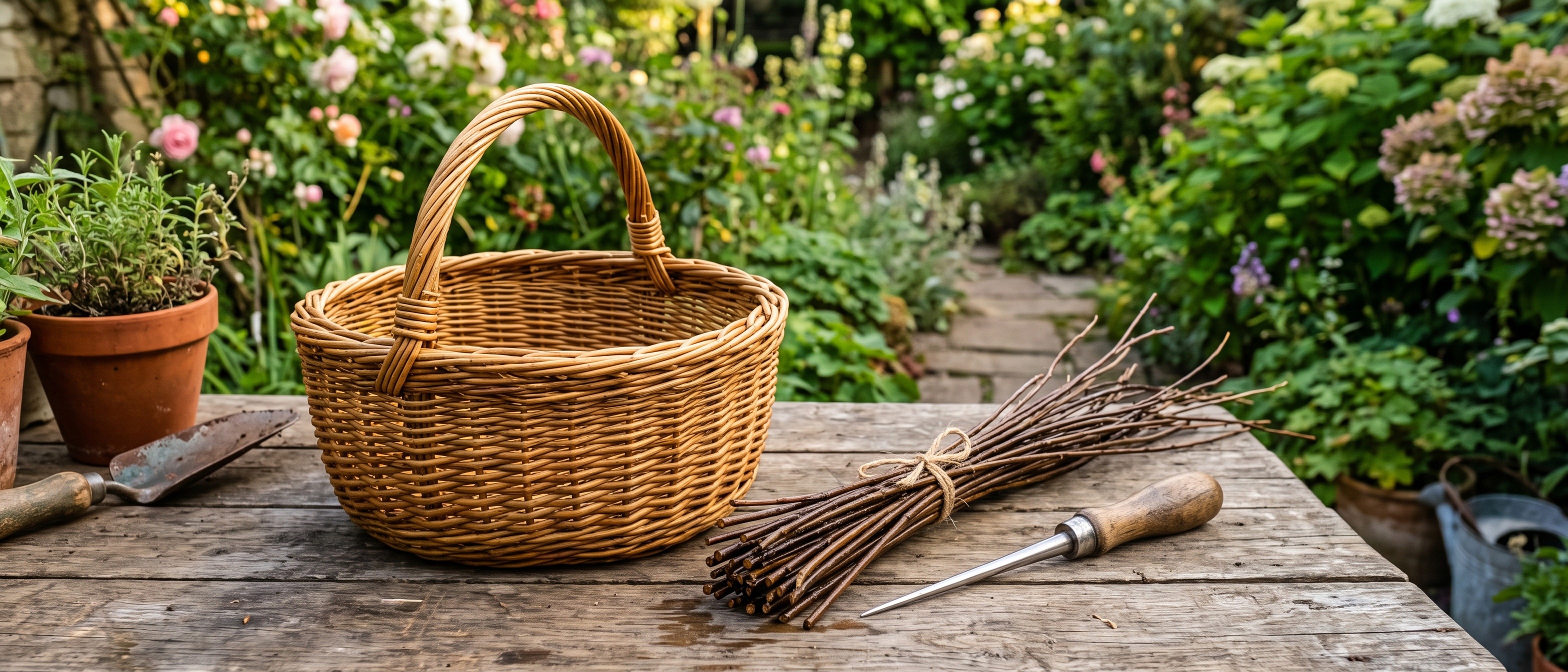
What you need
🌿 Materials
- Willow rods. 40-60 dried and re-soaked rods, mixed lengths: thicker 4-5 ft rods for stakes, thinner ones for weaving. Buff or brown willow both work for a first basket.
- Water. A bath, trough or wrapped-in-a-damp-towel arrangement - willow is only workable wet, and it drinks for days, not minutes.
🧰 Tools
- Secateurs. Sharp bypass pruners cut rods cleanly without crushing the fibres.
- Bodkin or stout awl. For opening gaps in the weave to slype new rods in.
- Knife. For slyping - the long angled cut on a rod end.
- Weight. Anything heavy sits inside the base while you weave the sides.
The build, step by step
1Soak the willow
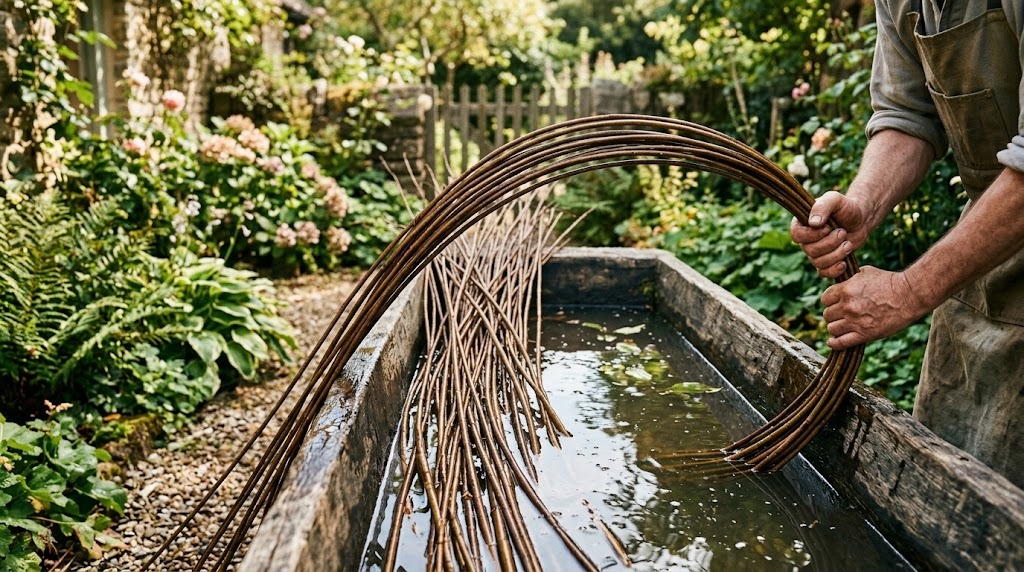
Dried willow has to be brought back to life before it will bend, and this is the step everyone underestimates. Brown (unpeeled) willow wants roughly a day of soaking per foot of rod length - a five-foot rod soaks for the better part of a week - then a day standing wrapped in a damp towel to mellow, which lets the moisture even out through the rod. Buff willow (boiled and peeled) is much quicker: an hour or two of soaking and an overnight mellow. A rod is ready when it will bend around your wrist without cracking. Weave with dry willow and the basket loosens as it shrinks; every slack, gappy first basket started here.
2Make the slath
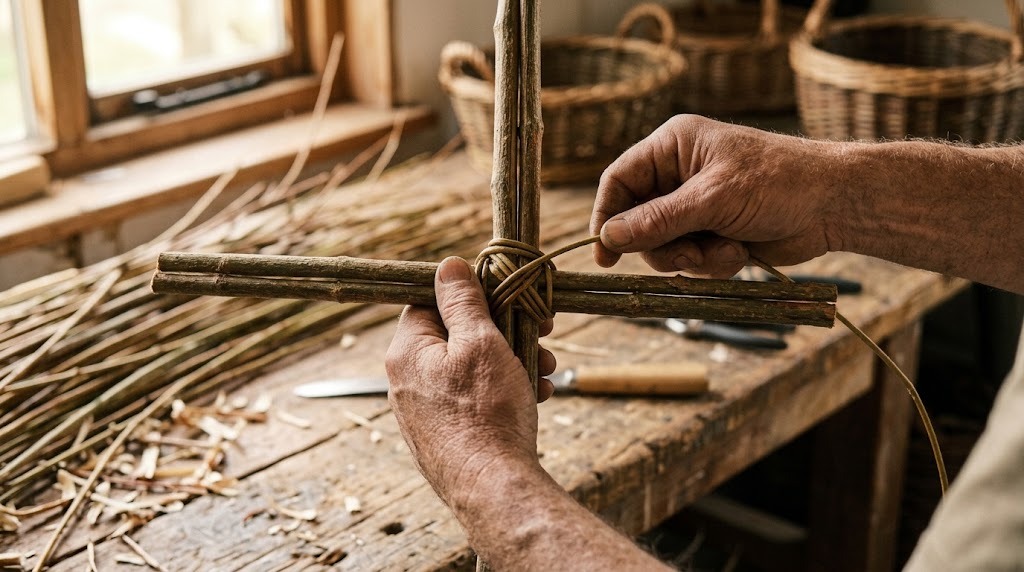
The base starts as a cross called a slath. Take six of your stoutest short rods, cut to about a foot. Pierce three of them through the middle with the bodkin (or a knife worked carefully on the bench, never toward a hand) and thread the other three through the split so you have a tight three-through-three cross. Now take two of your thinnest, longest weavers, fold them in half, loop them around one arm of the cross, and begin pairing - the two weavers twist around each other as they travel, one passing over each arm while its partner passes under. Two rounds locked around the cross as-is, then open the arms out like the spokes of a wheel.
3Weave the base
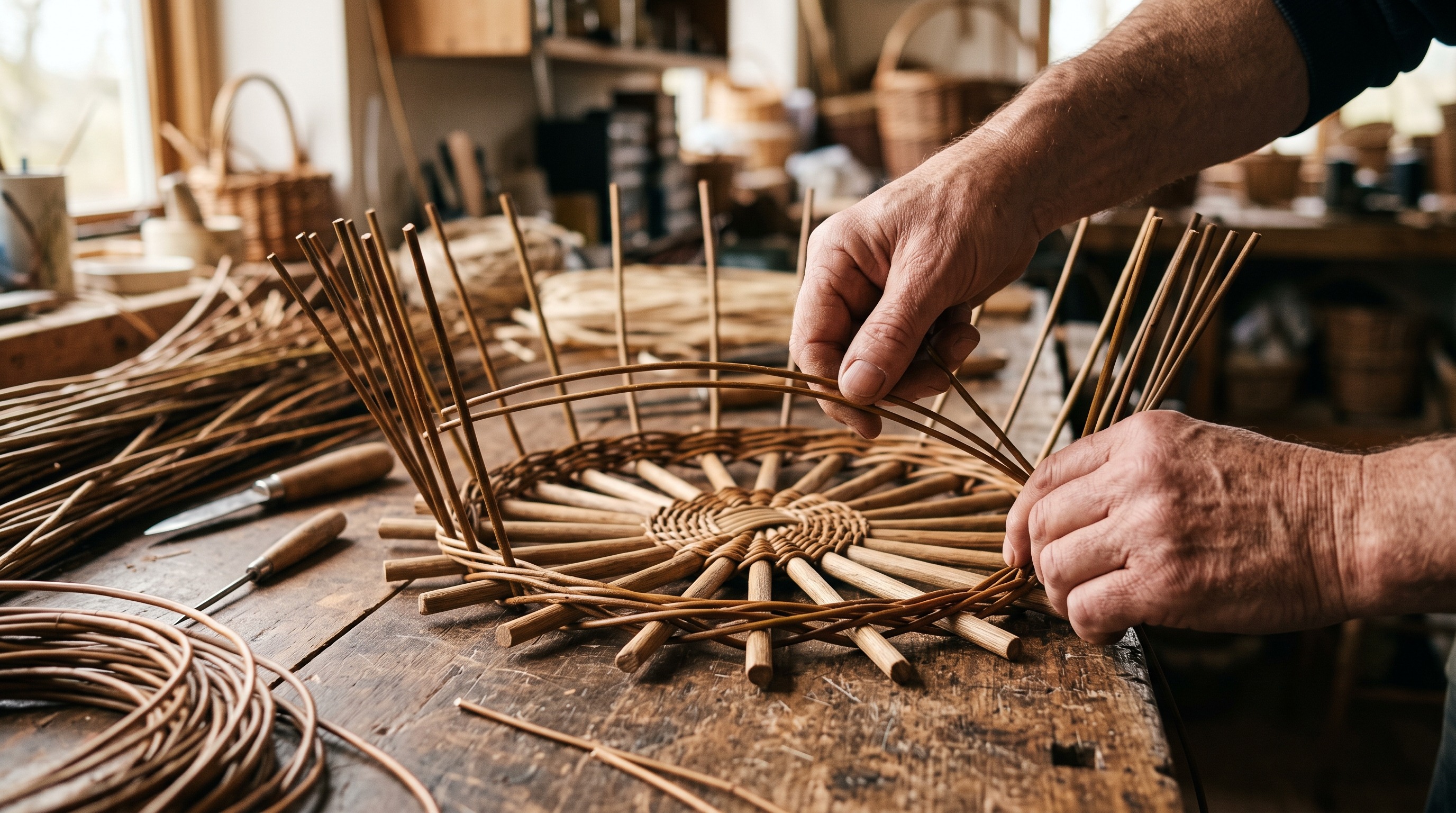
With the spokes opened out - twelve arms now, spread as evenly as you can - keep pairing round and round. The discipline of the base is spacing: every round, nudge the spokes so the gaps stay even, because a base that goes oval here stays oval forever. Add new weavers when one runs out by laying the new butt against the old one and carrying on. Weave until the base is a hand-span or so across - 8-10 inches is a friendly first size - then trim the weaver ends. A slight dome in the base is correct, not a fault: baskets sit on the rim of the base, and the dome puts spring in the bottom.
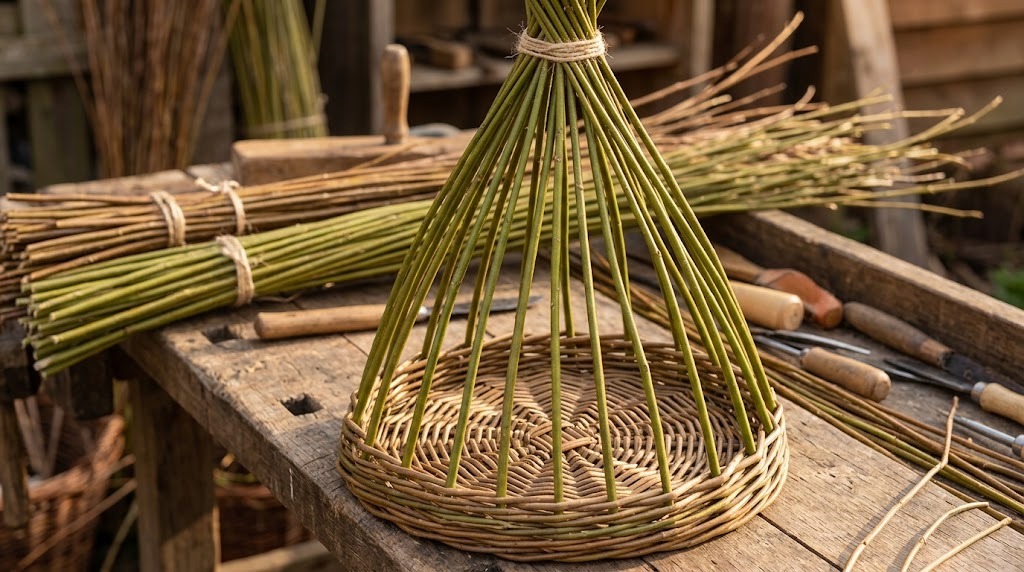
4Stake up
The side stakes are the skeleton of the basket. Slype 24 rods - one long angled cut across the butt end - and push one down into the weave beside each spoke, slyped face against the spoke, two per spoke on a twelve-spoke base. Then the moment of commitment: kink each stake upward with a thumbnail or the back of the knife right at the edge of the base, gather the whole bundle upright, and tie the tips together at the top so the basket-to-be looks like a wigwam. Weave a three-rod band called an upsett (three weavers, each passing in front of two stakes and behind one) around the bottom to lock the stakes upright and set the angle of the sides. Flared or straight is decided here, by how you hold the stakes as you work the upsett.
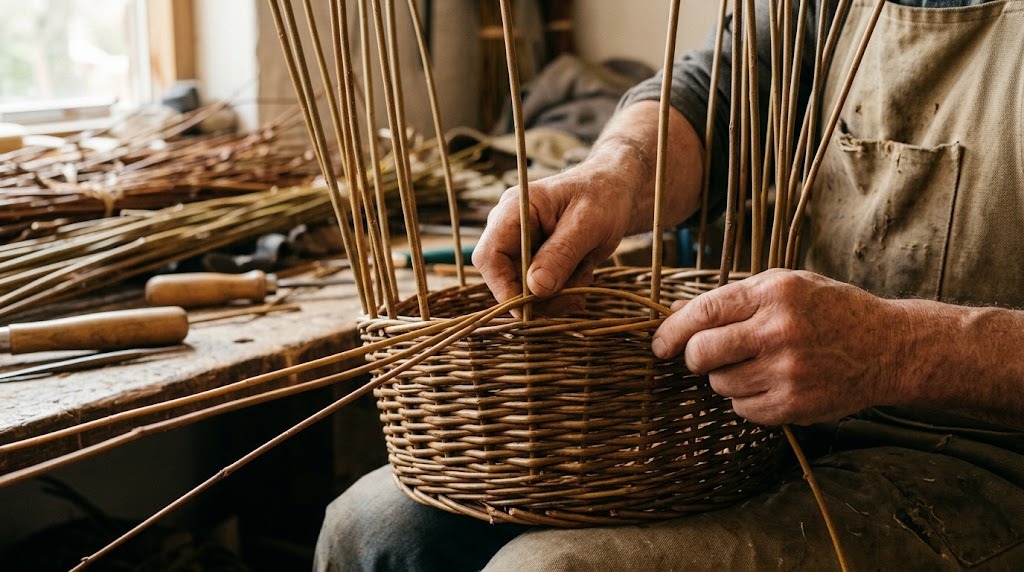
5Weave the sides
Untie the wigwam and weave. The beginner-proof stroke for sides is French randing: take one weaver per stake - all of similar length - set them in one behind the next around the whole basket, then work each one in turn a single stroke (in front of one stake, behind the next) so the whole set spirals up together at the same rate. It looks complicated written down and becomes obvious with the willow in hand. Keep a weight in the basket so nothing shifts, rap each row down snug with your fingers or the side of the bodkin as you go, and check the stakes stay vertical - sides that lean out a little are charming, sides that lean out more on one side are a lesson for basket two.
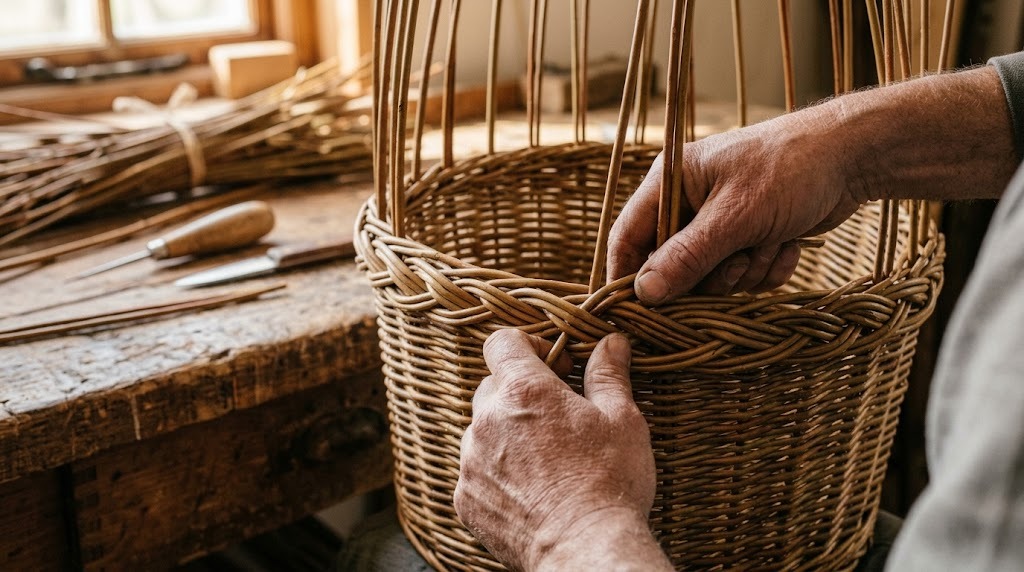
6Wale and border
Above the randing goes a band of waling - three weavers chasing each other, each stroke in front of two stakes and behind one - which draws the top of the basket in tight and makes the shoulder. Then the border: trim the stakes to a working length, kink each one down at the same height, and work a trac or three-rod border - each stake in turn bends down behind its neighbour, in front of the next, and tucks away, so the stakes themselves become the rim. Keep the kinks at one height and the border comes out level; rush it and the rim waves. Ends are trimmed on the slant, flush against a stake so nothing catches.
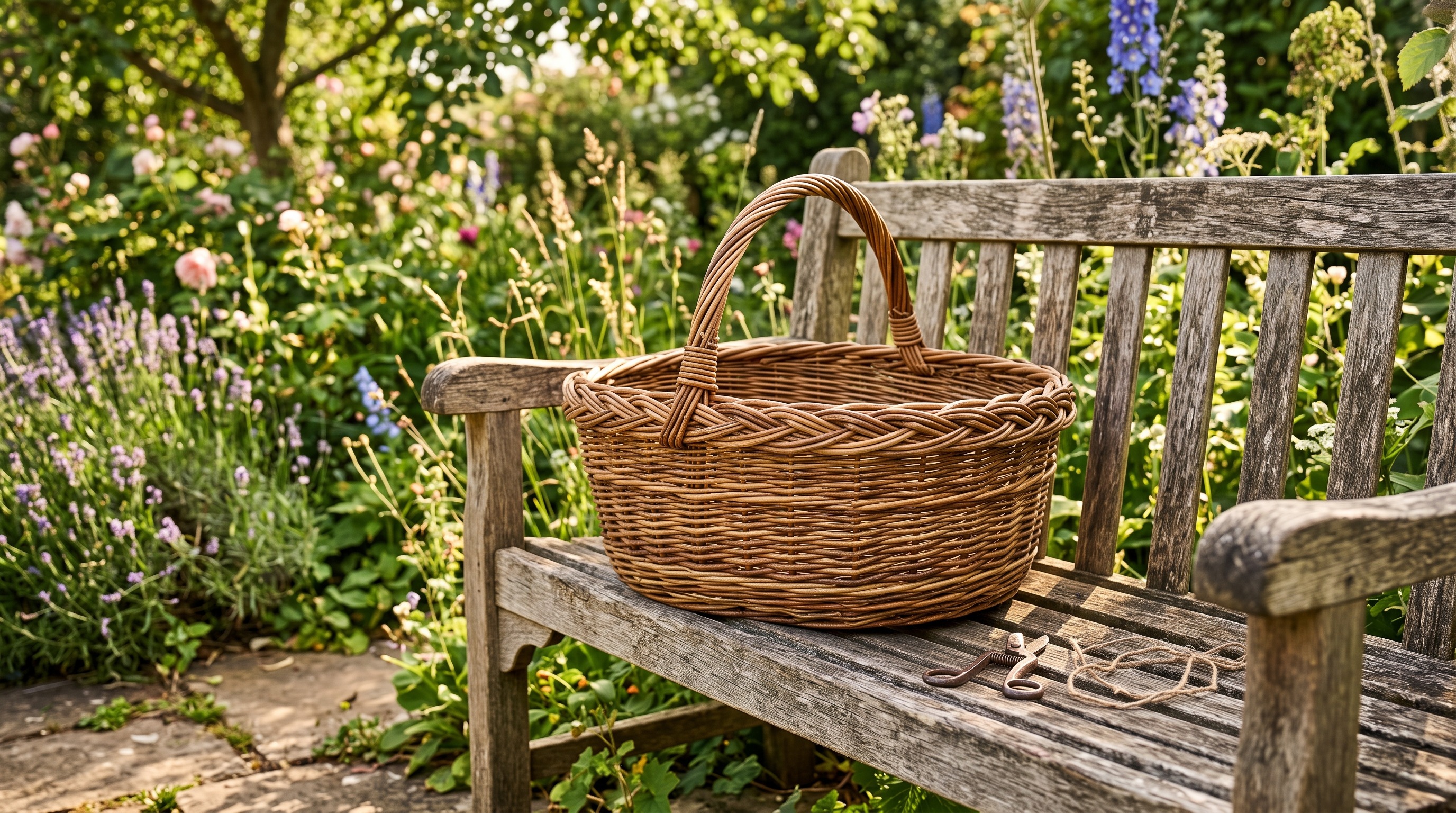
7Dry it and judge it
Let the basket dry slowly for a few days out of the sun, then trim any whiskers you missed. Now the honest look: the first basket is lopsided, the spacing wobbles, and the border has one awkward corner. That is the standard first basket, everyone's, including the people who now teach it - willow only becomes predictable in your hands after a few thousand strokes. Use it for kindling or onions, and start the second one while your hands still remember.