Spiral Cactus
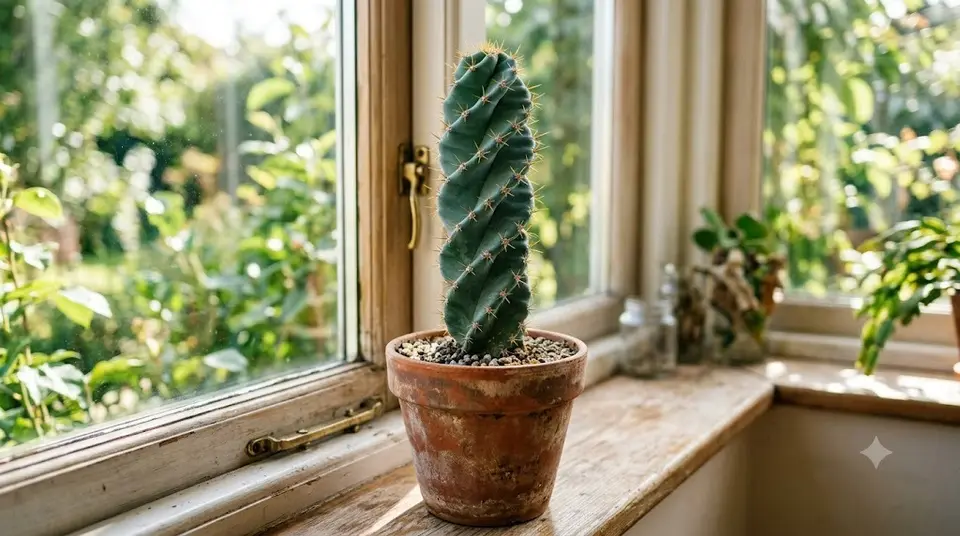
The spiral cactus is a mesmerising columnar cactus whose ribs twist gently around the stem in a slow helix, so the whole blue-green column looks gently wrung like a barley-sugar twist.
Last reviewed: October 2026
 AI illustration
 Overview
The spiral cactus is a mesmerising columnar cactus whose ribs twist gently around the stem in a slow helix, so the whole blue-green column looks gently wrung like a barley-sugar twist. A naturally occurring curiosity that grows relatively fast and opens huge white night flowers with age, it is a living sculpture for a bright spot.
Origin & Natural Habitat
The spiral form is a stable variant of Cereus (Cereus forbesii f. spiralis, sometimes listed under Cereus repandus), originating in South America. The spiralling is a genuine growth trait, propagated to keep the twist - and it grows at a satisfying pace for a cactus.
Appearance
An upright, ribbed, blue-green column in which the ribs wind slowly around the stem in a distinct spiral, giving a twisted, sculptural look that intensifies as the plant grows taller. Golden-brown spines line the ridges. Large, fragrant white flowers open at night on mature plants, followed by fruit.
Why People Love It - Qualities & Benefits
People love the hypnotic twist (a natural spiral is rare and beautiful) along with the fast (for a cactus) growth, the striking blue colour and the bonus of dramatic night flowers on older plants.
Care
Light
The brightest, sunniest position you have - a south window with hours of direct sun, or outdoors in warm weather. Strong light keeps the column firm, blue and tightly spiralled; poor light gives thin, pale, less-twisted growth.
Watering
Soak, then let the soil dry out before watering again - it drinks a little more than slow desert globes during warm growth but rots the same if kept wet. Keep nearly dry in winter. Avoid rubbing the stem, which marks the waxy bloom.
Soil & Potting
A gritty, free-draining cactus mix in a stable pot with drainage - a fast column gets top-heavy.
Humidity & Temperature
Warm, dry air suits it; ordinary room air is fine. Keep frost-tender plants above about 5-10°C and give a cooler, drier winter rest.
Feeding
A dilute cactus feed monthly through the warm growing season fuels its comparatively quick growth.
Repotting
Repot every couple of years in spring as it grows, handling with thick gloves and folded card. Choose a heavier pot as the column lengthens.
Propagation
From stem cuttings (callus a week, root upright in dry gritty mix); cuttings keep the spiral trait. Seed does not reliably reproduce the twist.
Common Problems & Pests
Overwatering rot at the base is the main danger. Finger-marks and rubs leave permanent green patches in the blue bloom, so handle by the pot. Etiolation (thin, pale, straighter growth) means too little light. Mealybugs can hide in the areoles.
Toxicity & Safety
The spiral cactus is not toxic to people or pets, but its spines can prick, so keep it out of reach of children and animals and handle with protection.
Pros & Cons
Pros: mesmerising natural spiral, striking blue colour, fast-growing for a cactus, night flowers with age. Cons: gets tall and top-heavy, blue bloom marks if handled, needs strong light to twist tightly, spiny.
Best Suited For
For anyone who wants a living sculpture on a sunny windowsill - the twist is a guaranteed talking point and it actually grows fast enough to enjoy.
FAQ
Is the spiral natural? Yes - it is a genuine, stable growth trait, propagated from cuttings so each plant keeps the twist.
Why is my column growing straighter and paler? Too little light - give it your sunniest spot and new growth twists tighter and bluer.
Gear for growing spiral cactus
Links go to Amazon or a partner store (such as Adagio Teas) and may earn us a commission at no extra cost to you. As an Amazon Associate we earn from qualifying purchases. We link gear types, not sponsors' picks: you choose the exact product.