Ruby Necklace (Othonna capensis)
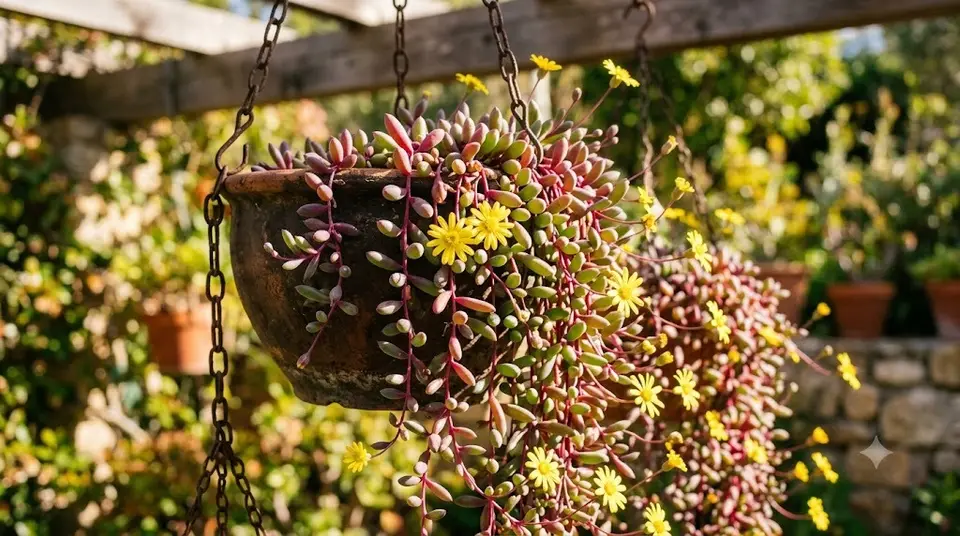
Ruby necklace is a fast, trailing succulent whose bean-shaped leaves hang on striking ruby-red stems - and in sun and mild stress the leaves themselves flush deep purple-red, with little yellow daisy flowers strung along the strands.
Last reviewed: October 2026
 AI illustration
 Overview
Ruby necklace is a fast, trailing succulent whose bean-shaped leaves hang on striking ruby-red stems - and in sun and mild stress the leaves themselves flush deep purple-red, with little yellow daisy flowers strung along the strands. It is the quickest, easiest way to add wine-dark colour to a hanging display.
Origin & Natural Habitat
Othonna capensis comes from the Eastern Cape of South Africa, trailing over rocks. It is related to the daisy family's succulent members and shares their speed and easy rooting.
Appearance
Slender trailing stems in vivid ruby-purple, set with plump, narrow, bean-like leaves that turn from green to rich purple-red with sun and drought stress ('happy stress'). Small bright yellow daisy flowers open along the strands in sun, mainly spring through autumn.
Why People Love It - Qualities & Benefits
People love the colour combination (ruby stems, wine-flushed beads, yellow daisies), and how fast it fills and spills from a pot. It is the red counterpart to string of pearls, and rather easier.
Care
Light
Full sun to very bright light brings the ruby colour and the flowers - a south-facing sill or bright porch. In shade it stays plain green and grows lax.
Watering
Soak when the soil is fully dry, then wait; a touch of drought deepens the red. Keep drier in winter. It rots in constantly damp soil like any trailing succulent.
Soil & Potting
A gritty, free-draining succulent mix in a hanging pot with drainage.
Humidity & Temperature
Ordinary dry room air is fine; keep it above about 5°C. Good light matters far more than warmth.
Feeding
A dilute succulent feed once or twice in the growing season - overfeeding gives lush green growth at the cost of the ruby colour.
Repotting
Repot every year or two in spring as it fills the pot; trim leggy strands freely - trimmings are cuttings.
Propagation
Very easy from stem cuttings: snip a strand, callus a day, lay it on gritty mix and it roots at the nodes within weeks.
Common Problems & Pests
Overwatering rot is the main risk; aphids and mealybugs occasionally. Plain green, sparse strands mean too little sun. Its daisy-family sap is best kept off skin, and the plant is not meant for eating.
Toxicity & Safety
Ruby necklace's toxicity is not well documented - as with other daisy-family succulents, treat it with caution: keep it out of reach of pets and children and wash hands after pruning.
Pros & Cons
Pros: ruby-red stems and wine-flushed leaves, fast and easy, cheerful yellow daisies, roots from any cutting. Cons: colour needs real sun and lean care, toxicity unclear so keep from pets, rots if kept damp.
Best Suited For
For hanging pots and bright sills that need colour beyond green - and for growers who like quick, visible results.
FAQ
How do I get the red colour? Full sun and lean, dryish care - pampering in shade keeps it green.
Is it safe for cats? Its toxicity isn't well documented - play safe and hang it out of reach.
Gear for growing ruby necklace (othonna capensis)
Links go to Amazon or a partner store (such as Adagio Teas) and may earn us a commission at no extra cost to you. As an Amazon Associate we earn from qualifying purchases. We link gear types, not sponsors' picks: you choose the exact product.