Mexican Butterwort
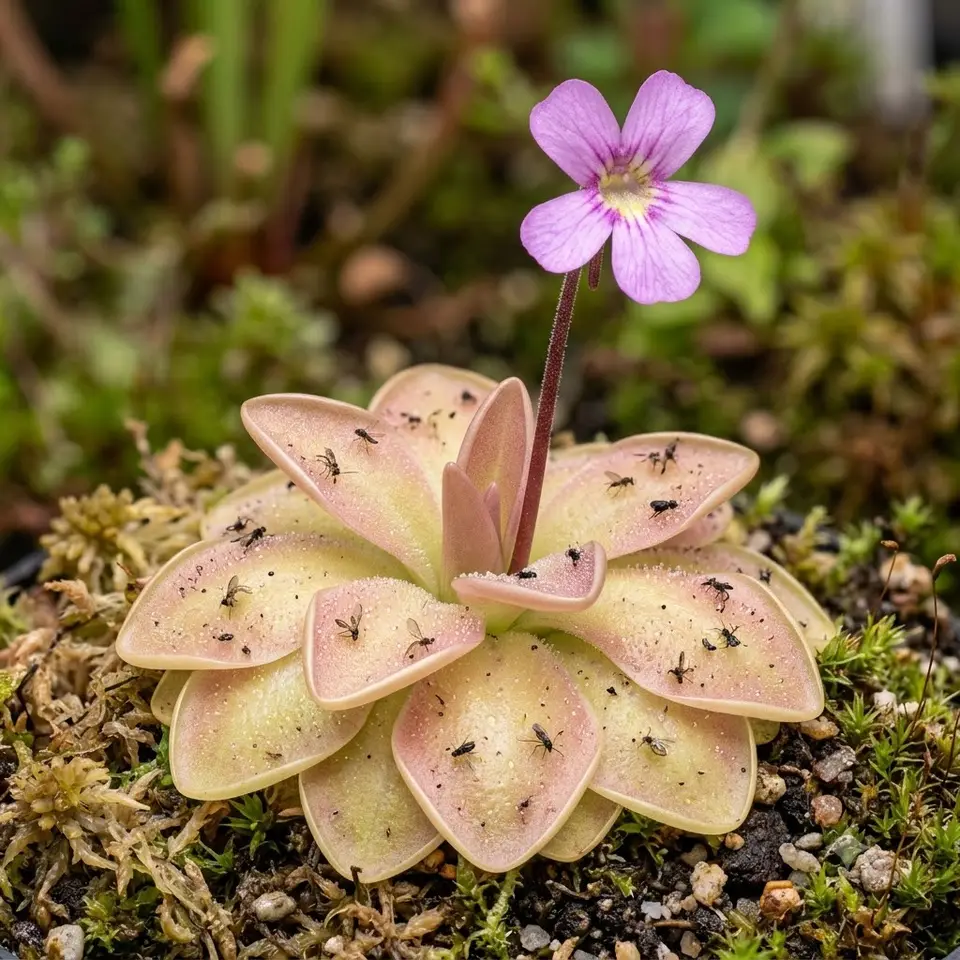
Mexican butterworts form pastel rosettes whose greasy leaves are lethal flypaper for gnats, crowned with orchid-pink blooms half the year.
Last reviewed: October 2026
 AI illustration
 Overview
Mexican butterworts form pastel rosettes whose greasy leaves are lethal flypaper for gnats, crowned with orchid-pink blooms half the year. Uniquely among carnivores they take succulent-adjacent care and even tolerate harder water: the windowsill diplomat of the guild. (Pinguicula (Mexican species/hybrids).)
Origin & Natural Habitat
Limestone and gypsum cliffs of Mexico - seasonally dry, bright; they grow beside cacti, not in bogs, which rewrites their rules.
Appearance
Flat buttery rosettes 4-12 cm, pink-flushed in light; leaves are micro-flypaper (gnats stick by the dozen); tall violet-like pink/purple flowers repeatedly through the warm season.
Why People Grow It - Qualities & Benefits
- THE fungus-gnat solution: flypaper that reblooms
- Orchid-pretty flowers on a carnivore
- Tolerates (mildly) hard water and dry spells: unique
- Tiny footprint, endless charm
Care
Light: Bright with gentle sun - succulent-shelf light; blushing leaves = happy.
Water: Loose rules by carnivore standards: pure water preferred, moderately hard tolerated (limestone genes); keep just-moist in growth, DRIER in winter when many form succulent non-carnivorous rosettes.
Soil: Their own recipe: mineral mix (perlite/pumice/sand with a little peat) - or even pure pumice; the limestone exception to the peat rule.
Temperature & Dormancy: 15-29°C rooms; winter 'succulent phase' (smaller fleshy leaves) wants light watering only - respect the phase change.
Feeding: Self-service gnat control - a colony under grow lights ends a gnat problem in weeks.
Propagation
Absurdly easy from leaf pullings in winter phase - each fleshy leaf sprouts a plantlet; collections multiply themselves.
Common Problems & Pests
- Winter rot from summer-level watering (read the succulent phase)
- Etiolation in dim corners
- Almost pest-free (pests land, pests stick, pests die)
Toxicity & Safety
Non-toxic to cats, dogs and people - carnivorous plants digest insects, not pets; the only real risk runs the other way (cats batting the traps).
Pros & Cons
Pros
- Best-in-class gnat control
- Repeating pink blooms
- Forgiving water rules
- Propagates from single leaves
Cons
- Small and subtle vs pitcher drama
- Phase-based care to learn
- Sticky leaves scar if handled
Best Suited For
- Houseplant shelves with gnat issues
- Succulent growers crossing over
- Windowsills and grow-light cabinets
- Collectors of quiet perfection
FAQ
My butterwort shrank into a tight bald rosette - dying?
Winter succulent phase - the Mexican species' resting form. Water sparingly until spring's sticky leaves return, and take leaf pullings NOW (they root best from this phase).
Will one really clear my fungus gnats?
A few plants near the infested pots out-trap yellow sticky cards in most homes - and rebloom in pink while doing it.
Gear for growing mexican butterwort
Links go to Amazon or a partner store (such as Adagio Teas) and may earn us a commission at no extra cost to you. As an Amazon Associate we earn from qualifying purchases. We link gear types, not sponsors' picks: you choose the exact product.