Lifesaver Plant (Huernia zebrina)
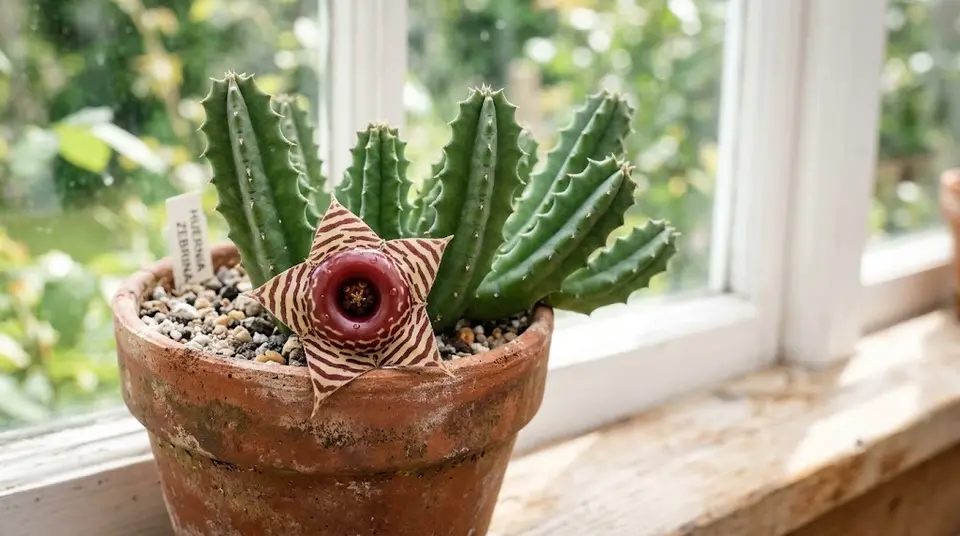
The lifesaver plant is a low, creeping succulent with toothed stems and one of the oddest flowers a windowsill can hold: a flat, five-pointed star striped like a zebra, with a thick, glossy red ring in the middle that looks like a sweet.
Last reviewed: October 2026
 AI illustration
 Overview
The lifesaver plant is a low, creeping succulent with toothed stems and one of the oddest flowers a windowsill can hold: a flat, five-pointed star striped like a zebra, with a thick, glossy red ring in the middle that looks like a sweet. It is easy and compact, and it holds the Royal Horticultural Society's Award of Garden Merit (Wikipedia). Like its stapeliad relatives, the open flower smells of carrion to call in flies - usually faintly, from close up.
Origin & Natural Habitat
Huernia zebrina is native to Namibia, Botswana, northern South Africa, Zimbabwe and Mozambique (Wikipedia). LLIFLE describes its home as open, dry scrubland at low altitude, on stony ground, often over calcrete or hard loamy soil - which is why it wants gritty, fast-draining mix and warmth.
Appearance
Short, toothed green stems - LLIFLE gives about 5 cm long and 12 mm thick, with five or six angles and teeth around 4.5 mm - that sprawl and root into low mats, often flushing red or purple in good light. The flowers are flat stars (25-)35-45(-50) mm across according to LLIFLE, greenish-yellow with red to purple cross-stripes, around a raised, glossy annulus in red to purple-brown: the "lifesaver" of the name.
Why People Love It - Qualities & Benefits
The flower does the work: few houseplants produce anything as strange as the striped star with its shiny ring, and a small clump flowers freely once it is warm and bright. It stays low, roots from any broken stem, and takes up very little room.
Care
Light
LLIFLE advises half shade in summer, and that suits a windowsill: bright light for most of the day, but not the full glare of a hot south window at noon, which can redden and scar the stems. Too little light gives thin, pale stems and few buds.
Watering
Water when the mix has dried out, and less than you would give most succulents on hot days - LLIFLE says to water very carefully when it is warm. In winter keep it almost dry. The stems store water; rot, not drought, is what kills it.
Soil & Potting
LLIFLE recommends a very draining substrate with a large share of sharp sand, perlite or pumice. A shallow, wide pot suits the creeping stems better than a deep one.
Humidity & Temperature
Warm and airy. LLIFLE puts the winter minimum above 10 °C - warmer than many succulents - so keep it away from cold glass and unheated rooms over winter, and dry while it is cool.
Feeding
A weak cactus feed once a month in late spring and summer, when it is growing and setting buds; none in autumn and winter.
Repotting
When the mat reaches the rim, in late spring once nights are warm. Old stems in the middle often die back; this is the moment to discard them and replant the young outer pieces, then wait a few days before the first watering.
Propagation
Rooting stem cuttings is the easiest way (LLIFLE): snap off a stem, let it dry for a few days and lay it on gritty mix, where it roots along the underside. Pieces of a mat that already carry roots can simply be potted up.
Common Problems & Pests
LLIFLE names black rot and mealybugs as the main threats. Rot shows as stems turning soft and black from the base - cut away everything affected, dry the healthy pieces and reroot them in fresh, dry mix. Mealybugs hide in the furrows between the teeth and at soil level. In summer an open flower can bring the odd fly to a window.
Toxicity & Safety
It is not considered toxic to people or pets, so it can sit where animals are around - still, keep cats and dogs from chewing the stems.
Pros & Cons
Pros: striped star flowers with a glossy red ring, low and compact, roots from any stem, RHS Award of Garden Merit, not considered toxic. Cons: the open flowers smell of carrion and can draw flies, the stems rot in cold or wet soil, needs more winter warmth than most succulents.
Best Suited For
A warm, bright windowsill in a home where an occasional whiff from an open flower is part of the fun - for growers who want a remarkable flower from a small, easy plant.
FAQ
Does it smell like the carrion flowers? Yes, though usually faintly and only from close up: LLIFLE and Wikipedia both say the flowers give off a carrion smell to attract flies, which pollinate them.
Why are the stems going soft and black? Black rot, which LLIFLE names as the main threat - usually from water given when it is cool. Cut out the soft parts, let the healthy stems dry and reroot them.
Gear for growing lifesaver plant (huernia zebrina)
Links go to Amazon or a partner store (such as Adagio Teas) and may earn us a commission at no extra cost to you. As an Amazon Associate we earn from qualifying purchases. We link gear types, not sponsors' picks: you choose the exact product.