Hoya Retusa
Hoya retusa is the grass hoya - flat, ribbon-thin leaves notched at the tip, tumbling from the pot like a head of green hair.
Last reviewed: October 2026
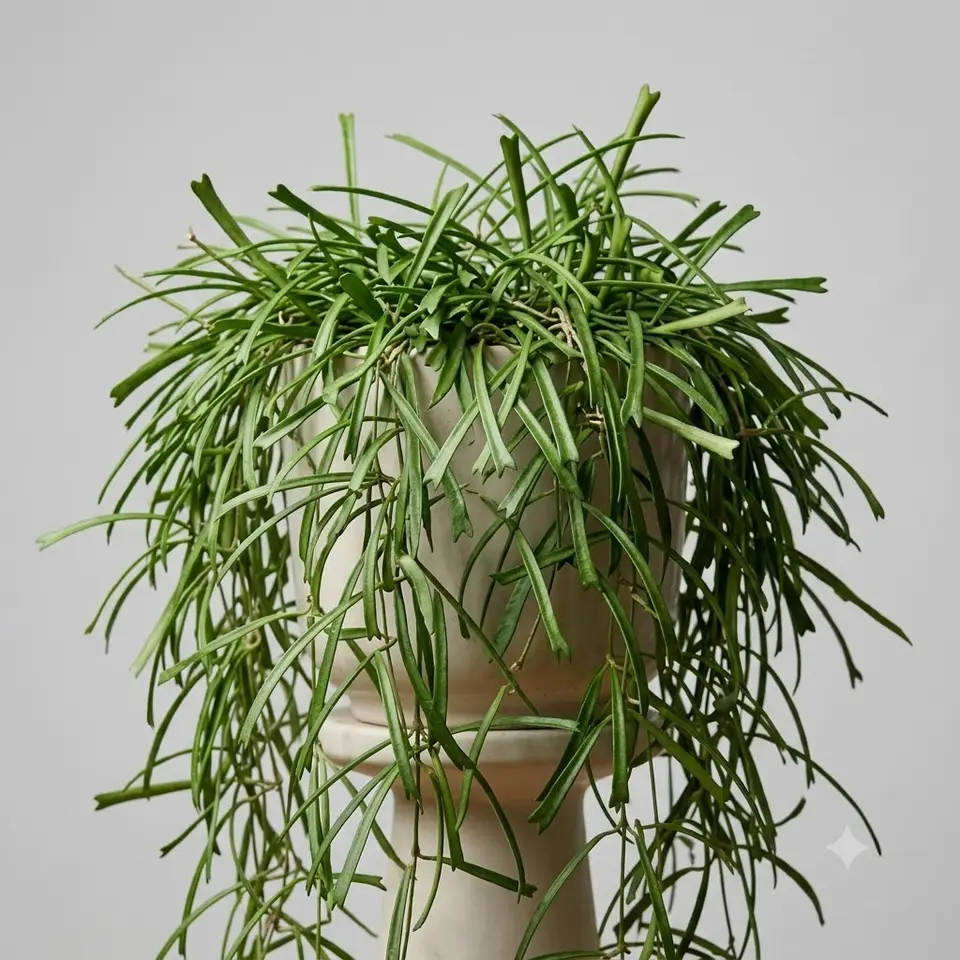 AI illustration
 Overview
Hoya retusa is the grass hoya - flat, ribbon-thin leaves notched at the tip, tumbling from the pot like a head of green hair. Nothing about it says 'hoya' until the perfect white-and-maroon stars appear, singly, all over the mop. The genus's best double-take. (Hoya retusa.)
Origin & Natural Habitat
The Western Ghats of India - a fine-leaved epiphyte of monsoon forest, adapted to bright light and seasonal moisture rhythms.
Appearance
Flat linear leaves 5-7 cm ending in a notch, densely tufted on thin stems to 60 cm; flowers come mostly SINGLE (not in umbels) - crisp white stars with maroon coronas dotted through the foliage.
Why People Grow It - Qualities & Benefits
- Grass-mop look unique in the genus
- Single scattered flowers: a different bloom style
- Denser and easier than linearis
- Compact, curious, conversation-starting
Care
Light: Bright indirect with gentle sun; more light = denser mop and more stars.
Water: Even moisture with brief dry-downs - finer leaves than the succulent set, tougher than linearis; weekly checks.
Soil: Airy epiphyte mix, modest pot.
Temperature & Humidity: 17-28°C; more heat-tolerant than its Himalayan lookalike.
Feeding: Dilute monthly in growth.
Extra: Often confused with linearis: retusa's leaves are FLAT with notched tips (linearis = rounded/grooved, fuzzy) and it's the more forgiving plant. Buy retusa for the look with fewer tears.
Propagation
Bundle a few stems as one cutting into sphagnum - they root in weeks and instantly look intentional. Singles look like stray grass.
Common Problems & Pests
- Drying to crisp in neglect (finer margins than thick-leaf hoyas)
- Rot in heavy wet soil
- Tangling: purely cosmetic
Toxicity & Safety
Non-toxic to cats and dogs.
Pros & Cons
Pros
- Unmistakable texture
- Freckled-with-stars bloom habit
- Easier than it looks
- Small-space friendly
Cons
- Middling drought buffer
- Can look scruffy unstyled
- Flowers lack umbel drama
Best Suited For
- Hanging pots at eye level
- Texture contrast in plant walls
- Linearis admirers wanting easier
- Collectors of oddities
FAQ
Retusa or linearis?
Same vibe, different difficulty: retusa is flatter-leaved, denser, warmth-tolerant and forgiving; linearis is fuzzier, cool-loving and touchy. Start retusa.
Why are flowers appearing one by one, not in balls?
Species habit - retusa blooms mostly solitary stars scattered through the mop rather than umbels. It reads like the plant put on polka dots.
How do I thicken the mop?
Root bundles of cuttings back into the same pot each spring - the hairdo doubles every season.
Gear for growing hoya retusa
Links go to Amazon or a partner store (such as Adagio Teas) and may earn us a commission at no extra cost to you. As an Amazon Associate we earn from qualifying purchases. We link gear types, not sponsors' picks: you choose the exact product.