Hoya Multiflora (Shooting Star)
Hoya multiflora is an upright, shrubby hoya whose flowers don't form balls at all: they streak backward like tiny comets, in big sprays, nearly all year.
Last reviewed: October 2026
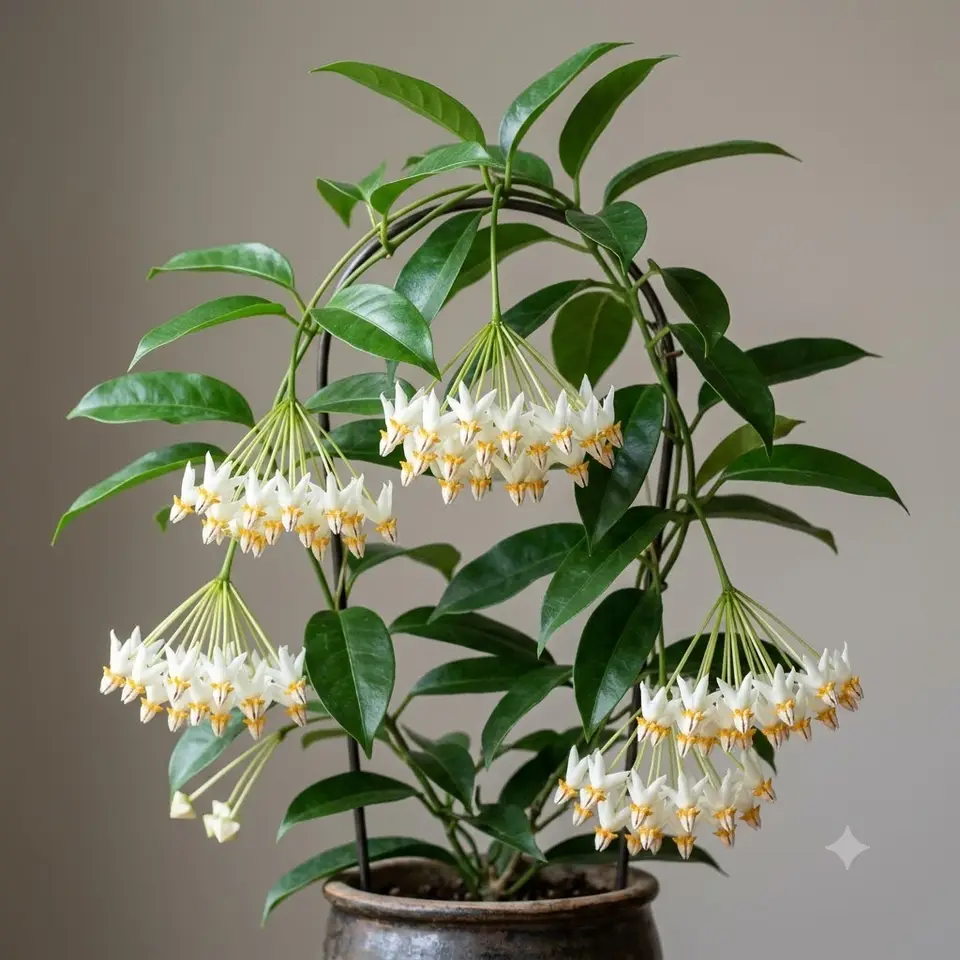 AI illustration
 Overview
Hoya multiflora is an upright, shrubby hoya whose flowers don't form balls at all: they streak backward like tiny comets, in big sprays, nearly all year. It skips most hoya rules (including the succulent ones), and out-blooms everything wearing the family name. (Hoya multiflora.)
Origin & Natural Habitat
Lowland rainforest of Malaysia, Indonesia and the Philippines - a warm, moist, shade-edge shrublet rather than a dry-forest vine.
Appearance
An upright bush 30-90 cm with large thin glossy leaves; sprays of white-and-gold flowers with fully reflexed petals (the 'shooting star' silhouette) often 20-40 per umbel, repeating almost continuously.
Why People Grow It - Qualities & Benefits
- The most and longest blooms of any hoya
- Unique comet-shaped flowers
- Self-supporting bush: no trellis, no hanger
- Fast, satisfying, generous
Care
Light: Bright indirect; tolerates less than most bloomers and still flowers.
Water: Evenly moist with the top drying between - thin leaves mean it drinks like a normal tropical, NOT like a succulent hoya; drought crisps it fast.
Soil: Rich-but-airy tropical mix (more peat/coir than typical hoya blends).
Temperature & Humidity: 18-30°C, the warmer the better; no cold windowsills.
Feeding: Dilute, every two weeks, year-round-ish - continuous bloom runs on continuous groceries.
Extra: Expect some leaf drop after relocation (it re-leafs), keep it away from cold drafts, and never remove spurs - the comets return from the same launch pads for years.
Propagation
Cuttings root in warm sphagnum readily; young plants can bloom within the year - the genus's quickest payoff.
Common Problems & Pests
- Crisping/drooping from missed waterings (no succulent buffer)
- Leaf drop after moves or chills (temporary)
- Occasional aphids on the endless buds
Toxicity & Safety
Non-toxic to cats and dogs; sap can irritate sensitive skin - the usual hoya note.
Pros & Cons
Pros
- Blooms basically always
- Sculptural comet flowers
- No support structures needed
- Quick from cutting to flowering
Cons
- Thirstier than hoya reputation suggests
- Cold-sensitive
- Bushy habit surprises vine expectations
Best Suited For
- Warm bright rooms wanting constant flowers
- Hoya collectors after the oddball
- Tabletop specimen pots
- People who overwater hoyas anyway (finally, a match)
FAQ
Why does my multiflora wilt when my other hoyas don't?
Thin leaves, no water storage - it's the hoya that actually needs regular watering. Treat it like a gardenia, not a cactus.
How long do the flower sprays keep coming?
Healthy warm plants push overlapping umbels most of the year - dozens of comets at a time, with a light honey scent and (fair warning) some sticky nectar drips: coaster underneath.
Does it climb?
Barely - it's naturally an upright shrublet. Stake a leaning stem if needed and enjoy the rare hoya that holds its own posture.
Gear for growing hoya multiflora (shooting star)
Links go to Amazon or a partner store (such as Adagio Teas) and may earn us a commission at no extra cost to you. As an Amazon Associate we earn from qualifying purchases. We link gear types, not sponsors' picks: you choose the exact product.