Hoya Curtisii
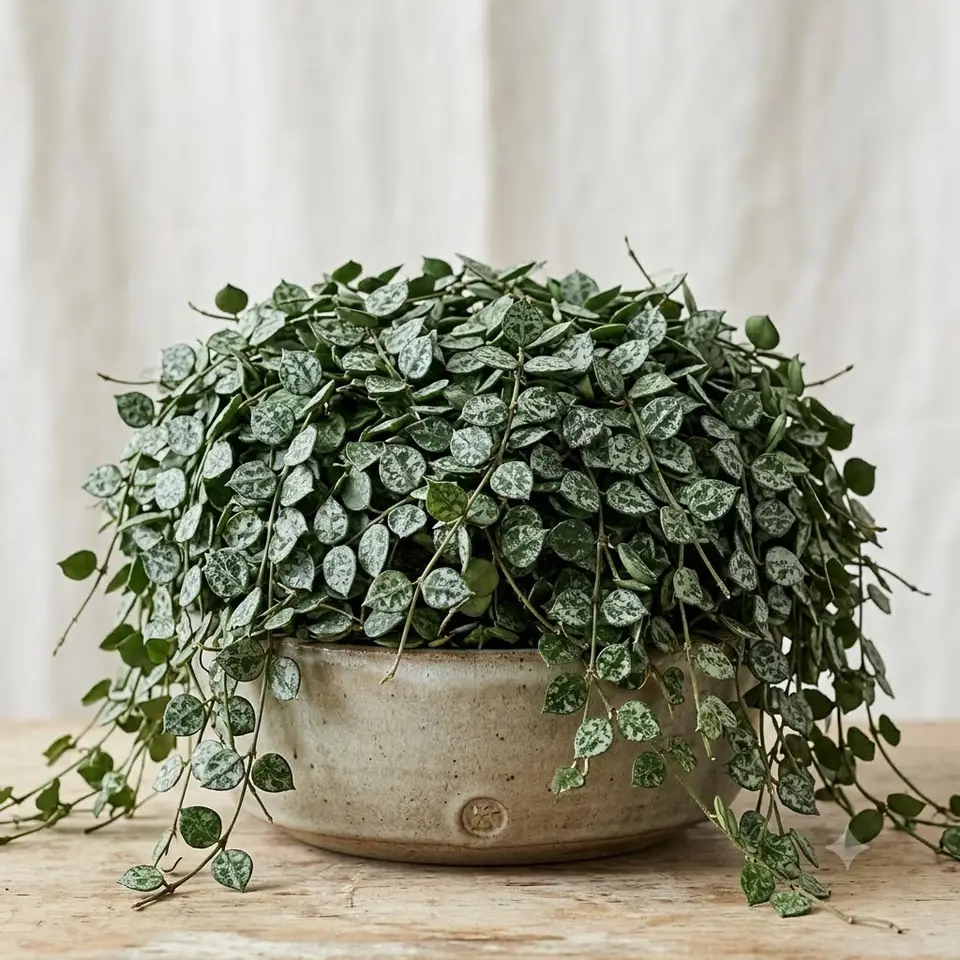
Hoya curtisii has fingernail-sized leaves of grey-green mosaic on threadlike stems that creep over the pot rim and hang like a beaded veil.
Last reviewed: October 2026
 AI illustration
 Overview
Hoya curtisii has fingernail-sized leaves of grey-green mosaic on threadlike stems that creep over the pot rim and hang like a beaded veil. It behaves more like a miniature groundcover than a vine, filling shallow pots into perfect cushions. (Hoya curtisii.)
Origin & Natural Habitat
The Philippines, Malaysia and Thailand, creeping across mossy rocks and bark in filtered light.
Appearance
Heart-to-spade leaves under 1.5 cm, olive marbled with silver, on fine trailing stems; mature cushions produce comparatively large fuzzy yellow-green stars with red eyes - alien and lovely.
Why People Grow It - Qualities & Benefits
- Miniature mosaic foliage: jewelry-scale beauty
- Cushion habit unique among common hoyas
- Perfect for small pots and tight shelves
- Surprisingly tough for its size
Care
Light: Bright indirect; some gentle morning sun deepens the marbling.
Water: When the shallow pot's top dries - small root systems dry faster than big hoyas, so check weekly; still never soggy.
Soil: Fine-chunky epiphyte mix in a SHALLOW pot - depth it will never use invites rot.
Temperature & Humidity: 18-28°C, average humidity or better.
Feeding: Very dilute monthly feeding in growth.
Extra: Let it carpet the surface before expecting cascade: curtisii spreads first, spills second. Pin wandering stems onto the mix with hairpins - they root and thicken the cushion.
Propagation
Pinned-stem layering (rooting while attached) is nearly foolproof; snipped cuttings in sphagnum work too. Build density, then share.
Common Problems & Pests
- Drying out in tiny pots (its one vulnerability)
- Rot in deep wet containers
- Slow start before the carpet thickens
Toxicity & Safety
Non-toxic to cats and dogs.
Pros & Cons
Pros
- Exquisite miniature foliage
- Fits where no other hoya fits
- Self-thickening with pinning
- Odd, beautiful flowers
Cons
- Small margin for neglect
- Slow to make a show
- Easily overpotted to death
Best Suited For
- Shallow bowls and azalea pots
- Small-space collections
- Desk and shelf gardens
- Terrarium edges (open, airy ones)
FAQ
Why a shallow pot?
The roots are as fine as the stems - unused deep soil stays wet and rots them. A bonsai-style shallow pot matches root reality.
How do I make it fuller?
Pin every wanderer back onto the soil; each pinned node roots into new density. Six months of pinning = the lush cushion in the photos.
Does it really flower?
Mature cushions do - waxy chartreuse stars with red centers, big for the plant. Bright light and root-snugness are the triggers, as ever.
Gear for growing hoya curtisii
Links go to Amazon or a partner store (such as Adagio Teas) and may earn us a commission at no extra cost to you. As an Amazon Associate we earn from qualifying purchases. We link gear types, not sponsors' picks: you choose the exact product.