Flaming Katy
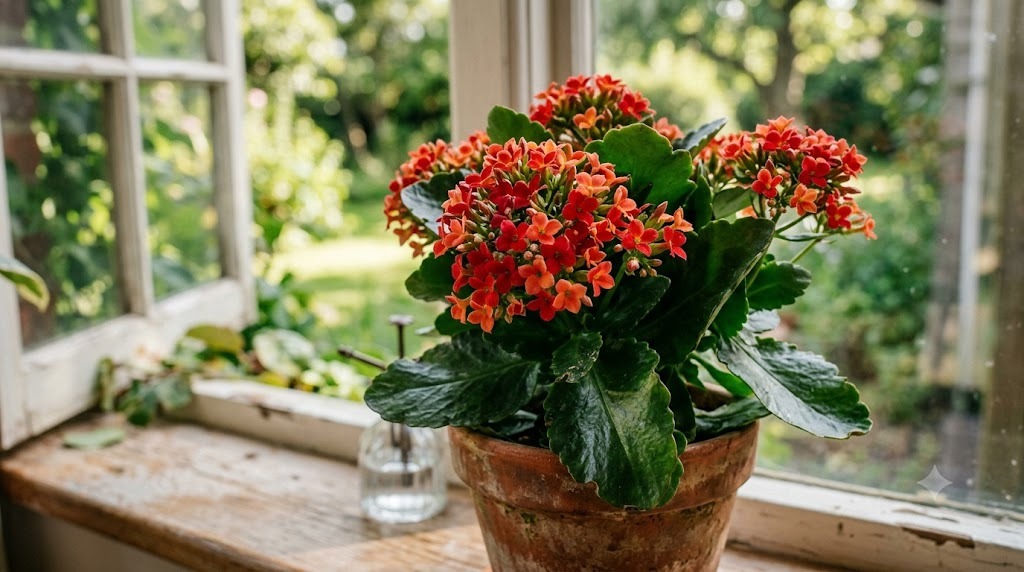
Flaming Katy is the cheerful, mass-market kalanchoe you see banked up in supermarkets, smothered in long-lasting clusters of tiny flowers in red, orange, pink, yellow or white above glossy, scalloped leaves.
🗓️ Last reviewed: July 2026
Overview
Flaming Katy is the cheerful, mass-market kalanchoe you see banked up in supermarkets, smothered in long-lasting clusters of tiny flowers in red, orange, pink, yellow or white above glossy, scalloped leaves. It is an easy, forgiving succulent that blooms for weeks - and, with a little dark-nights trick, can be coaxed to flower again. Note it is toxic to pets.
Origin & Natural Habitat
Kalanchoe blossfeldiana comes from Madagascar, growing in bright, dry, rocky conditions. It has become one of the world's most popular flowering pot plants, bred into countless colours.
Appearance
A compact, bushy succulent with thick, glossy, scallop-edged green leaves, topped by dense, rounded clusters of many small four-petalled flowers in vivid reds, oranges, pinks, yellows and whites. Flowers last for weeks, sometimes months. Modern strains are often dwarf and double-flowered.
Why People Love It - Qualities & Benefits
People love the sheer flower power - weeks of bright bloom from an easy, cheap, forgiving plant - and the glossy succulent foliage between flushes. It is a reliable spot of colour for a bright windowsill and a popular gift.
Care
Light
Bright light with some direct sun keeps it compact and flowering - a sunny windowsill is ideal. It also needs genuinely dark nights to set new buds (see FAQ). Too little light gives leggy, shy-flowering growth.
Watering
Water when the soil is fully dry, then soak and drain; the fleshy leaves store water and rot if kept wet. Water into the soil, not over the flowers, and keep drier in winter. Overwatering is the main way to kill it.
Soil & Potting
A gritty, free-draining succulent mix in a pot with drainage.
Humidity & Temperature
Warm, dry air suits it; it dislikes humidity. Ordinary dry room air is ideal; keep it above about 10°C - it is frost-tender.
Feeding
A dilute succulent or flowering feed once or twice in the growing season supports the blooms; ease off in winter.
Repotting
Repot every couple of years in spring, or simply replace tired plants - they are inexpensive and root easily from cuttings. Pinch back after flowering to keep it bushy.
Propagation
Very easy from stem or leaf cuttings: let a cutting callus for a day or two, then set it on gritty soil to root. New plants flower within a season or two.
Common Problems & Pests
Overwatering rot is the main danger. Leggy growth and no flowers mean too little light - or too much artificial light at night blocking bud set. Mealybugs and aphids can appear, especially on flower buds.
Toxicity & Safety
Flaming Katy is a kalanchoe, and kalanchoes are toxic to cats and dogs if eaten - they can cause vomiting and, less commonly, dangerous heart-rhythm problems. Keep it well out of reach of pets and children, and if a pet chews it, contact a vet. Enjoy this one at a safe height in a pet-aware home.
Pros & Cons
Pros: weeks of vivid flowers, easy and cheap, glossy succulent foliage, effortless to propagate. Cons: toxic to cats and dogs, needs dark nights to re-bloom, rots if overwatered.
Best Suited For
For a bright windowsill that needs dependable colour, and for beginners - best in a pet-free home, or kept well out of any animal's reach.
FAQ
How do I make it flower again? After blooming, give it about six weeks of long, uninterrupted dark nights (14+ hours of total darkness, no lamps or screen glow) to trigger new buds - a short-day plant.
Is Flaming Katy safe for cats? No - as a kalanchoe it is toxic to cats and dogs; keep it out of reach.