Claret Cup Cactus
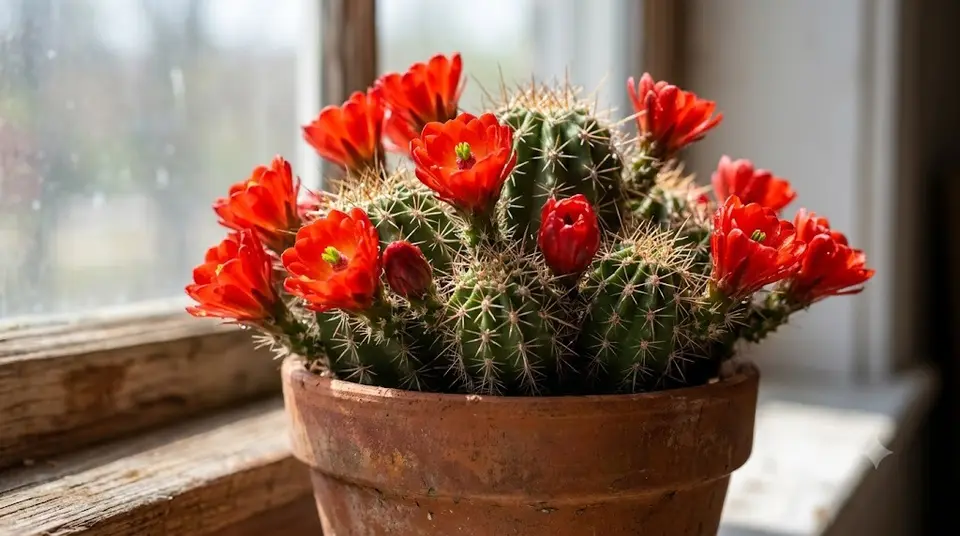
The claret cup is a hardy, clustering hedgehog cactus that mounds into a dome of spiny green stems and then, in spring, sets it ablaze with waxy, cup-shaped scarlet flowers that last for days rather than hours.
Last reviewed: October 2026
 AI illustration
 Overview
The claret cup is a hardy, clustering hedgehog cactus that mounds into a dome of spiny green stems and then, in spring, sets it ablaze with waxy, cup-shaped scarlet flowers that last for days rather than hours. Cold-tolerant and generous, it is one of the most rewarding flowering cacti for a bright, cool windowsill or a sunny rock garden.
Origin & Natural Habitat
Echinocereus triglochidiatus is native to the mountains and high deserts of the American Southwest and Mexico, where it forms mounds on rocky slopes at altitude. Its mountain home makes it unusually cold-hardy for a cactus.
Appearance
A clustering mound of ribbed, cylindrical green stems armed with spines, building into a low dome with age. In spring it produces striking, waxy, cup-shaped scarlet-to-orange flowers (unusually long-lasting for a cactus, staying open for several days) that draw hummingbirds in the wild.
Why People Love It - Qualities & Benefits
People love the blaze of long-lasting scarlet cups, the tidy mounding habit, and the cold-hardiness that lets it live outdoors in many climates. It is generous with flowers and genuinely easy given sun.
Care
Light
Bright light with plenty of direct sun keeps the mound compact and drives the spring flowering - a sunny windowsill indoors, or a bright spot outdoors. Poor light gives soft growth and few flowers.
Watering
Soak, then let the soil dry out completely before watering again. Keep it nearly dry through a cool winter rest - that cold, dry spell is what sets the spring flowers. Overwatering rots it.
Soil & Potting
A gritty, sharply draining cactus mix in a pot with drainage - or lean, stony ground outdoors in mild climates.
Humidity & Temperature
Cool to warm, dry air suits it; it dislikes humidity. Unusually cold-hardy, it takes a cold, dry winter well - which is exactly what triggers flowering. Just keep it dry when cold.
Feeding
A dilute cactus feed once or twice in the growing season supports the flowering.
Repotting
Repot every couple of years in spring when the cluster fills the pot, handling with folded card. Offsets can be split off at repotting.
Propagation
Easy from offsets: remove a stem, callus it for a few days, and root it on gritty soil. It also grows from seed.
Common Problems & Pests
Overwatering rot, especially in a cool winter, is the main risk. Red spider mite and mealybugs can appear. No flowers usually means too little light or the lack of a cold, dry winter rest.
Toxicity & Safety
The claret cup cactus is not toxic to people or pets, but its spines can prick, so keep it out of reach of children and animals.
Pros & Cons
Pros: blazing, long-lasting scarlet flowers, unusually cold-hardy, tidy mounding habit, easy and generous. Cons: needs a cold dry winter to bloom, spiny, rots if overwatered.
Best Suited For
For sunny windowsills, cool rooms and rock gardens - one of the best flowering cacti for cold-climate growers who can give it a proper winter chill.
FAQ
How long do the flowers last? Unusually long for a cactus - the waxy scarlet cups stay open for several days, not just hours.
Can it live outside in the cold? Yes - it is one of the more cold-hardy cacti, as long as it stays dry through winter.
Gear for growing claret cup cactus
Links go to Amazon or a partner store (such as Adagio Teas) and may earn us a commission at no extra cost to you. As an Amazon Associate we earn from qualifying purchases. We link gear types, not sponsors' picks: you choose the exact product.