Rambler Roses
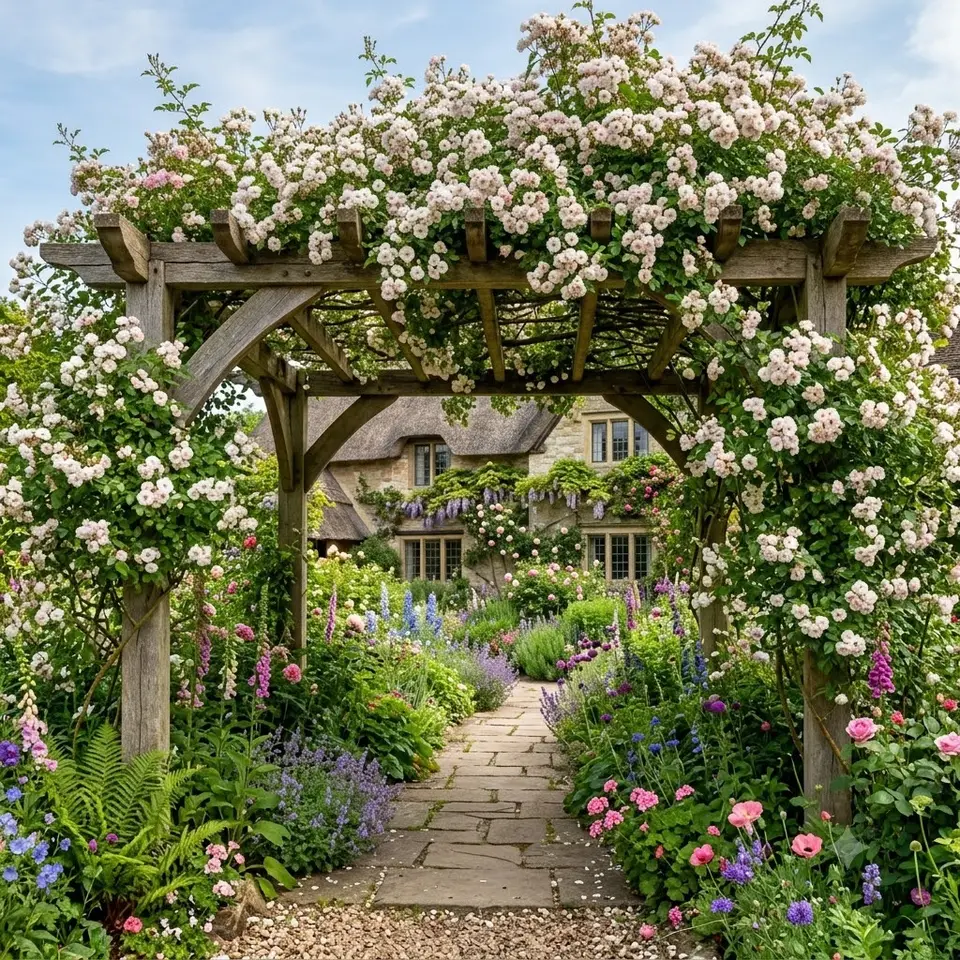
Ramblers are vast flexible-caned roses that cover pergolas, trees and eyesores with thousands of small blooms in a single June flush.
Last reviewed: October 2026
 AI illustration
 Overview
Ramblers are vast flexible-caned roses that cover pergolas, trees and eyesores with thousands of small blooms in a single June flush. Where climbers repeat politely, ramblers do one unforgettable thing enormously. (Rosa: rambler class.)
Origin & Natural Habitat
Early-1900s crosses of Asian species (wichurana, multiflora) - 'Dorothy Perkins', 'American Pillar', 'Rambling Rector' built a garden era; modern repeat-blooming ramblers now blur the lines.
Appearance
Canes 4-10 m, flexible enough to weave; June-July sees sheets of small (2-4 cm) clustered blooms (white, pink, crimson) often followed by small hips.
Why People Grow It - Qualities & Benefits
- The biggest floral spectacle a rose can produce
- Swallows ugly structures, climbs living trees
- Flexible canes train onto anything
- Old-rose romance, tough constitutions
Care
Light: Full sun, 6+ hours a day.
Water: Established ramblers on real root-runs largely fend for themselves.
Soil & Feeding: As for every garden rose - the full routine is in the rose care guide.
Temperature & Hardiness: Zones 5-9 by variety; many are toughened old survivors.
Pruning & Maintenance: OPPOSITE of climbers: prune right AFTER the summer bloom (they flower on last year's wood) - remove a third of the oldest canes at the base, tie in the new. Spring pruning cancels the show.
Planting & Propagation
Famously easy from hardwood cuttings and layering - old ramblers travel between gardens as passed-along sticks.
Common Problems & Pests
- Mildew on some classics (Dorothy Perkins notoriously): airflow helps
- Sheer scale overwhelming small structures
- One-flush disappointment if you expected repeat (buy modern repeaters if so)
Toxicity & Safety
Roses are non-toxic to dogs and cats - the thorns are the only hazard.
Pros & Cons
Pros
- Unmatched June spectacle
- Covers big things fast
- Easy-going, easy to propagate
Cons
- Mostly one flush
- Serious space/support needs
- Post-bloom pruning gymnastics
Best Suited For
- Pergolas, arches, dead trees
- Screening sheds and fences
- Romantic/cottage schemes
- Wildlife gardens (hips + cover)
FAQ
Rambler or climber?
Climber: stiff canes, larger repeat blooms, prune in spring. Rambler: flexible canes, one massive small-flowered flush, prune after bloom. Check the label twice - the pruning calendars are opposites.
Can one really grow up a tree?
The classic use - plant a Rambling Rector at an old apple's base and in three years the tree flowers twice a year, once as itself.
Gear for growing rambler roses
Links go to Amazon or a partner store (such as Adagio Teas) and may earn us a commission at no extra cost to you. As an Amazon Associate we earn from qualifying purchases. We link gear types, not sponsors' picks: you choose the exact product.