'Queen Elizabeth' Rose
'Queen Elizabeth' is a tall clear-pink rose bred by the American breeder Walter Lammerts and introduced in 1954, the first member of the grandiflora class.
Last reviewed: October 2026
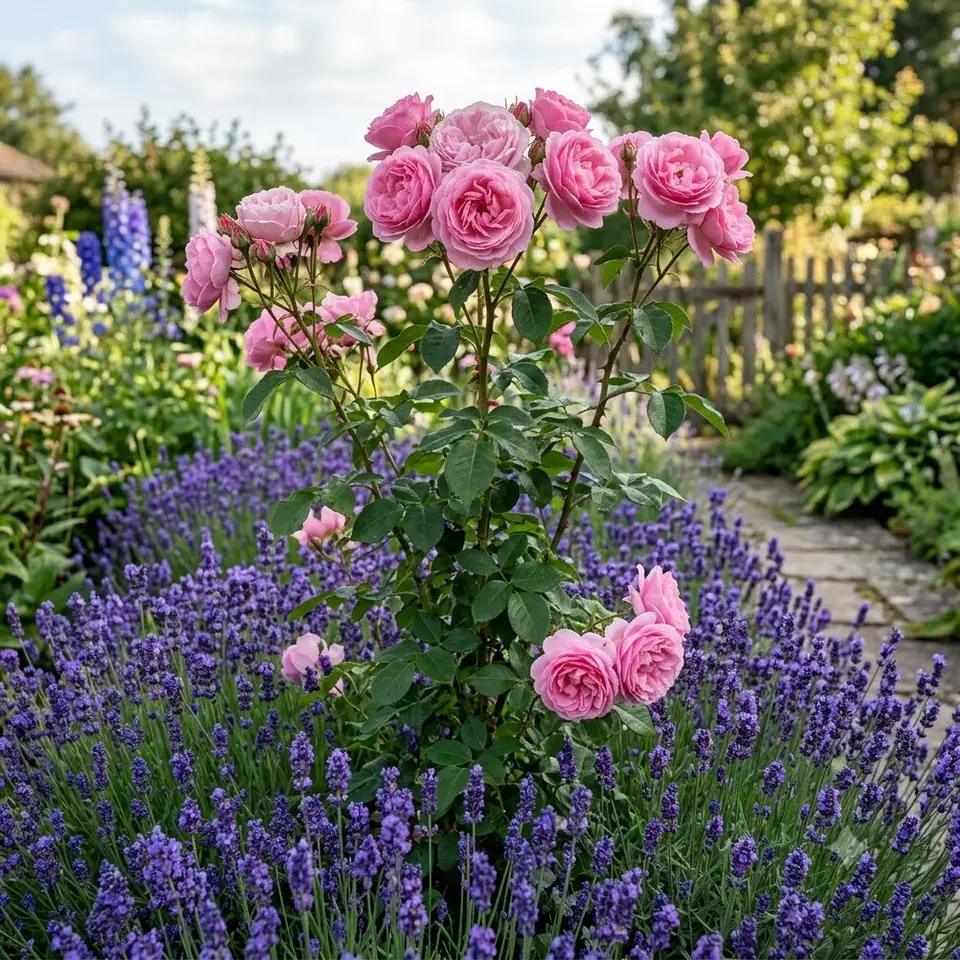 AI illustration
 Overview
'Queen Elizabeth' is a tall clear-pink rose bred by the American breeder Walter Lammerts and introduced in 1954, the first member of the grandiflora class. It was named in honor of Queen Elizabeth II, who came to the British throne in 1952, and in 1979 it entered the World Federation of Rose Societies' Rose Hall of Fame. (Rosa 'Queen Elizabeth', grandiflora.)
Origin & Natural Habitat
Its parents were 'Charlotte Armstrong', a hybrid tea, and 'Floradora', a floribunda, and the American Rose Society created the grandiflora class to accommodate the result. Weeks Roses dates its American introduction and its All-America Rose Selections award to 1955. Wikipedia lists a Portland Gold Medal (1954), the American Rose Society Gold Medal (1957), the Golden Rose of the Hague (1968) and an Award of Excellence for Best Established Rose (2015). It has been used to breed 30 new cultivars and has produced a climbing sport, 'Climbing Queen Elizabeth' (1957), and color sports such as 'Yellow Queen Elizabeth' (1964) and 'White Queen Elizabeth' (1965).
Appearance
Weeks Roses lists clear pink, medium-large blooms of about 35 petals on an upright plant of 5-10 feet. Wikipedia describes a tall, narrow shrub with pale pink flowers that are darker on the petal backs, high-centered to cupped, in large open clusters of 3-15, over large, leathery, dark green leaves; the stems are thick and carry large prickles. In British gardens the RHS describes a very tall, robust plant to 2.2 m with small clusters of large, rounded, fully double blooms on long stems.
Why People Grow It - Qualities & Benefits
- Height: the RHS suggests it for hedging and screens
- Sturdy, upright stems that Wikipedia says make it a popular cutting rose
- Tolerance of poor soil and some shade, according to the RHS
- Strong disease resistance; Wikipedia calls the plant very disease resistant
Care
Light: Full sun or partial shade; the RHS says it grows best in a sunny, open position and tolerates some shade. It takes exposed as well as sheltered sites facing south, west or east.
Water: Water deeply before the ground freezes if autumn rain has been short (Purdue Extension). Purdue notes that plants under the eaves of buildings may get little rainfall.
Soil & Feeding: Wikipedia says it grows well in poor soils, and the RHS lists chalk, clay and sand. The RHS mulches it in late winter and, to improve flowering, feeds with a balanced fertilizer in late winter or early spring and again in early summer. Feeding in more detail: rose care.
Temperature & Hardiness: Weeks Roses gives zones 5b-9b, the same range Wikipedia gives; in the RHS scale it is H6.
Pruning & Maintenance: In Britain the RHS prunes it with the floribundas, in its pruning group 16, leaving longer stems than on a hybrid tea; the work is done in late winter, when growth is just resuming.
Planting & Propagation
The RHS raises new plants from semi-ripe cuttings in late summer or hardwood cuttings in autumn, or by chip budding in summer. For walls and fences there is the climbing sport, which Wikipedia describes as a very popular, vigorous climbing rose.
Common Problems & Pests
- Large prickles on thick stems, noted by Wikipedia
- Rust, black spot and powdery mildew may affect it, the RHS warns
- Pests in its RHS profile include rose aphid, leaf-cutter bees and rose leafhopper
Toxicity & Safety
Roses are non-toxic to dogs and cats - the thorns are the only hazard.
Pros & Cons
Pros
- Height and vigor for screens
- Flower clusters on long stems
- Copes with poor soil
Cons
- Light to moderate scent: Weeks Roses calls it a light tea fragrance, Wikipedia a moderate, sweet one
- Large prickles
- At 5-10 feet, too tall for small beds
Best Suited For
- Hedges and screens
- Cutting gardens
- The back of a border
- Gardens with poorer soil
FAQ
Is it a grandiflora or a floribunda?
That depends on who is classifying it. American sources such as the American Rose Society and Weeks Roses call it a grandiflora, the class created for it. The RHS lists it as 'The Queen Elizabeth' (F), a floribunda, and the WFRS describes it as a large-flowered rose that was placed in the grandiflora class in the United States. Read more on the grandiflora roses page.
How tall does it grow?
Weeks Roses gives 5-10 feet, and Wikipedia gives 5 to 10 feet with a spread of 3 to 4 feet. The RHS, writing for British gardens, gives a maximum height of 1.5-2.5 metres and a spread of 1-1.5 metres.
Gear for growing 'queen elizabeth' rose
Links go to Amazon or a partner store (such as Adagio Teas) and may earn us a commission at no extra cost to you. As an Amazon Associate we earn from qualifying purchases. We link gear types, not sponsors' picks: you choose the exact product.